Dear Points,
We've been in school together for such a long time. Remember those book reports in elementary school where I just read enough to complete the book report so I got a good enough grade? or that time in high school where I colored a few extra maps and did some word searches in my geography class to earn points and raise my grade? or how about that senior English class in high school where I racked up massive extra credit points for turning assignments in early? or that one time at band camp? O wait, I wasn't in band. We had some good times, didn't we? Or so I thought.
When we went to college, we hung out way less and I wasn't ready for that. I missed you because my classes and instructors actually wanted me to demonstrate understanding of course content. They didn't really have a relationship with you. Now I know why. I had those math, science, and engineering courses that simply assessed my understanding through tests and labs. You abandoned me many times throughout college. After college, I fell into teaching and you showed your face again because I was confused and thought we could be friends again.
After teaching for 8 years now, our relationship has taken a toll on me. Last year, we definitely butted heads mid-year with a student and their parent who demanded I give them a point-based assignment to raise your grade from an F to a D-. What did they learn? Nothing. What did I learn? YOU SUCK! Our relationship while being a teacher has always been constrained. I'll admit, I was never 100% committed and vested in our relationship. Each year I was trying new ways to convince myself and my students that we needed you on campus or in my class by revising homework procedures, quizzes, tests, etc. I couldn't wait for last school year to end and be free from you during the summer. I ran into someone new over the summer: Standards Based Grading. He goes by SBG.
SBG introduced me to friends (teachers) who keep learning exciting and relavent for their students: Sam Shah, Shawn Cornally, Frank Noschese, Dan Meyer, etc. They have open relationships with SBG and share how their students are benefiting from it. In the short months of summer 2012, I've already learned more with SBG than my entire academic career with you. Points, you suck! Even better, I got to spend my summer getting well acquainted with SBG and discussing with Fawn Nguyen and Nathan Kraft about how flexible SBG is. All three of us had our reservations about committing to SBG, but we have now seen how SBG is the BFF to both students and teachers. SBG doesn't put any clamps on student learning nor hold a carrot in front of them. SBG has a circle of friends that welcomed me. They have unconditional love for my students and their learning. It feels naturally right. Recently, Chris Robinson even devoted an entire website to SBG.
This isn't the first goodbye letter you've received. I read the letter my pal Timon Piccini sent you and I was thoroughly excited to write you one as well. There's been others and I hope you receive more... maybe more letters than Santa receives at Christmas time. Be lucky it's just a letter and I'm not filing a restraining order. I wish I could. However, I know that we will have to coexist at my school. I'm not moving to another school, but if I ever do I know SBG will come with me and can only hope there are SBG friends there too. Since we have to coexist at the same school, I will respect those you hang out with, even if they're in my department. You still have their friendship based on fear of changing. Leaving you intimidates them. Points, you suck! My department wants to see how long and fruitful my relationship with SBG is this year. They're ready and willing to spend next summer getting better acquainted with SBG. I think your days are numbered. However, my greatest joy is that you will no longer bully my students this year. On the flip side, I hope you don't bully kids in other classes too much or let teachers abuse the joy of learning. I wouldn't want them to be the victims of your rebound.
I bid you farewell, points. Feel free to keep anything I've lent you. Keep my worksheets, handouts, CDs, that one t-shirt you borrowed, and even my book report from third grade. I need a fresh start and SBG has given me that. If we see each other on campus, in the hall, or in another teacher's classroom, I won't turn my nose up at you or talk down to you. We can still coexist at school, just know that you're not welcome in my classroom. If I see you bullying any of my students, expect me to stand up for them. SBG has my back, know that!
Sincerely,
Andrew Stadel
Showing posts with label Frank Noschese. Show all posts
Showing posts with label Frank Noschese. Show all posts
Elmo's Microwave Travel
Summer school has been a fantastic testing ground for 3 Act lessons with incoming 6th & 7th graders. I'm constantly reassessing my deployment of the lesson format. If you have any improvements to offer, go for it. Check out Dan's whole catalog. Here's a few I used this summer:
View and immediately get those Q's (questions) in the air.
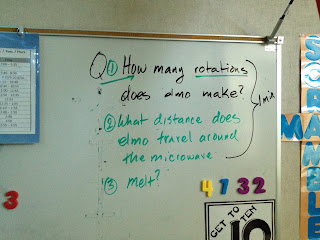
I don't perseverate anymore over having at least one student ask the intended Q. Let students ask what they wonder and state observations. If they hit your intended mark, don't jump for joy. Act as if it's just another Q in the mix. Summarize the questions and observations before revealing the Q. I usually say something like, "I'm right there with (insert name) on this and I also want to know (state question)." Luckily, there was at least one kid form each class who wanted to know how many rotations Elmo makes in the microwave. Get that Q on the board immediately along with any other questions that could be answered during the lesson. Have students write the Q's at the top of their paper, notebook, handout (whatever you use). Everyone needs an objective, something to work toward. Once it's scribbled down, encourage your students to make an estimate for each Q and pencil it in near the Q. We came up with:
Act 3 (theoretical v. practical):
On paper, many 6th graders miscalculated that Elmo travels 37.68 inches for one minute. Even after asking them if it made sense, they stuck with their answer (I let it go). There were a couple who got the correct answer! I didn't tell them; we watched Act 3. The students who had the correct answer and saw that 37.68 inches was quickly ruled out, watched intently as the time wound down. The anticipation on their face was priceless. The video ended and one girl was both happy and confused at the same time as she awkwardly asked, "Is it okay that my answer is one inch off?" Hello! Here's our opening for discussion. Theoretical v. Practical. I was so happy. First we discussed why 37.68 inches was incorrect. They didn't multiply their circumference by the number of rotations in a minute. Then we tackled the theoretical v. practical results. My microwave plate is kind of wiggly. It doesn't rotate at a constant speed the entire time: it slows down and speeds up. That one inch could be accounted for a few reasons. Their world was rocked, but Elmo's world made sense.
[Sequel to come] Dan contacted me for some video footage of Elmo traveling for 30 seconds in real time so he could use it at a workshop. He wanted his attendees to graph:
Traveler,
252
- Print Job: Talk about rate and breach theoretical v. practical discrepancies.
- Nana's Chocolate Milk: Ratios, Fractions, Proportions, Equivalencies, do it!
- Popcorn Picker: Do identical rectangular papers have the same volume?
- Super Bear: Unit rate, ratios. Discuss Percent Error (genius)!
Act 1 (go get that Q):
I don't perseverate anymore over having at least one student ask the intended Q. Let students ask what they wonder and state observations. If they hit your intended mark, don't jump for joy. Act as if it's just another Q in the mix. Summarize the questions and observations before revealing the Q. I usually say something like, "I'm right there with (insert name) on this and I also want to know (state question)." Luckily, there was at least one kid form each class who wanted to know how many rotations Elmo makes in the microwave. Get that Q on the board immediately along with any other questions that could be answered during the lesson. Have students write the Q's at the top of their paper, notebook, handout (whatever you use). Everyone needs an objective, something to work toward. Once it's scribbled down, encourage your students to make an estimate for each Q and pencil it in near the Q. We came up with:
- How many rotations does Elmo make? (They nailed this Q!)
- What distance does Elmo travel around the microwave? (Extension of the 1st Q)
- Will he melt? (Some students really worried about him melting. How considerate.)

* Using their wording for the Q's, I encouraged them to put it in relation to one minute.
Students do all the thinking, questioning, noticing, etc. but in the past I wasn't writing the Q on the board. Big mistake. Now it's monkey see, monkey do! Get the Q on the board. Go!
Act 2 (muy importante!):
Ask the students to discuss, "What do we already know?" Here are some responses from students:
Elmo travels for a minute. (Me: "How does that help?")
He's on a circular plate. (Me: "What do we know about circles or can do with that?")
Write the facts on the board. Now I ask, "What information would help you answer those Q's on the board?" or "What would you want to know in order to answer the Q's?"
Really make students think here. Don't make it easy. I have to keep working at this tactic. Allow students to struggle with the notion that they need to determine what's relevant before you divulge any new information. This allows students to be better critical thinkers. Here's what they thought:
Maybe we could see how far he goes in 10 seconds (Me: "Interesting.")
The plate is a circle. Can we know the circumference? (Me: "Is that easy to measure?")
Then can we have the radius? (Me: "I'll give you the diameter. How's that?")
Roll Act 2 Elmo. Students, get solving. Start discussing, debating, testing, calculating, etc. If you come up with something let the class know. If we agree on it, we'll write it on the board. If not, we'll erase it. Hey Frank Noschese, now I'm starting to see the importance of those student whiteboards. WWFSD? (What would Frank's students do?) Can we still jot down necessary info at the front while students collaborate? Of course.
Okay students, you got a solution? What does that number mean? Does it make sense? Did you check it for reasonableness? Did you give a unit of measurement? Did he travel in miles, feet, inches, millimeters? Does it make sense? I bombard them with questions. I'm almost getting to the point where I forget about Act 3. I want to see their work during Act 2. I want to hear their rationale. I want to learn from my students and their thought process. I enjoy that. Lately, the big driving force for me to actually leave Act 2 behind and attack Act 3 is the discussion that follows after viewing Act 3.
Act 2 (muy importante!):
Ask the students to discuss, "What do we already know?" Here are some responses from students:
Elmo travels for a minute. (Me: "How does that help?")
He's on a circular plate. (Me: "What do we know about circles or can do with that?")
Write the facts on the board. Now I ask, "What information would help you answer those Q's on the board?" or "What would you want to know in order to answer the Q's?"
Really make students think here. Don't make it easy. I have to keep working at this tactic. Allow students to struggle with the notion that they need to determine what's relevant before you divulge any new information. This allows students to be better critical thinkers. Here's what they thought:
Maybe we could see how far he goes in 10 seconds (Me: "Interesting.")
The plate is a circle. Can we know the circumference? (Me: "Is that easy to measure?")
Then can we have the radius? (Me: "I'll give you the diameter. How's that?")
Roll Act 2 Elmo. Students, get solving. Start discussing, debating, testing, calculating, etc. If you come up with something let the class know. If we agree on it, we'll write it on the board. If not, we'll erase it. Hey Frank Noschese, now I'm starting to see the importance of those student whiteboards. WWFSD? (What would Frank's students do?) Can we still jot down necessary info at the front while students collaborate? Of course.
 |
| This is all student derived. I was simply the scribe. |
Act 3 (theoretical v. practical):
On paper, many 6th graders miscalculated that Elmo travels 37.68 inches for one minute. Even after asking them if it made sense, they stuck with their answer (I let it go). There were a couple who got the correct answer! I didn't tell them; we watched Act 3. The students who had the correct answer and saw that 37.68 inches was quickly ruled out, watched intently as the time wound down. The anticipation on their face was priceless. The video ended and one girl was both happy and confused at the same time as she awkwardly asked, "Is it okay that my answer is one inch off?" Hello! Here's our opening for discussion. Theoretical v. Practical. I was so happy. First we discussed why 37.68 inches was incorrect. They didn't multiply their circumference by the number of rotations in a minute. Then we tackled the theoretical v. practical results. My microwave plate is kind of wiggly. It doesn't rotate at a constant speed the entire time: it slows down and speeds up. That one inch could be accounted for a few reasons. Their world was rocked, but Elmo's world made sense.
[Sequel to come] Dan contacted me for some video footage of Elmo traveling for 30 seconds in real time so he could use it at a workshop. He wanted his attendees to graph:
- Elmo's distance from the center of the plate over time [Update: Video]
- Elmo's distance from the glass door over time [Update: Video]
- Elmo's total distance traveled over time [Update: Video] *My recent addition
Traveler,
252
Subscribe to:
Posts (Atom)