Showing posts with label Estimation. Show all posts

#PuzzleMath ideas

Tonight, my son wanted me to work with him on his new puzzle.

I don't know your strategy for doing puzzles, but I find all the corners first and then start putting the border together before I start working on the inside. Look at that box again. Would you be able to determine the dimensions (in puzzle pieces) of this puzzle by knowing the total number of pieces?

That was my first question:
A) If you know the total number of puzzle pieces, could you think of the all the possible dimensions (in puzzle pieces) of the puzzle?

Answer:
This puzzle will either be a 1x35 or 5x7.

Then came the next question:
B) Estimate the actual dimensions (in puzzle pieces) given the picture on the box?

Answer:
I'm going to go with 5x7 because five and seven are the only factors of 35 that would reasonably make the rectangular picture on the front of the box. The puzzle should be 5 pieces high and 7 pieces across from left to right.

With a box of 35 pieces, these questions aren't too ridiculously challenging. However, I know there are crazier puzzles out there in the world; puzzle with 500, 750, 1000 pieces, etc. That's where I called on Twitter to help out. Like a champ, the #MTBoS came through and hopefully will continue to come through with #puzzlemath.

Below are some of the tweets I received followed by additional math questions I'm curious about.


Additional Questions:
C) If you think you know the dimensions, could you determine:
  • The number of corner pieces
  • The number of border (non-corner) pieces
  • The number of inside pieces
If so, could you write a rule for any of these?

D) Knowing these quantities, say you randomly choose a puzzle piece, what are the chances it's:
  • A corner piece
  • A border (non-corner piece)
  • An inside piece
  • The exact center (if possible) piece
Please add to the collection of puzzles and questions by tweeting with the hashtag #puzzlemath.

Puzzlemath,
1050

Pumpkin Seeds

For Halloween, we gutted the larger pumpkin from Day 197 for two reasons:
1) To carve it and
2) To roast the seeds
*Little did I know this pumpkin would produce many number sense opportunities beyond Day 197's weight estimate.

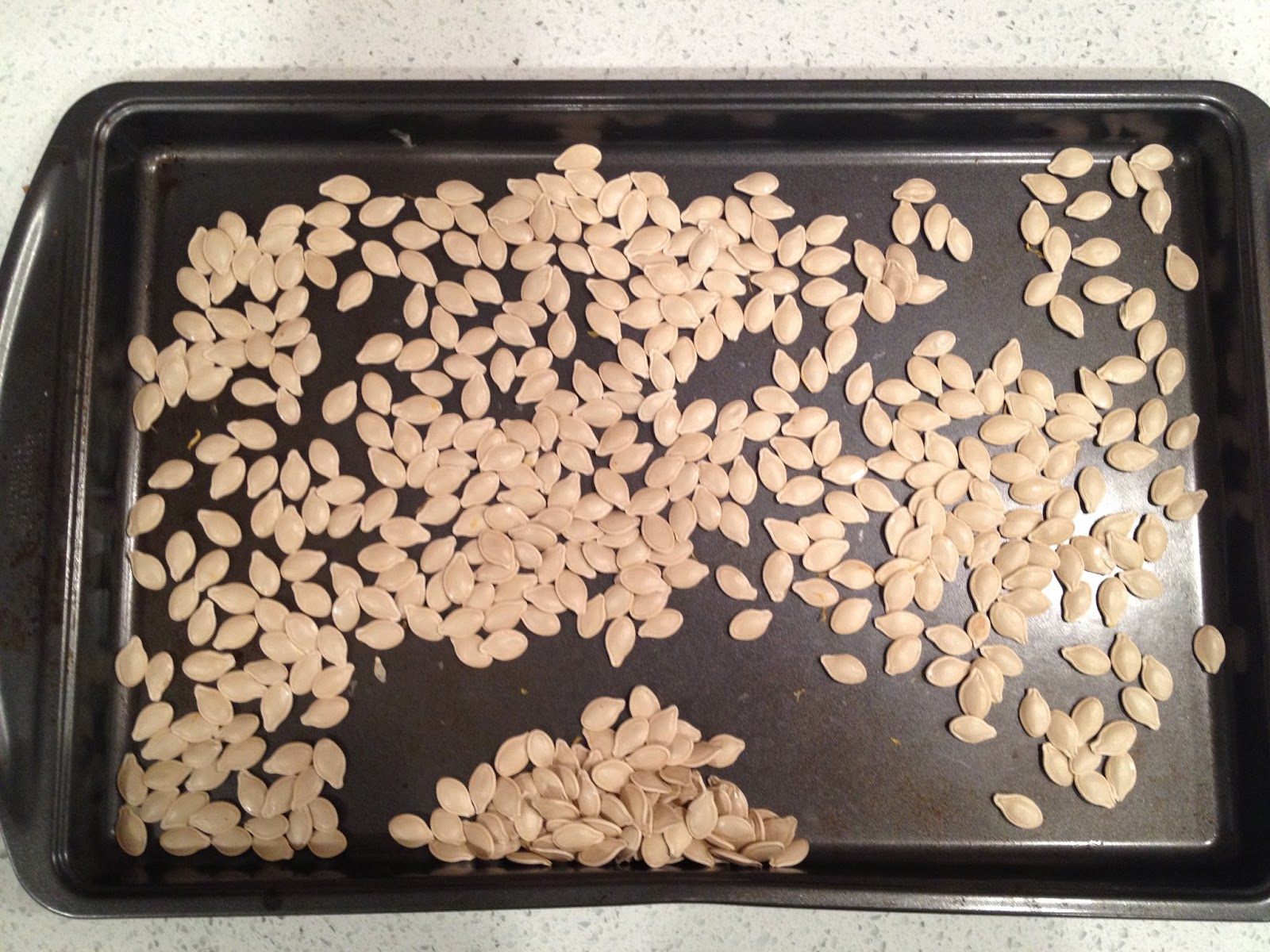
My 4.5 year-old son helped gut the pumpkin with me. We gathered as many seeds as possible and set them aside for the roasting process. The recipe I use can be found here. Before mixing the seeds in olive oil and seasonings, I lowered the pan down to my son and asked how many seeds he thought there were. [How many do you think there are?]
 
Me: How many seeds do you think there are?
Son: Well, ...[thinking for a few seconds]... there's definitely more than a hundred.
Me: How do you know it's more than a hundred?
Son: It just looks like more than a hundred.
Me: Make me a pile of seeds that would be about 100. 
He takes his hands and makes a pile toward the bottom of the pan. I can't contain my excitement to see what he has done.

His pile actually makes sense to me and definitely looks close to 100, give or take. Now that we've made a pile of his "one hundred" seeds. I ask:
Me: How many piles of 100 seeds do you think we can get?
I see he's a little confused by my question, so I ask it differently.
Me: How many piles do you think we could make where each pile has 100 seeds?
He starts to think, but by this time, my almost two year-old daughter sees the pan of seeds is now at her level, so she comes running over and wants in on the action of moving seeds. I thought our conversation was derailed as I brought the pan back up to counter height. But my son keeps it going. He didn't necessarily attempt to answer my question (which is fine by me). He took it in a different, pleasantly unexpected direction:
Son: What if we could get 10 piles?
Me: Do you mean ten piles of one hundred?
Son: Yes!
Me: Are you asking me how many seeds we would have if we had ten piles of 100?
Son: Yes.
This blew me away. Where'd this come from?
Me: Well, ten piles of one hundred seeds would mean we have a thousand seeds.
Son: A thousand??!!
Me: Yes.
Son: What if we had twenty?
Me: Twenty piles of 100 seeds?
Son: Yes.
Me: Well, what two numbers make twenty? Ten and...
Son: Ten!
Me: Right. So if ten piles make a thousand and another ten piles make a thousand, we would now have two th...
Son: ...ousand! 
Me: Right.
Son: What's 100 piles? 
Me: You mean, what's one hundred piles of one hundred? 
Son: Yea.
Me: That would be ten thousand.
My wife chimes in.
Wife: No. 
Me: One hundred piles of one hundred? Ten thousand.
Wife: Wait. You're right.
And our kids are now off in the other room playing and getting ready for going outside and looking at Halloween decorations before trick or treating. So many cool things happened:
  1. I love how we pursued my son's questions and not mine. 
  2. I love that he was fascinated by the word "thousand" even if it didn't make sense.
    1. Because he thinks a "hundred" is big.
  3. I love how we started with actual seeds (concrete) and went way more abstract.
  4. I love how my wife had the best estimate in the house [375 seeds].
  5. I love how the "pumpkin seeds" estimation challenge is just large enough so you can't accurately eyeball the amount and it's just small enough where it wouldn't take me an absurd amount of time to accurately count.
My wife and son watched the video answer this morning. My wife's response:
This is perfect for my [1st grade] students!

We paused the video when we saw ten groups of ten and paused it again when I made a larger pile of one hundred seeds. He struggled with making sense of final amount. 
Me: How would you say that number?
Son: Forty-eight eight? 
Me: How many piles of one hundred are there? 
Son: Four.
Me: So we say "four hundred" and let's count the piles of ten together. Ten, twenty,..
Together: thirty, forty, fifty, sixty, seventy, eighty,  
Me: And. Wait. There are only eight in this last group. So we say eighty-eight. Four hundred eighty eight. Say that.
Son: Four hundred eighty eight.
Me: Great. Let's go make breakfast.
Here's the recipe again and some pictures of the process.
Seasonings!
Ready for the oven.
Roasted and ready to eat!
Seeds,
225

P.S. Thanks to Christopher Danielson and all he does at #tmwyk!

Estimation 180 Gear

They're here! Estimation 180 t-shirts and stickers! Yes, I'm excited.

Estimation 180 was born out of my love for number sense and visual mathematics. In addition, it was important I help my students develop better number sense and see the world of mathematics in a different way. Little did I know, the site would make its way into classrooms across the United States, Canada, and other parts of the world. Thank you all for tweeting or emailing your experiences as I find it so cool that students are exploring number sense in your classroom and having mathematical conversations, sometimes even constructive arguments.

It makes my math heart full of joy to see other teachers do amazing things with Estimation 180 and beyond. Please make some time to check out blogs like Joe Schwartz, Jonathan Claydon, Mary Bourassa, and Megan Schmidt who are just a FEW of the teachers taking the idea and running with it. Teachers like MichaelHedge, DanRobert, John, Matt, and others spread the Estimation 180 love when doing teacher trainings or presentations. I couldn't be more appreciative and grateful. Thank you! Chris Harris even shared some bacon estimations to a roomful of parents one weekend.  I love how the site has become an instrument to help teachers create a classroom of curiosity with students, building number sense along the way. In addition to daily estimation challenges, the site has many of the lessons I've developed over the past few years.

These shirts are just another extension of my passion for number sense. As I present at conferences and give teacher trainings, I'm excited to give away some t-shirts to attendees nailing estimation challenges built into my workshops. Likewise, stickers are available for you to stick some number sense in your favorite place. This is how I roll!

I'm not in this to make money. This is more of a hobby to go along with the site. I would be eternally grateful if you decide to buy shirts and stickers and spread the Estimation 180 love. Head over to the Estimation 180 store and check out the shirts, their sizes, and how easy it is to order.

Nuts and Bolts:
If you're interested, I think it'd be good to be transparent on the nuts and bolts behind the t-shirts and stickers. If you're not interested in the nuts and bolts behind the t-shirts, skip the rest of this post and check out the t-shirts and stickers.

No outside party is financially backing Estimation 180. AND I don't plan on charging for using the site, ever! Therefore, I have done everything I can think of to make these shirts as affordable as possible, because I'm not in this to make money. Any money made from shirts and stickers would go back toward web costs associated with Estimation 180 and the free t-shirts and stickers I would pass out at conferences. As you can imagine, it's been one huge math task keeping track of expenses in order to set reasonable price points for the t-shirts and stickers so that teachers can afford them.

$20 for a shirt gets you a lot! You get a high-quality shirt for one. This price also includes tax and shipping. It also looks like I can throw in a sticker with each t-shirt order. Sweet! This $20 also goes toward the cost of the blank shirt, printing, mailing envelopes, and labels (mailing and return).

$2.50 gets you a high-quality sticker. This covers the cost of getting the sticker made, the envelope, labels, and postage. Of course, if you order two or three stickers, it's a better deal.

*Important note: my buddy Johnny from Speysyde was in charge of printing the t-shirts and he did a fantastic job! Please cruise by his site. It's all about the sustainable lifestyle:
Our mission is simple. To spread awareness and advocate an eco & social sustainable lifestyle through the creative collaboration of culture, music, sport, art, adventure & travel.
I declined using some of the premium web store features my host offers, such as shipping calculators, tax calculators, and other premium web store features. This drastically keeps the cost of the shirts at $20. For each purchase and transaction, Stripe takes a small percentage from my side. There is no additional cost to you. Their service, similar to PayPal, makes each transaction secure, safe, and easy.

I think you'll truly enjoy your shirt. I am!

Gear,
1047

180 Ways to Use Estimation 180

New challenge: Find 180 ways to use Estimation 180. Wait a minute. That's seems a little extreme, yet I still love the idea. Here's one use I came up with this week: inequalities.  Click on any picture to enlarge.
Me: Hey guys, here's a piece of paper. Fold it into fourths for me like this.
Me: Great. Now, who remembers how tall I am?
I know, silly question, right? If these guys don't know my height by now, I'll send them back a few grades. Then I show them this picture and ask: What's the height of Mrs. Stadel compared to Mr. Stadel?
I take about 4-6 guesses and write them on the whiteboard. It’s been awhile since we’ve done this specific estimation challenge in class. Many have forgotten my wife’s height. Great! However, it’s quite obvious her height is less than mine.
Me: Let me step back. Let’s all look at these guesses. Is it safe to say that all of your guesses put her height less than mine?
Class: Yes.
Me: Okay, so before I reveal the answer let’s put this in our notes for today.
Me: Before I reveal the answer, who can remind me why we used an open circle?
Student: Because we know her height is not the same as yours.
Reveal Mrs. Stadel's height. Wait for it... Wait for it... Here it comes... Student responses: 
“Yes, I was right!” 
“Ohh, I was close.”
“Ohh, I was off by an inch.”

Next up, our beloved Mr. Meyer.

“Woah! He’s tall!”
“Someone is actually taller than you, Mr. Stadel?”

Again, toss 4-6 guesses up on the whiteboardStep back. What do we notice? Yes, all the guesses should be greater than my height.

Walk through the notes on this new section with more student confidence and participation.
Ask students:
  • What type of circle should we use this time?
  • If we’re talking about guesses that are greater than my height, how will that affect the inequality symbol?
  • What are ways to remember this inequality as greater than?
  • Which direction will we shade now?
  • Someone give me a variable we can use for Mr. Meyer's height.

Reveal answer. Same responses as my wife, but usually a different kid was right this time.

Okay, great. Now what? What about those other two inequalities, right?
Me: Before I show you this next picture, last year the 6th grade English teacher (@mrkubasek) at my old school read this novel with his students and came across these two books he found interesting. I found it interesting too and took a picture so we could talk about it in math.
Show picture.
Me: How many pages in the book on the LEFT?

No need to write anything down. Just get 6-8 guesses out loud. Don’t spend much time here. Reveal the answer. Give some math love [one clap on three: 1, 2, 3, CLAP!] to the closest student. Seriously, it’s pure gut instinct here people.  

NOW, show this picture and ask how many pages in the book on the RIGHT.

They don't know it yet, but you just broke their brains for a bit. Yup, you’ll get a lot of guesses below 307. But wait for it. I guarantee in a class of 35-40 students like mine, one student will say 307. If you do, treat it like every other guess you've gotten.
...and if no one guesses 307, step back after about 6-8 guesses and...
Me: You know all of your guesses make sense to me. I'm curious though guys. This is the same novel here, right? What if? I mean, WHAT IF? What if these books had the same amount of pages? Do you think that's possible? Do I have your permission to add it to your guesses?
Step back again. Look at all those beautiful guesses. 
Me: So if I'm looking at this right, you guys think the number of pages could be equal to 307, or could be less than 307? I wonder how we could represent this mathematically?
BAM! Focus here on the circle. Why are we shading it in this time? What's up with that line under the less than inequality?
Me: Okay, before I reveal the answer, someone remind me why we shaded in the circle. 
Reveal!
Brains broken! Now repair. 
Me: What's up with that? Anyone have any ideas/theories why they have the same amount of pages?
Alright. That fourth and final inequality. Here are the goods. Repeat all the other moves from above. 
Initial guess of one bar.
Take some guesses out loud. Reveal the answer.
Toss up new picture.

Write down some guesses on the board. Play up the "what if" again. Complete the notes. Ask a few questions before revealing the answer.
BAM!

That was fun. Boy, I wish it didn't have to end. But it did. Okay, let's find other ways to use Estimation 180 in the curriculum. The full lesson will soon be is available on the lessons page at Estimation 180.

180 ways,
957

Guest Blog Posts at Estimation 180

Today, at Estimation 180, I posted some guest blog posts I collected from the beginning part of this year. I'm grateful, honored, and inspired by the stories they (or their students) shared. I hope you have time to check them out and share your story too.

Read their stories here. 


Back to School Ignite Talk

Man, I love a good Ignite talk.
5 minutes.  15 seconds per slide.  20 slides.
Concise.  Succinct.  Compelling.

Why not do my own version of an Ignite talk at Back to School Night next year? I get 10 minutes with parents and would love to change it up a little this coming year. Trust me, after surviving last year, I think the parents deserve a better, improved, and more reassuring version of Mr. Stadel. I'll explain that last sentence in some upcoming blog posts that I'll use to debrief about the 2012-2013 school year. If you're not sure what an Ignite talk is, let me introduce you to my man, Steve Leinwand.


If you like that, check out more Ignite talks by Annie Fetter, Dan Meyer, Max Ray, and Phil Daro. These are my go-to talks when I need a math pick-me-up. Do the math, that will be a little over 20 minutes well spent, being inspired by some key people in our math community. Seriously, check out those four talks.

I'm brainstorming in this space, so feel free to share some input please. At Back to School Night, I'll start by giving a brief 30-60 second introduction of what an Ignite talk is and how they work. I'll give an Ignite talk for 5 minutes, covering any of the following things:
This leaves approximately 4 minutes for parents to ask questions or something else... Have any suggestions for those last 240 seconds?

Who's with me? Does anyone else want to do a Back to School Ignite talk? There's already been some interest generated on Twitter and I started a Back to School Ignite list. Shout at me if you're in. Or is this a really foolish idea? Seth Leavitt, my new online colleague and EnCoMPASS Fellow asked if I'll post it online. I don't see why not. Maybe we can create a space for Back to School Ignite talks.

*UPDATE: Each item listed above does not correspond to its own slide. I simply listed ideas that could possibly work their way into the presentation. Some support each other. For example, when talking about the importance of problem solving, I would mention resources such as 3 Act lessons and The Math Forum's PoWs. Feel free to add to or subtract from the list.

Ignite,
930

CCSS Workshop 2013

I did my first workshop this past week (5-30-2013), discussing the transition to Common Core State Standards, with a focus on the 8 Standards for Mathematical Practice. I'm working with K-5 elementary teachers, a couple of middle school math teachers, some support teachers, and a couple of administrators in the room. I'll admit, I'm not as eloquent a speaker as Steve Leinwand, but there might be a few times where I actually make sense. I'm throwing this video out there for some feedback. I don't expect you to watch the whole thing so I've provided some chapter markers you might be interested in. At the end of the notes for each chapter, I reflect by creating a wish-list of moves I would've done differently. They come across as rhetorical questions, but feel free to chime in. However, here are a few angles I'd appreciate you considering:
What did I forget to talk about?
Where could I have been more explicitly clear?
Where coud I have used a better strategy? ...and so on.


Opener: 0:00-10:10
I use an estimation task (Day 127) to kick things off, providing teachers with the handout Michael Fenton created for estimation180.com and my students. The handout has been through many revisions and I think we have a final version that's a winner.

I use the whiteboard to write the "Too Low", "Too High", and "My Estimate" of a few teachers, asking for reasoning along the way. We watch the answer and discuss.
8:15 is a precious moment where a teacher asks, "Wait a minute! What was it (the song length answer) really?" I love how a teacher is demanding more information. I wish I spent more time expressing the importance of her question. I feel rushed because of all the workshop content I have prepared. I wish I had allowed the other teachers to address her question more. I do with my students, why didn't I do this here?

Active Notebook Part 1: 10:15-12:55
Teachers glue their Estimation 180 handout to the inside cover of their workshop Blue Book and the Table of Contents to the first sheet while listening to Can't Buy Me Love.

Preview of Workshop: 12:55-20:50
I attempt at working on the following question throughout the workshop,
What's our role as we reshape the classroom with the Common Core State Standards?
I share with teachers what today will not be and what today will be. On a parallel universe I share with teachers what I perceive the CCSS to not be and what I perceive the CCSS to be. Then I share a few personal items from this past school year. Seeing that I'm doing a workshop with multiple grade level and content teachers, I'm expressing the focus of the day to be the 8 Mathematical Practices and what we do in the classroom. How do we help facilitate the learning?

Estimation Task #2: 20:50-26:45
We use Day 129 where teachers see that the song length is also the track length. Listen to their reasoning. I love this! Hearing this reasoning from teachers and students is one of the many joys I get from doing these daily estimation tasks. However, I wish I did a better job (23:50) of getting the teachers to justify their reasoning and "argue" a little more than I did. I wish I created a little more tension. Check out (25:00) the excitement of the teachers as they watch the answer.

I introduce the language of creating a task that has a low-entry point and could see that many teachers had no idea what I was referring to. Not their fault. However, I like their reaction when I translate "lower-entry point" to being easier. I wish I explained "low-entry point" better. I wish I had explained it as creating a task where most, if not all students have an equal opportunity to engage with the task, regardless of their mathematical proficiency. I wish I expressed the importance of providing students with a task where math vocabulary and thinking come as a natural result of solving the task.

Math Tools & Two Uses: 26:45-33:55
I ask teachers to glue a picture of a math tool to the front of their Blue Book and write down at least two uses for each tool. They have two minutes to complete this task. After We Will Rock You, I ask the teachers for their uses instead of telling them. This serves two purposes. Yes, I have a list of uses that I anticipate them to come up with, but I want to hear from them first, selfishly providing me with additional uses that I didn't anticipate. Secondly, I'm using this activity to illustrate how students need to provide the answers in the classroom. I wish I could have given this more time in the workshop where the teachers actually used the tools in the manners they suggested. I also should have had the teachers write down all the uses we came up with.

Introduction of 8 Mathematical Practices 33:55-1:04:00
Again, I'm feeling rushed for time! Yes, I said it, "Let me talk about these 8 Math Practices real quick." Real quick? How silly of me. These practices are not something to gloss over. Don't worry, we spend ample time doing a Jigsaw activity so teachers are out finding information about them. I provided the teachers with the handouts found at Jordan School District's site. The practices are presented in a manner representative of the grade level you might teach. Thanks Fawn for this link.  I could have explained and facilitated this a lot better, but the redeeming value is hearing teachers that were appreciative of this specific activity because they were "forced" to explore the practices instead of just receiving a handout with the information embedded. If I were you, I'd skip the section (39:30-52:00) unless you want to hear some of the teachers talking in their groups as they rotate around the room to their four different stations. I'm proud of the rotation table I provided and how teachers travel together according to their "math tool." DON'T miss the "perfect high-five" at 38:10. I love that a teacher commented that "perfect" is subjective. I say this all the time to my students.
At 52:30 I give teachers time to regroup and complete the practices by receiving information from the other teachers in their group. I recap (1:00:00) and then show teachers how to create a pocket (1:01:00) inside their Blue Book so they can store a Quick Reference "teacher" version (I referred to as "adult") of the 8 Mathematical Practices.
I wish I gave more time for reflection. I wish I reviewed each practice with the whole group by having them share out loud something they learned. During the Jigsaw activity, I was told that my time with the teachers was cut short by about ten minutes so I had to hurry things along. Arghh!

Find My Mistake: 1:04:20-1:13:00
I made an executive decision to skip the model lesson I had prepared for the worksop. I'm glad I didn't skip the Find My Mistake segment of the workshop. I'm very adamant about teachers finding the mistake quietly here. I encourage them to share with each other before we review with the whole group. I give props to Michael Pershan for mathmistakes.org. You can hear kids in the hallway, alerting me that our workshop is coming to an end very soon. We listen to each other make corrections or talk about the misconception and why us teachers are good at knowing the content we teach. We're constantly telling students what their mistakes are and telling them how to fix it. Let's switch that role. Make the students find, correct, and tell each other what the mistakes are, especially items that use algorithms. Remember, most of the teachers here are elementary teachers. I also point out that I haven't been jumping for joy every time a teacher gets an answer correct. Instead, I try my best to throw it back on the class for what they think, allowing them to critique the reasoning of others. I love how estimation and number sense is addressed with teachers on how to help encourage students to avoid these mistakes.
I hit a nerve (1:10:45) when I was asked, "What about simplifying?"
I could very well be wrong here, but my current understanding is we (as teachers) are to allow for multiple representations of the correct answer, unless explicitly instructed otherwise. In other words, ten-eighths is just as acceptable as five-fourths.
I wish I reviewed with the teachers the importance of doing an activity like this quietly and individually first, before group discussion. I wish I expressed how much I love group work and collaboration, but need to remember both teachers and students need that quiet time FIRST. The worst is being in a group where one person dominates the conversation and you don't have time to think or worse, problem-solve. I wish I had covered this with the teachers.

Summary: 1:14:15-1:19:00
I provide teachers with a fill-in-the-blank handout to glue to the inside of the back cover. Again, watch their reaction when we get to "low-entry" point. I hope I drive it home when referencing the "Cent-ed Whiffle Ball" task I recently did in Geometry. I remind myself and the teachers to listen to the students. I'm constantly working on allowing students to finish their thoughts. Don't cut students off or finish their sentences for them. I ask teachers to create a couple of goals. I provide the teachers with a list of resources found here. I like how they (at least some of them) want another in-service/workshop.
I wish I emphasized the importance of knowing the 8 Mathematical Practices better and to use the summer to better prepare for next year. I wish I had more time to pump up these points in the summary. I wish I had more time!

Unleash yourself in the comments if you will.

Thanks!
729

Couch Coins

Today, I had 25 minutes to get as far as possible with Couch Coins and a second grade class at my school. I'd like to debrief on a few things, but here's Act 1.


During the Summer 2012, I found a money/coins concept in a Second Grade Everyday Mathematics book similar to Couch Coins. I was inspired by PES' Coinstar commercial and ran with the concept. The intended question is: "What coins will my wife get?" On my way into work knowing that I would soon be surrounded by seven and eight year olds, I announced to Twitter that I'd be doing this 3 Act lesson with second graders today and wondered how it will go, asking for their thoughts. The response was great. Robert Kaplinsky, Christopher Danielson, and Sadie Estrella all chimed in offering that money can be challenging and to be careful of the "fewest coins" part of the task. In other words, finding the total value of the coins and half the total might just be challenging enough for second graders. Chris Lusto (in true Lusto fashion) provided some comedic relief:
Act One: Which one of these kids do you think has to pee? Act Two: Watch them squirm. Act Three: Reveal. (Act Four: Clean up.)
Why just 25 minutes? I had to bail after 25 minutes to go teach my own students (8th graders) or else I would have had about 50 minutes with these second grade kiddos. So what transpired in those precious 1500 seconds? I asked the students what they wondered and noticed about the Act 1 video. I had them write down at least one thing they wondered and one thing they noticed. I asked them to share, starting with "notice." Keep in mind my time was limited here so I only took a few...

-The coins were moving on the chair like magic.
-There were just coins.
-There were a lot of quarters.

Now, I asked what they wondered. I followed each student question with, "Who else would like to know the answer to that question?"

-Why are the coins moving out of the couch? 10
-How did the coins stack like they did? 7
-How much is half of the coins? 10
-How many coins were moving on the couch? 3

Not one student asked anything about the coins my wife should get. NO PROBLEM! You can see there was a tie between two questions and don't ask why the numbers are so low; the class had 26 kids. I told the students since most of the questions revolved around the animated coins, I would reveal the camera magic at the end while we focus on the other top (main) question: How much is half the coins?

Time for estimating the right answer and guessing a number that's too low and too high. The second graders really enjoyed this part. One student felt 10 cents was too low because they saw quarters. One student was very proud of his $99,999 being too high. Once we got our estimates, I asked the class to read and revisit the main question: "How much is half of the coins?" I typically ask my students to reengage with the task/question before moving to Act 2 so we are reminded of our task.

Here comes Act 2: I asked the students what information would help them answer the main question. Many raised their hands. One student said, "We need to know how many of each coin." This was immediately followed by agreements voiced as "yea" or "that's what I was going to say." I displayed this information and we had less than 10 minutes to work. The second grade teacher broke the kids into groups.

Students were chatting, drawing pictures, using tally marks, adding by grouping, and using other strategies. One student asked, "Can we get out our money bags?" My response, "Shyea!" (translated yes). It was fascinating to see them operate for that short amount of time. I wish I had taken pictures. Sorry everyone! I had to leave.

This morning before the lesson, the teacher and I talked about the expectation of her students and the original task. She knew her kids were capable of finding the total and half. However, she also thought that finding the fewest coins might prove to be a challenge. The second grade teacher and my pals on Twitter were right. I think Act 1 deserves an edit saying, "My wife wants half of the money." This allows the sequel to be, "What coins would my wife get if she also wants the fewest coins?" and this can be used for the early finishers.

This experience reminds me that I need to record one of these 3 Act lessons so you guys can help me get better at doing them. There's still a ways to go, but I'm loving the opportunity to work with other teachers and grade level students. I've learned so much from these other teachers. I have a great respect for elementary teachers. I also love seeing how elementary students remind me that learning can be a blast. They're not going through puberty. They're energetic. They're so much fun! Not fun enough for me to pursue a multiple subject credential and teach primary though. I love my middle schoolers. I received an email from the teacher this afternoon saying:
It was hard, awesome, fun and different, cool, fantastic, interesting, the best, made us smarter, fabulous, I liked it, and magical!  Those were a few of the comments from my class about the math lesson this morning:)  Thanks for spending some time with us this morning!  It was fun for me, too!!
Soon, I will also be posting about my recent experiences in a 4th grade (Back Box2) and 5th grade (iPad percentages) classroom. Thanks for reading!

Cha-ching,
1119

Estimation180 site

Its official: I've launched estimation180.com

The Google doc was a temporary holding place for my daily estimation challenges. I'm proud to announce that I will be updating my daily estimation challenges through this site. The site is way more interactive than a Google doc spreadsheet... and quite possibly, more fun too. You can make estimates, share your reasoning, see how others estimate, and more.

The goals of the site:
  1. Document my daily estimation challenges.
  2. Create opportunities for teachers & students to build number sense together.
  3. Share!
What you can do:
  1. Click on a picture.
  2. Read the question.
  3. Look for context clues.
  4. Make an estimate.
  5. Tell us how confident you are.
  6. Share your reasoning (what context clues did you use?).
  7. See the answer.
  8. See the estimates of others.
The most important part is step #6. It's so valuable to a classroom when students share their logic or use of context clues when formulating an estimate. After you make an estimate, feel free to give us a brief description.

I've posted the first 15 days and will continue to update the site. Go do some estimating, build some number sense with your students and throw me some feedback if you find any glitches or ways to improve it. I want to sincerely thank Fawn Nguyen, Nathan Kraft, Chris Robinson, Michael Pershan, Dan Meyer, and Steve Leinwand for any help, inspiration, and/or feedback you've given me regarding estimation180.com You all are amazing!

Happy estimating!

Estimation vs. guessing Part 2

Yesterday I blogged (part 1) about visiting a fourth grade classroom and their lesson on estimation. After her lesson and her students left for lunch, the teacher and I debriefed. I really hope I complimented her enough. I was inspired. She asked me for some feedback. To remind you, she started the lesson by picking up a small cup, about half full of cubes, somewhat concealing it and asked students how many cubes were inside. She wanted to demonstrate that their initial answer would be a "guess" and not an "estimate". However, she had many observant students who already saw the size of the cup, the fact that it wasn't full of cubes, and even from my seat in the back I could tell that the cubes were small enough to fit inside the small cup. I told her I loved everything. The only additional thing I would have done was this:
Don't even show the kids anything. Don't go and pick up the cup. Simply say to the students:
Students, I will have a cup in my hands very soon. There will be cubes inside. How many cubes do you think will be in the cup?

Okay, look how simple this uninformative setup was. If I were a student, a bunch of questions would have just popped into my head: Hey teacher, what size is the cup? Is it a small paper cup? A medium coffe cup? or a large Big Gulp cup? What size are the cubes? As a fourth grader, I know what base ten cubes look like. Are they bigger like the size of snap cubes? Are they the size of ice cubes? and how about the amount of cubes in the cup, teacher? Are there just two at the bottom? Is the cup half full (or over half empty for you pessimists)? Is the cup full of cubes?

Any number the students produce would simply be a guess. It's a low-entry point, but doesn't hold much strength for long. How many cubes are in the cup? It could be two. It could be two hundred. Two thousand. You get the point. This strategy reminds me of a couple engineering classes I took in which we discussed a black box. In other words, there's something inside this black box that serves a purpose or function. However, you have no idea what's inside or the parts that make it function.
Students are guessing blindly at this stage. However, I wouldn't want them to just guess. I want them to beg for more information. Even better, I want them to think what information would help them solve this question. Let's move to the next stage.

Let's spiffy up our description, but still refrain from showing students the cup, cubes, or content level:
Students, I have a small drinking cup in my hand that's about 8 oz. Inside are cubes that are slightly smaller than six-sided dice. The cup is a little less than half full. How many cubes are inside?
By this time, I hope students would be falling out of their seats trying to sneak a peek at the cup. They're lusting after more information to make a more accurate assessment. You're simply adding some labels to the black box. Heck, put the cup inside a brown paper bag for this part.
What stage is this? I think this is the in-between stage. Shall we call it guesstimating? I used to really loathe this term as I want my students to use estimation. I thought it was a silly verb and should be eliminated from our vocabulary. I no longer think that. A guesstimate implies we could make a better attempt. We could use better clues. It's the bridge between guessing and using sufficient clues and observations to make a reasonable estimate. In other words, we must encourage our students to demand better information. Demand facts. Demand relevance. Don't SETTLE! Okay, so what takes us to that next stage, estimation?

Reveal the cup. Take it out of the black box and put it in the display case. That's right, put it in the display case. Don't let them touch it.
Demand they use their intuition, their available senses, and rely less on the sense of touch. Show a picture of the cup, a cube, and a birds eye view of the cup. Remember, it's in a display case. An even greater challenge to your display case would be to put the cup on the students's desks, but don't allow them to touch anything. Hold onto any last shred of information you could provide them with. Guard it. Be stingy. Let them use their sense of sight and intuition to build their number sense. Help students build up a thirst for relevant information. Build a problem solving plan or strategy. Don't be mean about it or covet the information for malicious reasons. Give students time to respond to the clues provided. The display case is a prime stage for estimation. Students have many context clues from either a picture or physical model. This should be enough for students to really build a strong theory and/or problem solving plan. As we saw in yesterday's post, students came up with a couple of theories on how to more accurately estimate the cubes in the cup by counting the top layer or cubes on the sides. The teacher didn't just hand her students the cup. She helped them climb the ladder of abstraction.  I think the key to this is encouraging students to demand more information. Don't inundate them with all of the context clues immediately. Make them demand the clues.

Hands-On is the last stage of estimation. Without counting, allow the students to pick up the cup. I'm not saying students will change their estimate. However, it will give them opportunities to consider another perspective of the task. They are including another component: weight, size, etc. There's only one place to go from the hands-on stage and that's revealing the answer: the payoff.

Recap:
1-Black box: Keep that description minimal. Avoid a visual.
2-Label the black box: gradually reveal some information
3-Display case: Look but don't touch
4-Hand-On: incorporate one last sense in order to bring one last perspective to the estimate.

By the way, did you know that Stevie Wonder played many of the instruments on his Innervisions album. I read somewhere that he virtually played all the instruments on about six of the nine songs. That's one of my favorite Stevie Wonder albums. If he can do that without the use of sight, imagine what we can do with all of our senses. 

Part 3: Why should we be the gatekeeper of information for our students? How can you help your students build their number sense and demand more information to make a reasonable estimation? How do I incorporate estimation in my classroom?

Part 2,
639

Estimation vs. guessing Part 1

Estimation vs. guessing and the space between, let's talk about it.

If you've been following my thoughts lately, via Twitter (#estimation180) or this blog, I've really been investigating the relevance of estimation for some time now. However, the past few days have really had a great impact on my approach with students, leaving me even more intrigued with the relevance and application of estimation with students. Over the next few days, I plan to share a few of the interactions: here's part 1.

Today, I visited a fourth grade classroom at my school. It's a personal goal of mine this year to visit as many classrooms as possible during my prep period and learn, learn, learn from other teachers, especially elementary teachers. I love observing elementary classrooms and seeing how so many children are still excited about learning. I'm constantly looking for strategies to bring back to my own classroom that will create a sense of excitement with my middle schoolers. The fourth grade teacher and I will be working on creating and implementing 3 Act lessons this year, so I was getting acquainted with the climate of her classroom. It was destiny: the class was discussing estimation and guessing.

First off, she's a fantastic teacher. Second, she did a wonderful job comparing and contrasting what the students thought estimation and guessing meant in their own words. She created a list for each on a huge giant sheet of paper, like a giant Post-It note. She does this often and sticks them around the class for students to refer to. The fourth graders decided that guessing could be something:
  1. you don't know
  2. you think could be the answer
  3. 50% sure
  4. or anything
As for estimation, the fourth graders decided it could be something:
  1. you round
  2. you think is close to the answer and reasonable
  3. you look at and use clues to carefully give an answer
This last definition was very insightful for a fourth grader.  The teacher proceeded to pick up a cup in front of the class and tell the class there were cubes inside. She asked them to make a guess and students were stretching their necks to gather any information about the cup in her hands. She did a great job concealing it, but many students had already mentally logged characteristics of the cup. She had a low-entry point for the students. They all wanted to know how many cubes were in the cup. They wrote down guesses in their journals and she took them to the next level. She showed the students how full the cup was with the cubes and asked them if this would be a good time to keep guessing or make an estimate. Students agreed, they had more information to make an estimate and they jotted this new number down in their journal. Lastly, she passed out cups, requesting students to not touch, but think of a strategy with their small group to get an even better estimate of the cubes in the cup. Students shared their theories:
  • I counted the cubes in the top layer and then counted the layers down and multiplied the two numbers.
  • I counted the number of cubes around the cup on each layer and made a reasonable guess for the hidden cubes inside.
The teacher asked the class who had similar theories and many of them chose the first. I really enjoyed how the teacher didn't once offer her theory on how to estimate. She let the students take ownership. As the lesson drew to a close, she requested the students work together to quickly count the cubes inside their cup and compare it to both their guess and estimate. The teacher had a low-entry point for all students, she let the students define their own vocabulary, she took them up the ladder of abstraction with gradually revealing information they needed/wanted and going from guessing to estimation. Lastly, the payoff was huge as she allowed students go hands-on with the cup and cubes to validate their learning for the day. I left her class inspired. But before I left, the teacher and I had a valuable brief discussion. A few things came out of that conversation I will touch base on in part 2.

Part 2 will connect estimation with guessing and the space between, sometimes referred to as a guess-timation. I want to create a low-entry point that's even more inviting for students. Lastly, I want to discuss how number sense can be strengthened as we transition from guessing to estimation before the payoff.

Part 1,
855

Estimation 180

Estimation initiative:
[*UPDATE: www.estimation180.com has gone live]

Last year I willingly started adding an estimation question to my daily warm-up, inspired by Steve Leinwand, Dan Meyer, and a monthly ASB gag we did a few school years back. Everyday, I greet my students at the door and hand them a 3x5 index card for their warm-up. They get the first 2-3 minutes of class to complete the warm-up exercise and estimation question. The first question reviews the previous day's skill. As for the estimation question, last year I was putting questions that were comparable to fun facts and students had no context clues for making logical estimates. It got silly. Here are some examples:
  • How many miles is the California coastline?
  • How long does an elephant stay pregnant?
  • How many In-n-Out Burger restaurants are there?
  • How many miles from the Earth to the Sun?
  • etc.
Stepping back over the summer and really fine-tuning the goal of estimation (improving number sense), I began using estimation questions that were more relative and provided better context clues. Every chance I get, I use a picture or something inside my classroom that will allow students to make logical estimates. Here's today's (Day 10):

I've had to cover up the bottom half of the screen now because students come in and immediately want to go for the estimation question. They want to come up to the screen and do weird measurements, or ask me factual questions, and they flat out forget about the first question. I don't blame them. It's fun. Once we go over the first question (favorite yes/no), I usually have students give me estimates that are too low or too high and then we "go right at it." "Who thinks they got this?"
Once I get about 8-10 estimates, I reveal the answer and it's so cool to see how the students react. "Ohhhh, I was sooo close." Or "I was way off!" Either way, I ask the student or students who were close to explain their logic. It's fascinating how kids think.
For today's, I snapped a picture of a measuring cup full of almonds (my new favorite snack). Tomorrow, they'll estimate how many are in the jar from CostCo. Estimation should build. The whole first week we talked about height, based off my height. 
Day 1: What is Mr. Stadel's height? They don't need a picture for that.
Day 2: What is Mrs. Stadel's height? They needed a picture for that. 
Day 3: What is my son's height? Another picture.
Day 4: What's the height of a lamppost Mr. Stadel is standing near? etc.
The first four days used my height as a frame of reference. Check out Estimation 180 (Google doc will be replaced with estimation180.com )and you'll see what I mean. My estimation initiative is to begin documenting my 180 days of estimation, simply titled Estimation 180. Seriously, do I need one more thing on my plate right now? No. However, I do this every day and would love to share this stuff and receive feedback. Estimation is important to me. I've already seen student improvement with number sense in just 10 days of school.  
I'm starting small here, but would love to expand this idea: stay tuned. In the meantime, check out the spreadsheet catalog (tab at the top).
[UPDATE: estimation180.com is live. Forget the spreadsheet!]

Number sense,
1056

Elmo's Microwave Travel

Summer school has been a fantastic testing ground for 3 Act lessons with incoming 6th & 7th graders. I'm constantly reassessing my deployment of the lesson format. If you have any improvements to offer, go for it. Check out Dan's whole catalog. Here's a few I used this summer:
  • Print Job: Talk about rate and breach theoretical v. practical discrepancies.
  • Nana's Chocolate Milk: Ratios, Fractions, Proportions, Equivalencies, do it!
  • Popcorn Picker: Do identical rectangular papers have the same volume?
  • Super Bear: Unit rate, ratios. Discuss Percent Error (genius)!
Dan's lessons are wrapped up in a neat little package, following his own framework for digital media. It's up to us to deliver. Today, I used my Elmo's Microwave Travel lesson. Keep in mind this was with incoming 6th graders. I'm more generous with them than my 8th graders. I continue to learn about the 3 Act lesson format (here's Act 1):


Act 1 (go get that Q):
View and immediately get those Q's (questions) in the air.
I don't perseverate anymore over having at least one student ask the intended Q. Let students ask what they wonder and state observations. If they hit your intended mark, don't jump for joy. Act as if it's just another Q in the mix. Summarize the questions and observations before revealing the Q. I usually say something like, "I'm right there with (insert name) on this and I also want to know (state question)." Luckily, there was at least one kid form each class who wanted to know how many rotations Elmo makes in the microwave. Get that Q on the board immediately along with any other questions that could be answered during the lesson. Have students write the Q's at the top of their paper, notebook, handout (whatever you use). Everyone needs an objective, something to work toward. Once it's scribbled down, encourage your students to make an estimate for each Q and pencil it in near the Q. We came up with:
  1. How many rotations does Elmo make? (They nailed this Q!)
  2. What distance does Elmo travel around the microwave? (Extension of the 1st Q)
  3. Will he melt? (Some students really worried about him melting. How considerate.)
* Using their wording for the Q's, I encouraged them to put it in relation to one minute.
Students do all the thinking, questioning, noticing, etc. but in the past I wasn't writing the Q on the board. Big mistake. Now it's monkey see, monkey do! Get the Q on the board. Go!

Act 2 (muy importante!):
Ask the students to discuss, "What do we already know?" Here are some responses from students:
Elmo travels for a minute. (Me: "How does that help?")
He's on a circular plate. (Me: "What do we know about circles or can do with that?")

Write the facts on the board. Now I ask, "What information would help you answer those Q's on the board?" or "What would you want to know in order to answer the Q's?"
Really make students think here. Don't make it easy. I have to keep working at this tactic. Allow students to struggle with the notion that they need to determine what's relevant before you divulge any new information. This allows students to be better critical thinkers. Here's what they thought:
Maybe we could see how far he goes in 10 seconds (Me: "Interesting.")
The plate is a circle. Can we know the circumference? (Me: "Is that easy to measure?")
Then can we have the radius? (Me: "I'll give you the diameter. How's that?")

Roll Act 2 Elmo. Students, get solving. Start discussing, debating, testing, calculating, etc. If you come up with something let the class know. If we agree on it, we'll write it on the board. If not, we'll erase it. Hey Frank Noschese, now I'm starting to see the importance of those student whiteboards. WWFSD? (What would Frank's students do?) Can we still jot down necessary info at the front while students collaborate? Of course.
This is all student derived. I was simply the scribe.
Okay students, you got a solution? What does that number mean? Does it make sense? Did you check it for reasonableness? Did you give a unit of measurement? Did he travel in miles, feet, inches, millimeters? Does it make sense? I bombard them with questions. I'm almost getting to the point where I forget about Act 3. I want to see their work during Act 2. I want to hear their rationale. I want to learn from my students and their thought process. I enjoy that. Lately, the big driving force for me to actually leave Act 2 behind and attack Act 3 is the discussion that follows after viewing Act 3

Act 3 (theoretical v. practical):
On paper, many 6th graders miscalculated that Elmo travels 37.68 inches for one minute. Even after asking them if it made sense, they stuck with their answer (I let it go). There were a couple who got the correct answer! I didn't tell them; we watched Act 3. The students who had the correct answer and saw that 37.68 inches was quickly ruled out, watched intently as the time wound down. The anticipation on their face was priceless. The video ended and one girl was both happy and confused at the same time as she awkwardly asked, "Is it okay that my answer is one inch off?" Hello! Here's our opening for discussion. Theoretical v. Practical. I was so happy. First we discussed why 37.68 inches was incorrect. They didn't multiply their circumference by the number of rotations in a minute. Then we tackled the theoretical v. practical results. My microwave plate is kind of wiggly. It doesn't rotate at a constant speed the entire time: it slows down and speeds up. That one inch could be accounted for a few reasons. Their world was rocked, but Elmo's world made sense.

[Sequel to come] Dan contacted me for some video footage of Elmo traveling for 30 seconds in real time so he could use it at a workshop. He wanted his attendees to graph:
  1. Elmo's distance from the center of the plate over time [Update: Video]
  2. Elmo's distance from the glass door over time [Update: Video]
  3. Elmo's total distance traveled over time [Update: Video] *My recent addition
I plan on doing the video sequel and will experiment with it in Motion this week. My kids enjoyed the sequel discussion, but missed a video to back it up. Great sequel idea Dan, thanks.

Traveler,
252

Why? How? and What?

Inspired by Simon Sinek's TED talk (at least the first 6 minutes of it), The Teaching Gap (Stigler & Heibert), and you... I'm reevaluating some teaching ideas & restructuring some classroom details in preparation for next year. What are your thoughts, using
One sentence for Why?
One sentence for How?
One sentence for What? about:
  • Learning
  • Teaching
  • Estimating
  • Exploring
  • Discussing
  • Assessing
  • Improving
*PLEASE send me a CONFIRMATION TWEET when you take the poll, verifying your twitter handle.


Survey

Results here.

Thanks in advance!
1110

*Gold star for @fawnpnguyen for first post!