Showing posts with label Digital Framework. Show all posts

CueThink

CueThink is an application (iPad) I would love to see get some serious math love in schools and the online math community. I had the good fortune of being introduced to CueThink by the wonderful people at The Math Forum (thank you Suzanne). I simply want to give you a glimpse in hopes you'll take a tour of the app and teacher dashboard.

*Look over CueThink and keep potential in the back of your mind. The app already has fantastic features, but think how it could potentially support students in being better problem solvers.

Download the app. Take the tour:

What do you Notice? What do you Wonder?
  • Highlight text and see where it goes.
  • Make an ESTIMATE (so cool).
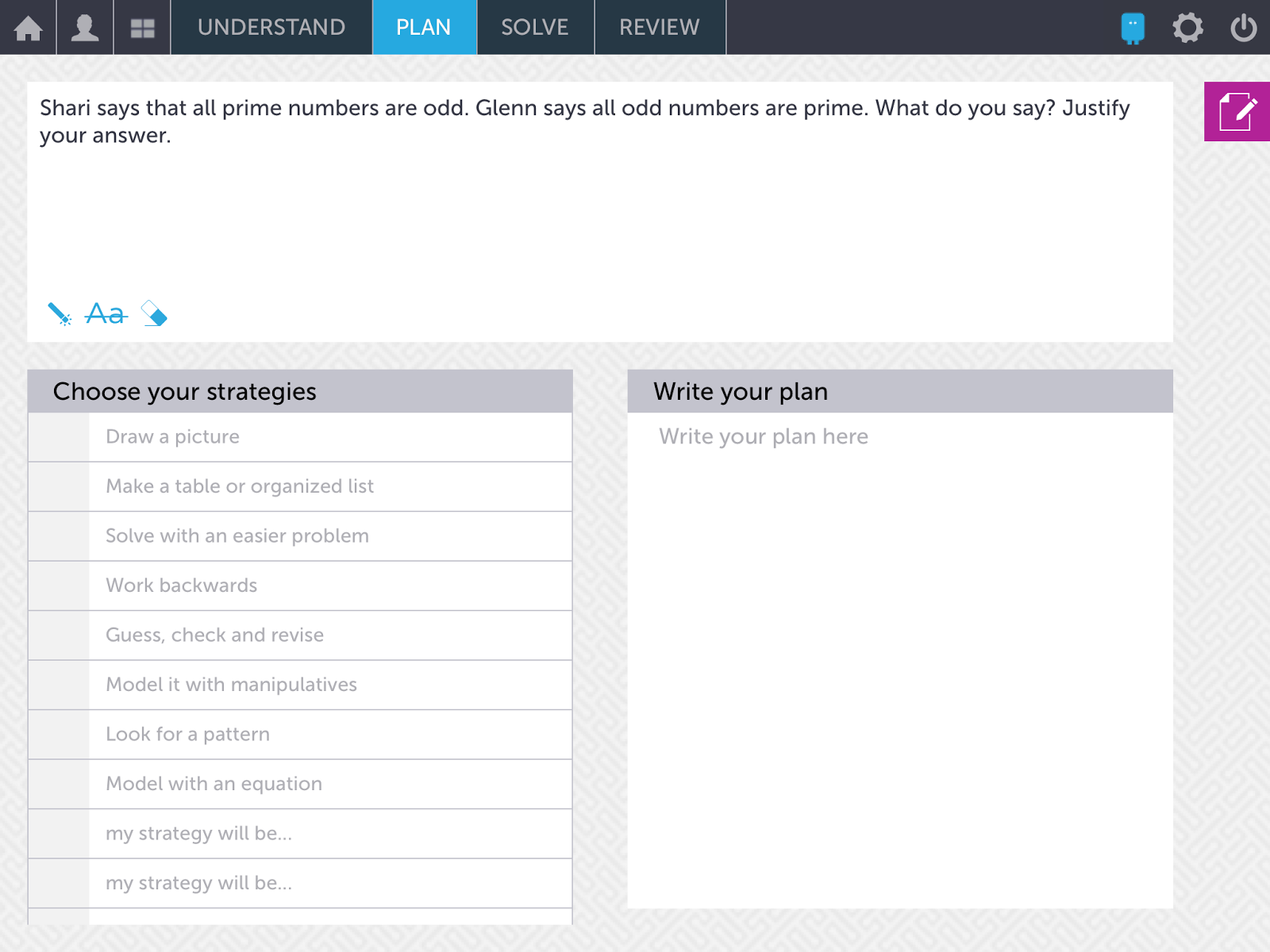
Choose your strategies:

Show and record your solution:
  • Cool tools on the right
  • Record the audio explanation of your solution
Review everything before you submit:

I was giddy exploring this app for the first time; seeing how well it could support students through the problem-solving process, seeing the functionality for feedback, and having a teacher dashboard. I know there's more to come to make this app even better, but think of the potential.

Teacher side: give students feedback at specific points of their recorded solution:

Hungry for more? Check out the CueThink teacher dashboard!

CueThink,
843

Your Eyes Are Amazing

This Centrum television commercial caught my ear for a few reasons. I tracked it down on the Internet tonight and edited it for Act 1. You can find the entire lesson here at 101qs.com. It's a quick little lesson for Math 6 (6.RP.3d).

Act 1:

Question: How many football fields is 10 miles?

Act 2:
I'm not giving much information for Act 2 as I'm leaving this part of the mathematical modeling process up to the teachers and the students (mainly students). I think there's an essential part to the classroom discussion and I hint at it with the following questions (if necessary) left in the teacher notes:

  • Ask students, "What information would be helpful here?"
  • Ask students, "How are football fields measured and with what unit of measurement?"
  • Allow your students to decide the length of a football field.

I'd like you to do the math right now. Go ahead. I'll wait. It won't take you long.

10 miles. How many football fields is that?

Act 3:

Wait!
Timeout!
Is this commercial's math wrong???

Should it be 176 football fields or 146 football fields?

What did you use as your football field length? Did you use 100 yards? Did you account for the end-zones being 10 yards each, making the total length of the football field 120 yards?

On a related note, I'm a little surprised the Centrum didn't use 100 yards so they could claim 176 football fields for a more dramatical pitch in their commercial. I also think it's fun to talk about what it would take for human eyes to actually see that candle 10 miles away. Darkety-dark-dark probably. No light pollution. No obstructions. Maybe a desert? No bright moon (which the commercial includes for some weird reason).

I'll be using this with my sixth graders this year when we get to conversions. It's a fun little task. Let me know if you have anything to add.

Candle Eyes,
1059

NEW JOB!!! and some fraction ideas

I recently accepted a new teaching position with a middle school where I'll be teaching 6th and 7th grade math. I was fortunate to be at my last school for about 10 years exploring 7th and 8th grade math: Pre-Algebra, Algebra 1, Algebra 1A, Algebra Honors, and Geometry. I'm extremely grateful for the opportunities, experiences, friendships, and professional growth opportunities the school afforded me. As I advance in my teaching career, I'm very excited about my new position, new school, new students, and new everything. There are many differences between my previous school and my future school... and I welcome them wholeheartedly.

As my future school transitions to Common Core, I'm giddy at the thought of exploring so many wonderful concepts in 6th and 7th grade math. However, I will be working with students that have typically struggled when it comes to understanding math. Therefore, I had a few ideas about fractions I thought I'd like to explore with you.

I'll include all the visuals here, but feel free to go to my "fractions test page" at Estimation 180 to get the full experience. Please offer me some feedback. I'd like to pursue these "fraction" ideas with other items; some easier, some more difficult. Is this something you could use? Is this something worth pursuing?

Question: Where would the cylinder be one-third full?
(Image 1)

We're estimating here. I did not provide any choices because I want students to formulate ideas on their own. Look at their screen and move their finger up and down the screen to find one-third. Come up to the board at the front of the classroom and put a post-it note on the board.

Offer some choices: When ready, click on the image for choices.

Notice I said, "when ready"? Did you have students discuss? point with their fingers? place a few sticky notes on the screen at the front of the room? or something else to get students invested? Because of the restrictions at Estimation 180, this image will currently serve as the next viable step. Now students have a choice. I'm not the biggest fan of this, but it's something. Were there students who were way off because their sticky or initial guess didn't even fall within the given range?

Make a choice and demand reasoning: Why did a student choose "C" instead of "D"? Have students try and convince each other. Argue! Egg them on a little bit. Have students choose a line in which they think the cylinder will reach one-third its capacity.

Do some math? I provide you with the capacity of the glass: 1,170 milliliters. Find one-third of that. Encourage different strategies in your class. Doing the math won't tell students if the answer is choice A, B, C, D, or E, but it might help with later parts of this activity.

Reveal the answer: a really short video.

I have additional video for two-thirds, fourths, and a full cylinder (when using thirds or fourths). I haven't inserted the choices, added a counter, or other after effects. Would this be something you'd be interested in? Please let me know.

Two things:

  1. I also set this up as Red Dot (Active Prompt) activity and it'd be fun to see how students would approach this activity without multiple choice. Then, show the class their results before watching the answer (video).
  2. I'd love to see Dave Major make a slider so students could slide a bar up and down the cylinder. Using a computer or tablet, students could place the bar where they want and without a given range of choices. Then we could see who was actually correct.

What feedback do you have for me? Again, is this something you could use? Should I prepare more at Estimation 180? Would you like to see the remaining fractions and other ideas?

NEW,
723


[Makeover] Low Arching Bridge: The Makeover

Once again, the task:
What I like:
I like the placement of the x-axis along the ground to represent zero height.
I like how this task reminded me of the low arching bridges along George Washington Memorial Parkway in Alexandria, Virginia.

What I dislike:
I dislike that the x-axis and the y-axis were already placed for us. The students have no say in this.
I dislike how the arch is already "modeled" by the given function. There isn't any chance for students to explore this on their own, especially if they had no say in the placement of the y-axis.
I dislike the answer to this question. It's hilarious. Get this:
The truck has to be dead center so that it will allow 0.23 feet of clearance on each side of the truck. Regarding number sense, what is twenty-three hundredths of a foot? No one talks like that, do they? After converting this answer, I could see myself telling the driver, “You have less than 3 inches to spare on each side. And that’s ONLY if you center the truck with the middle of the bridge." Let's look for an alternate route or someone might have to get out of the truck [not it] to guide the driver.

Things I'm intrigued by:
What was the reasoning behind the placement of the y-axis? Why isn't it dead center or along the right wall?
Why isn't there any sign on this bridge that says the maximum height and/or width of trucks allowed?
Is this a "one way" road?

Here's what I did:
*Disclaimer: I'm not pretending to nail this Makeover: I think it can be better. That's your job: so let's get it on and help me in the comments. I'll admit, the Makeover was more work than I anticipated and I'm tapped, but I'm happy to do it now during the summer. Thanks Dan for the Makeover challenge!

I found an accident report for a coach bus that crashed into this exact bridge (below) in 2004. There are many of these low arched bridges located along George Washington Memorial Parkway in Alexandria, Virginia. I've seen a few of them when we've taken our 8th graders to visit Mt. Vernon. I remember our bus driver telling us about this specific collision.

1) Show your students this picture, but don't tell them about the collision:
Allow students to make observations and ask questions (maybe Notice and Wonder). Tell them where this bridge is located if they ask. Don't tell them what the signs say. Have a discussion.

2) Now show your students this picture and ask:
Which of these (six) vehicles would safely pass under the arched bridge?

3) Have students make guesses and write it down. You're taking a chance, but at least one student should notice that some vehicles might pass safely using the left lane, but not when the same vehicle is traveling in the right lane.

4) Ask your students what information or tools they might need to help determine which vehicles can safely pass through this arched bridge.
  • Bridge height(s)
  • Vehicle height(s)
  • Width of road
  • Width of lanes
5) Find the vehicle heights we'll be working with. Depending on the time you have, students can use the internet for finding the average height of each vehicle. I did the grunt work for you with this slide:

6) Show students three heights of the bridge and street dimensions. They probably want to know what those yellow signs on the bridge say. Too bad! The picture is low quality and very pixelated. I'll admit, this might feel like we're now stringing the kids along, but let's offer them measurable dimensions, not some arbitrary equation that "models" the arch. Share the following:
Height of the bridge on the left side
Height of the bridge in the center
Height of the bridge on the right side

Width of the entire road (including space for lane lines and shoulder) and width of two lanes.

7) Offer your students Desmos or Geogebra. Plot the three heights. Use sliders to find an equation that models this low arching bridge. Here are three four scenarios I came up with in Desmos. I'm still not sure which I like best. You decide. I've linked the Desmos files for you to mess around with.
Where do you fancy the y-axis?


Okay, I like both the center and the justified right. Placing the y-axis in the center of the bridge made it a lot easier to find an equation that modeled the bridge. Placing the y-axis on the right side of the bridge might produce negative x-values, but since distance is never negative, the absolute value of the domain will tell me how many feet away from the right side of the road the vehicle must be.

8) Give students time to explore the functions, quadratics, sliders, domain, range, and so on. There's more. This task requires students to apply the heights of the vehicles in a specific manner. Sure, students can click and drag on the graphs in Desmos to find the heights of vehicles and determine if it safely passes, but what part of the car "safely passes"? The top left? Top center? Top right? Therefore, students have to now take into account the width of the vehicle. Let's go back to the original question:
Which of these (six) vehicles would safely pass under the arched bridge? And in what lane?
  • Which vehicle(s) will pass safely in both lanes? 
  • Which vehicle(s) will only pass safely in the left lane?
  • Which vehicles(s) would have to go into the oncoming traffic lanes?
  • Which vehicle(s) need to stop and turn around?
  • Ask how far the vehicles will be from the right side curb when "passing safely"?
9) Tell students to look for a little more clearance than 0.23 feet (2.76 inches). You can read the accident report for all the details about the street and bridge. You'll find the clearance heights posted on the bridge and about 1,500 feet before the bridge.


Unfortunately, the accident report will also show the bus that collided with the bridge while the driver was talking on his cell phone. The bus ran into the bridge without even applying the brakes.

What you did or suggested:
Amy Zimmer emailed:
"Is it the new Daniel Craig James Bond that has the train scene where he has to duck just before he is about to run into the bridge when the good guy and the bad guy are fighting on a speeding train?" followed by "I would give lots of trucks and see which ones fit."

Everyone else's input can be found here:


If you've made it this far. I appreciate your determination and perseverance. Thanks for tuning in. I know this task can be better, so let's get it on in the comments.

Up next, Global Math Department presentation on August 13, 2013: Back to School Night: Ignite. Join the fun.

Under the bridge,
1230

[Makeover] Low Arching Bridge

We encounter many low bridges on our drive to Mt. Vernon each year when we take our 8th graders. Our bus driver must pay extremely close attention. This textbook problem reminded me of our experience. I'm playing along with Dan Meyer's Makeover Monday. Here's the task:
From McDougall Littell's Algebra 2 textbook (2007)
I'm curious how you would make this over. Next Monday, I'll post what you do and what I do to this task.

Find me on Twitter.
Email me your makeover.

Makeover,
1017

*[UPDATE]: Here's the Makeover task.

More Tangrams Please!

This week in Geometry, we did the 3 Act lesson Hedge Trimmer. I'll debrief about that another time. Students needed to find the area of some isosceles trapezoids along the way and I didn't give them access to the area formula for trapezoids. Instead they needed to be resourceful and figure it out on their own. Well, that didn't go too well at first [cue the whining]. Many students had trouble breaking the trapezoid into 3 polygons: a rectangle and two triangles. Their warm-up the next day was to play around with tangrams for the first 5-10 minutes of class.
Me: Use all seven pieces to make any one of the following polygons. Do your best!
I drew a square, rectangle, trapezoid, parallelogram, triangle, and circle. I'm just kidding about the circle. However, I should have drawn one. That's funny. My 8th grade students were terrible at this. I use "terrible" with all the love in the world, knowing this is a learning experience for them.
Me: Have you guys ever messed around with tangrams?
Class: No!
Me: WHAT!!!! Are you guys serious? No one has ever let you mess around with tangrams before? Well, I'm glad we're doing it now. You guys need this. Seriously? You guys have never messed around with tangrams.
Class: Nope.
Me: Okay, well keep trying. [as I began scraping my jaw off the floor]
My request to you all: MORE TANGRAMS PLEASE!

Especially elementary teachers, more tangrams please. Have your students mess around with them. Sure you can download some app onto your tablet or find a web-based site to simulate tangrams, but please do your best to get actual tangrams into the hands of your students. Math formulas come and go for math students. However, if they can visually break apart polygons into more recognizable polygons such as rectangles and triangles, I believe their mathematical proficiency greatly increases. My goal is to get these 8th graders to play around with Tangrams once a week for the rest of the year. At least one of my students was eventually able to put together a trapezoid (top left), which quickly turned into a parallelogram, which quickly turned into a rectangle.
Me: How'd those other shapes come so quickly?
Sean: I just moved this one larger triangle to different spots.
I took a picture of his first configuration so I could share it with the class. I figured I'd give the class a chance to redeem themselves and copy his rectangle configuration.
More tangrams please! 
Repeat after me:


Thanks for listening.

Tangrams,
1104


BTW: Cheat sheet for displaying student work immediately:

  1. Sign up for Dropbox.
  2. Have the Dropbox app on your phone.
  3. Take picture(s) of student work.
  4. Allow the app to upload your camera photos.
  5. Sync your computer with Dropbox.
  6. The pictures arrive on your computer in seconds.

Wablammo!

Capturing Time (musically)

Recently, I had the idea to do a theme of "song lengths" over at Estimation 180. Inspired by a recent comment from Fawn, I chose Santana's Oye Como Va. At first, I opened up iTunes and took a screen shot of the music player.  I threw in an album cover and edited it to look like this, asking "How long is Santana's Oye Como Va?":


I can get away with directly asking the question at Estimation 180. How would you make your estimate? I'd make my estimate based on the time played so far (1:26) and the location of the playhead in the timeline. I absolutely love that students have to use time here, specifically 60 seconds in a minute. Furthermore, I'm hoping students use some type of spatial reasoning with the timeline, either as a fraction, percentage, proportion, or something else. But that's it. Can we go anywhere else with this? This task feels constrained. This doesn't capture the medium of music correctly. There's got to be more, right?

The more I thought about it, I was curious of better ways (or the best way) to capture time and music. Let me rephrase that. If I were going for a more perplexing approach and wanted to create a 3 Act task to share at 101qs.com, how would I go about doing that? I remembered that I own the djay app and experimented with a really lengthy Jethro Tull song titled, Thick As A Brick. This is where I need your help. I'd appreciate you checking out Act 1 and letting me know the first question that comes to mind. Or watch it here and leave a comment/question in the comments.


Based on some initial questions, I'm thinking of revising Act 1 where the virtual record player looks more like this. (notice the record?)


The virtual record player opens up many possibilities with this task. There's a white tape marker on the record for precise tracking when playing the track. I feel there's a lot more math opportunities here, but at the same time it feels a little contrived?
Am I over-thinking this?
What do you see here?
What are your thoughts?
I need some help. Thanks in advance.

Spin it,
339

Couch Coins

Today, I had 25 minutes to get as far as possible with Couch Coins and a second grade class at my school. I'd like to debrief on a few things, but here's Act 1.


During the Summer 2012, I found a money/coins concept in a Second Grade Everyday Mathematics book similar to Couch Coins. I was inspired by PES' Coinstar commercial and ran with the concept. The intended question is: "What coins will my wife get?" On my way into work knowing that I would soon be surrounded by seven and eight year olds, I announced to Twitter that I'd be doing this 3 Act lesson with second graders today and wondered how it will go, asking for their thoughts. The response was great. Robert Kaplinsky, Christopher Danielson, and Sadie Estrella all chimed in offering that money can be challenging and to be careful of the "fewest coins" part of the task. In other words, finding the total value of the coins and half the total might just be challenging enough for second graders. Chris Lusto (in true Lusto fashion) provided some comedic relief:
Act One: Which one of these kids do you think has to pee? Act Two: Watch them squirm. Act Three: Reveal. (Act Four: Clean up.)
Why just 25 minutes? I had to bail after 25 minutes to go teach my own students (8th graders) or else I would have had about 50 minutes with these second grade kiddos. So what transpired in those precious 1500 seconds? I asked the students what they wondered and noticed about the Act 1 video. I had them write down at least one thing they wondered and one thing they noticed. I asked them to share, starting with "notice." Keep in mind my time was limited here so I only took a few...

-The coins were moving on the chair like magic.
-There were just coins.
-There were a lot of quarters.

Now, I asked what they wondered. I followed each student question with, "Who else would like to know the answer to that question?"

-Why are the coins moving out of the couch? 10
-How did the coins stack like they did? 7
-How much is half of the coins? 10
-How many coins were moving on the couch? 3

Not one student asked anything about the coins my wife should get. NO PROBLEM! You can see there was a tie between two questions and don't ask why the numbers are so low; the class had 26 kids. I told the students since most of the questions revolved around the animated coins, I would reveal the camera magic at the end while we focus on the other top (main) question: How much is half the coins?

Time for estimating the right answer and guessing a number that's too low and too high. The second graders really enjoyed this part. One student felt 10 cents was too low because they saw quarters. One student was very proud of his $99,999 being too high. Once we got our estimates, I asked the class to read and revisit the main question: "How much is half of the coins?" I typically ask my students to reengage with the task/question before moving to Act 2 so we are reminded of our task.

Here comes Act 2: I asked the students what information would help them answer the main question. Many raised their hands. One student said, "We need to know how many of each coin." This was immediately followed by agreements voiced as "yea" or "that's what I was going to say." I displayed this information and we had less than 10 minutes to work. The second grade teacher broke the kids into groups.

Students were chatting, drawing pictures, using tally marks, adding by grouping, and using other strategies. One student asked, "Can we get out our money bags?" My response, "Shyea!" (translated yes). It was fascinating to see them operate for that short amount of time. I wish I had taken pictures. Sorry everyone! I had to leave.

This morning before the lesson, the teacher and I talked about the expectation of her students and the original task. She knew her kids were capable of finding the total and half. However, she also thought that finding the fewest coins might prove to be a challenge. The second grade teacher and my pals on Twitter were right. I think Act 1 deserves an edit saying, "My wife wants half of the money." This allows the sequel to be, "What coins would my wife get if she also wants the fewest coins?" and this can be used for the early finishers.

This experience reminds me that I need to record one of these 3 Act lessons so you guys can help me get better at doing them. There's still a ways to go, but I'm loving the opportunity to work with other teachers and grade level students. I've learned so much from these other teachers. I have a great respect for elementary teachers. I also love seeing how elementary students remind me that learning can be a blast. They're not going through puberty. They're energetic. They're so much fun! Not fun enough for me to pursue a multiple subject credential and teach primary though. I love my middle schoolers. I received an email from the teacher this afternoon saying:
It was hard, awesome, fun and different, cool, fantastic, interesting, the best, made us smarter, fabulous, I liked it, and magical!  Those were a few of the comments from my class about the math lesson this morning:)  Thanks for spending some time with us this morning!  It was fun for me, too!!
Soon, I will also be posting about my recent experiences in a 4th grade (Back Box2) and 5th grade (iPad percentages) classroom. Thanks for reading!

Cha-ching,
1119

Styrofoam Cups

Tuesday, I was on my way to BTSA and my subconscious screamed something at me. Find Dan Meyer's Stacking Cup lesson. Seriously, go read his post right now. I hadn't read this post for over a year now and I had to get my lessons ready for the next couple of days as my Algebra classes finished up Pixel Pattern. I was on the road dreading the idea of sitting through a couple hours of BTSA, so I asked Dan if he had the link to his lesson since it wasn't in my bookmarks (that was silly of me) and he came through like a champ! Seriously, check out his post. I'm promoting his blog post more than anything further I have to say here.

First, by all means, spend about $10 and do the lesson with your kiddos. This is one of those 3 Act lessons that just screams "hands-on" activity with your kids. It's tough to capture the overall excitement and energy with a video. If you can't do the "hands on" with your kids or you want to be environmentally friendly, here's my version of the Styrofoam Cup 3 Act lesson: a cheap backup.


It felt most natural to stage this so the cups stacked to the top of the door frame. Even then, I'm not convinced my Act 1 screams the question I'm looking for, "How many cups will stack to the top of the door frame?"

Enough about me and the video, to my classroom with the students. Dan's got a great script for you to follow, so do it! One of my classes was actually able to finish writing their rules before the bell on Friday so we had time to actually stack cups. Check out their rules and predictions for stacking cups to my height.

We started stacking with the lowest number and went from there. The kids went bonkers. Each group thought they were the best, but knew that they all couldn't be correct. When we revisit the lesson this next week, we'll be discussing where groups went wrong in order to learn from those mistakes. Watch Styrofoam Cups - Act 3 Stadel to find out who won. But I recommend you watch the door task also.


Styrofoamed out,
813


Best Halves [Square]

A few months ago Dan Meyer reached out to Timon Piccini, Chris Robinson, Nathan Kraft and me to participate in what would eventually become his Best Midpoint, Best Square, Best Triangle, and Best Circle series of 3 Act lessons. I was honored to be part of a stellar group and great lesson. I love the potential of these lessons and can't wait to use them with my geometry kiddos later this year. Currently Dan and Dave Major have kicked it up a notch with some great interactive play/learning for better best squares, also providing us with an interactive teacher's guide. Check it out: I nearly cried tears of joy upon reading their two posts: Dan and Dave.

Recently, I've had conversations with Fawn Nguyen about fractions and although fractions aren't the spotlight of my Algebra and Geometry curriculum, I'm still fascinated by them and in turn want to help students build their number sense or spatial reasoning. I had an idea to extend Dan's Best series into the realm of fractions and emailed him for his blessing, hoping I'd do it justice. Here's what I came up with so far:


You might notice
it closely resembles Dan's format with very few stylistic differences. "If it ain't broke, don't fix it." That's my motto here. I called on Dan and a few other comrades to make an appearance and compete in this first installment of Best Fractions. This first installment: "Who drew the best half?"

Thanks to Dan, Fawn, Sadie Estrella, and Shauna Hedgepeth for taking the time to contribute. They were great sports! I still don't know who drew the best half yet.

I see a lot of geometry potential here: area, perimeter, midpoints, distance, coordinates, polygons, etc. I'd love to target primary grades with this activity as well (not just secondary), finding an entry level that elementary kids are capable of exploring. I'm not too sure calculating the area of trapezoids would be appropriate for a 4th and 5th grade classroom, but I might be wrong.

I'm not pretending to nail this 3 Act lesson and I'd love some feedback on how you would apply this in your class or make it better. I'm still working on the Act 2 information and will gradually chip away at it over time.  I gathered enough information from the contestants to keep me busy for the next year. I plan to release other installments of Best Fractions, specifically the best half, third, fourth, and fifth of both a square and circle. Just imagine the fun with circles: area, sector area, arc length, degrees, percentages, and more. Stay tuned!

Test it out on your students in the meantime and give me some feedback. Click here for directions and handouts to use with your students.

Best,
420

Bouncy Balls

Today was a good day. Yesterday wasn't and I'll leave it at that (strictly speaking of school). One of those days where I couldn't find a wall fast enough in order to bang my head against it not once, but multiple times. It's a great thing that I get to end my days with my wife and son. My students are having a blast finding Felipe, our classroom Elf on the Shelf, each day. With a waterfall schedule, my last class of the day gets to hide him for the next day. It's a fun little activity for the kids to burn some energy off until the holidays. We did our seasonal estimate today and I started my Algebra classes with this video:

Yes, this video is cruel. Not necessarily perplexing, but enough to hopefully generate some curiosity? So, which ball will bounce higher? Give me a thumbs up if you think the 2012 Super Ball will bounce higher. Give me a thumbs down if you think the 1976 Super Ball will bounce higher. Give me a thumbs middle if you think they will bounce the same. In all three classes, there wasn't a strong majority, but if I had to estimate I think most students voted that 2012 will bounce higher. And... I don't tell them, show them, or even hint to them. I know, cruel. Enter this picture:

This lesson snuck up on me as I was collecting balls. I forgot to get the following balls: ping pong ball, racquetball, tennis ball, and one of those pink spongy balls. Okay, let's get this out of our system; middle schoolers and the word, "balls." So here we go, "balls, balls, balls, balls, balls, balls, balls, balls."

"Now, look at the balls and quietly, to yourself, make a guess. Guess which ball will be the best. In other words, which will bounce the highest? Now, guess which will be the worst? Don't say anything. Write that in the top corner of the handout you are about to receive. Don't share it with anyone." Students were looking at the screen, scoping out the different sizes, shapes, and textures of each ball. I saw some students writing the golf ball as the worst and the lacrosse ball as the best. Some were putting the Super Balls as the best. "Now, share your guesses with your group. Does anyone want more information about these balls besides just a picture." Trust me, it was very difficult not to work "balls" into the conversation as much as possible. Seriously, it can be fun to see them squirm, grin or laugh at times like these. I refrained from making comments like, "Don't worry guys, you'll get your hands on these balls soon enough." or "We're not playing with the balls people. Simply dropping them and seeing how high they bounce." C'mon people, "Make sure you handle the balls with care." You get the point.

I'm a slow learner. You've probably heard me say this before. This might be one of the best parts of my day. When introducing projects this year, I've made the mistake of displaying the handout on the screen first, having students read parts out loud, and throw in some pointers before they get their supplies. You can predict what happens next. Students get their supplies and start exploring the project in the wrong way or ask me questions to parts I already reviewed. What's the typical response? "Read the handout again." or "I already went over that. Ask a classmate." And you know with each student that you see not following directions or that comes up to you and asks what to do next simply gets more irritating with every time. For example, when we stole from Fawn Nguyen's Barbie Bungee, I'd see students simply letting Barbie hang freely from the top of their meter stick and measure that distance with every rubber band they added. They weren't dropping Barbie and measuring the lowest point she extended to. So it dawned on me, once again because I'm slow. "Everybody, you are to read the entire handout with your group first. When you've done that, come up to me and explain what you are doing. If you accurately tell me in your own words the objective and directions of the project, you may grab a ball and start collecting data. If you can't, I send you back to read it again." Money! It worked like a charm. Students knew what they were doing. They knew the correct steps. They knew what increments and how many drops per ball. It was great. I still have to do the Barbie Bungee project with my Algebra Honors class and will see how well they do with reading the directions.

Here's what students did today. Students were to use one ball at a time to drop the ball from 10 cm to 1 meter using 10 cm increments and at least three drops from each increment. Once they completed that, they were to exchange their ball for another ball and do this for a total of three balls. Hint: no one was allowed to use the 1976 Super Ball until they collected data for two balls first. Plus, I don't let the 1976 Super Ball out of my site. I've had that since I was a kid and do you know what those guys go for on eBay? They kept track of the rebound heights and were to make observations. Were there any constant changes? If not, was there a close average change? Our goal is to predict the rebound height of a drop from 3 meters and from our balcony of 5.7 meters.

At least I didn't play this video to intro the lesson.

Balls,
1026

Instructional tool: student cell phones

Tomorrow, I'll embark on the crusade of letting my students use their cell phones in class as an instructional tool. I will both email and send home the following letter/policy with students for parent approval. Understandably, my school has many hoops regarding things of the sort. Currently, cell phones are not allowed to be used during school hours anywhere on campus. Students may only use their phones before and after school. This is a K-8 school. I teach 8th grade. Over 95% of my students own phones and it kills me to see them carry around these expensive devices all day and not be allowed to use them as an instructional tool. You can see from the letter that the primary use of the phone will be for capturing student work. Tomorrow, I'll be laying down the law.

In case you missed it, here's the letter/policy again. Hopefully, what I call Phase 1, will be one of many phases for cell phone use in my class. Phase 1 has two objectives.

Objective 1: Capture student whiteboard work
My students do a crazy amount of work each day on their giant whiteboards. How lame is it that we have to erase it and never see it again. Even a black hole will never have the opportunity to consume it. It's gone. I've learned not to waste time having students transfer their work to their notebooks. BIG waste of time. We could use that time for learning, discussions, group work, etc. That said, I need students to capture what they're doing, because some of it is absolutely amazing. Even mistakes can be useful. For example, check out the student work done on these 3 Act lessons:


and Dan Meyer's Taco cart.
Seriously, I was lucky enough to capture it. So there you have it, I intend to support my students in capturing their work while at the same time assist them in using their devices responsibly. It's definitely going to be a change of thought for students to think of their phone as an instructional tool. That's why I'm easing into it with this simple task. We frequently do "gallery walks" in my class where students circulate the room and check out other student work. This will present another opportunity for students to capture whiteboard work. I'm thinking of some class 'lingo' and/or routines that will set everyone up for success. Make your math look good, now say, "CHEESE!" If you have any routines or tips to share, please let me know. When I assess this after a week or two, I'll let you all know what has been working and what has failed.

Objective 2: Send students and parents notifications
There is a great FREE service that my good buddy @mrkubasek sent me in this article. I will be using Remind101.com to send both students and parents notifications about class activities: Home Jams (my homework), quizzes, due dates, links, etc. I can send them notifications from a phone, computer, or tablet and they won't see my phone number. Likewise, I don't see their information. Furthermore, they can't send me anything back... mwoohahaha. I mean, how fantastic is that? They can email me if they have a question. I love the idea, because I won't be strapped to my phone answering questions related to the notification I just sent out. More importantly, my forgetful 8th graders will receive the ever-so-loving nudge or reminder about something vital to their success in math.

It doesn't stop here. Realistically, I can't pull off numerous uses for their cell phones a third of the way into the school year. Therefore, I will chip away at this. First and foremost, I plan to nurture responsible and mature digital citizens in my classroom. I hope that this works and I don't ruin it for other teachers at my school to test out. Speaking of which, I have to email them and keep them in the loop here. I hope I can work out any bugs and prevent any huge mishaps. I've seen and heard some of our student population abuse technology and that saddens me. Literally, less than a mile down the road are a couple of schools where students lack technology and/or personal devices. I'm fortunate to be in a place where this is possible and hope to learn with my students. Here are a few things to leave you with.

Bryan Meyer is on to something because I eventually want to have students create some type of digital folder, file, journal, blog, etc. I'd love for them to keep track of their work and either post it or submit it to me.

Dan Bowdin is doing some really amazing and inspring things in his class. Bounce around his website  for about ten minutes and you'll run into some fresh and inspiring ideas. I'd love to pursue the use of QR codes in class one day.

CHEESE,
942


Elmo's Microwave Travel

Summer school has been a fantastic testing ground for 3 Act lessons with incoming 6th & 7th graders. I'm constantly reassessing my deployment of the lesson format. If you have any improvements to offer, go for it. Check out Dan's whole catalog. Here's a few I used this summer:
  • Print Job: Talk about rate and breach theoretical v. practical discrepancies.
  • Nana's Chocolate Milk: Ratios, Fractions, Proportions, Equivalencies, do it!
  • Popcorn Picker: Do identical rectangular papers have the same volume?
  • Super Bear: Unit rate, ratios. Discuss Percent Error (genius)!
Dan's lessons are wrapped up in a neat little package, following his own framework for digital media. It's up to us to deliver. Today, I used my Elmo's Microwave Travel lesson. Keep in mind this was with incoming 6th graders. I'm more generous with them than my 8th graders. I continue to learn about the 3 Act lesson format (here's Act 1):


Act 1 (go get that Q):
View and immediately get those Q's (questions) in the air.
I don't perseverate anymore over having at least one student ask the intended Q. Let students ask what they wonder and state observations. If they hit your intended mark, don't jump for joy. Act as if it's just another Q in the mix. Summarize the questions and observations before revealing the Q. I usually say something like, "I'm right there with (insert name) on this and I also want to know (state question)." Luckily, there was at least one kid form each class who wanted to know how many rotations Elmo makes in the microwave. Get that Q on the board immediately along with any other questions that could be answered during the lesson. Have students write the Q's at the top of their paper, notebook, handout (whatever you use). Everyone needs an objective, something to work toward. Once it's scribbled down, encourage your students to make an estimate for each Q and pencil it in near the Q. We came up with:
  1. How many rotations does Elmo make? (They nailed this Q!)
  2. What distance does Elmo travel around the microwave? (Extension of the 1st Q)
  3. Will he melt? (Some students really worried about him melting. How considerate.)
* Using their wording for the Q's, I encouraged them to put it in relation to one minute.
Students do all the thinking, questioning, noticing, etc. but in the past I wasn't writing the Q on the board. Big mistake. Now it's monkey see, monkey do! Get the Q on the board. Go!

Act 2 (muy importante!):
Ask the students to discuss, "What do we already know?" Here are some responses from students:
Elmo travels for a minute. (Me: "How does that help?")
He's on a circular plate. (Me: "What do we know about circles or can do with that?")

Write the facts on the board. Now I ask, "What information would help you answer those Q's on the board?" or "What would you want to know in order to answer the Q's?"
Really make students think here. Don't make it easy. I have to keep working at this tactic. Allow students to struggle with the notion that they need to determine what's relevant before you divulge any new information. This allows students to be better critical thinkers. Here's what they thought:
Maybe we could see how far he goes in 10 seconds (Me: "Interesting.")
The plate is a circle. Can we know the circumference? (Me: "Is that easy to measure?")
Then can we have the radius? (Me: "I'll give you the diameter. How's that?")

Roll Act 2 Elmo. Students, get solving. Start discussing, debating, testing, calculating, etc. If you come up with something let the class know. If we agree on it, we'll write it on the board. If not, we'll erase it. Hey Frank Noschese, now I'm starting to see the importance of those student whiteboards. WWFSD? (What would Frank's students do?) Can we still jot down necessary info at the front while students collaborate? Of course.
This is all student derived. I was simply the scribe.
Okay students, you got a solution? What does that number mean? Does it make sense? Did you check it for reasonableness? Did you give a unit of measurement? Did he travel in miles, feet, inches, millimeters? Does it make sense? I bombard them with questions. I'm almost getting to the point where I forget about Act 3. I want to see their work during Act 2. I want to hear their rationale. I want to learn from my students and their thought process. I enjoy that. Lately, the big driving force for me to actually leave Act 2 behind and attack Act 3 is the discussion that follows after viewing Act 3

Act 3 (theoretical v. practical):
On paper, many 6th graders miscalculated that Elmo travels 37.68 inches for one minute. Even after asking them if it made sense, they stuck with their answer (I let it go). There were a couple who got the correct answer! I didn't tell them; we watched Act 3. The students who had the correct answer and saw that 37.68 inches was quickly ruled out, watched intently as the time wound down. The anticipation on their face was priceless. The video ended and one girl was both happy and confused at the same time as she awkwardly asked, "Is it okay that my answer is one inch off?" Hello! Here's our opening for discussion. Theoretical v. Practical. I was so happy. First we discussed why 37.68 inches was incorrect. They didn't multiply their circumference by the number of rotations in a minute. Then we tackled the theoretical v. practical results. My microwave plate is kind of wiggly. It doesn't rotate at a constant speed the entire time: it slows down and speeds up. That one inch could be accounted for a few reasons. Their world was rocked, but Elmo's world made sense.

[Sequel to come] Dan contacted me for some video footage of Elmo traveling for 30 seconds in real time so he could use it at a workshop. He wanted his attendees to graph:
  1. Elmo's distance from the center of the plate over time [Update: Video]
  2. Elmo's distance from the glass door over time [Update: Video]
  3. Elmo's total distance traveled over time [Update: Video] *My recent addition
I plan on doing the video sequel and will experiment with it in Motion this week. My kids enjoyed the sequel discussion, but missed a video to back it up. Great sequel idea Dan, thanks.

Traveler,
252

3 Act Presentation to K-8 staff

Last week I presented to the K-8 staff at my school about using Dan Meyer's 3 Act Lesson format with their students next year. My principal requested I do this about a week prior.

The initial sit-down with my principal went something like this:
Principal: I'd like for you to present to the staff about the 3 Act lesson format you've been using this year.
Me: Really?
Principal: I think our school can get a lot of mileage out of it.
Me: Sure, I'd be honored to. When? (please don't say tomorrow)
Principal: Next week at our staff meeting.
Me: Okay (gulp)

In between countless other responsibilities, I spent about a week putting the Keynote presentation together and practicing. The last thing I wanted to do was bore, scare, or upset anyone on staff. Especially if I plan to show something as lovely as this to them.
From McDougal Littell Algebra 2 (2007)
I really wanted to do the 3 Act lesson format justice. Besides the fact I said, "umm" a hundred times, I feel the presentation went rather well. I captured it on video so check out the video presentation.

With blogging, I've found it easier and more constructive (I think) to stick to 3 solid points/goals/objectives. For the presentation, my goals were to:
  1. Convey my enthusiasm, passion, and excitement for 3 Act lessons
  2. Do Dan Meyer's 3 Act lesson format justice via applicable examples
  3. Generate some interest
Enthusiasm. It felt very effortless to convey my enthusiasm and excitement for these types of lessons. I hope I was able to convey this in the video. I'll admit, I reviewed a few of Dan's presentations, including his TED talk and this recent presentation. Dan sells his stuff and ideas really well in my opinion. I don't feel I need to reinvent the wheel and gladly found myself referencing some of his examples, ideas, or sayings. I mean this with all sincerity and respect: Why try and find a new way to sell it, if it's been effectively delivered before? Furthermore, I have no personal or monetary gain by presenting. Students can be the beneficiaries here.

Justice. I hope from the video that my work does Dan's work justice. This can only be determined by the viewer or attendee. There were some strong points. The message was conveyed. I'm not a professional speaker (hence all the 'umms'), and I mainly recorded this to make improvements in the classroom or in case I ever find myself doing presentations in the future. I had to email Dan and ask for some feedback. It felt like the right thing to do. He was spot on! Dan recommended I place the basketball clips before the iPad answers during the Act 3 payoff segments. Great tip! This really did generate a sense of understanding and closure.

Interest. Generating interest can be tough, especially when presenting at the end of the year to both multiple-subject teachers and non-math single subject teachers. Furthermore, it's a staff meeting, enough said, right?
Many teachers left the meeting quickly, which is to be expected. I wasn't sure if I hit my mark, generated any interest, or bothered them. However, the next morning about eight teachers emailed me with interest. Furthermore, many of them noted how passionate I am about this and for some, even inspiring. That made my day! I also had some teachers in English and Social Sciences expressing interest. Cross-curriclar 3 Act lessons? Woah! This week I'm meeting with those teachers who are interested to see how we can possibly incorporate 3 Act lessons into their curriculum next year.

Lastly, the highlight of the presentation was from a kindergarten teacher. She showed her class File Cabinet - Act 3 and her student asked, "What about the bottom?" The kindergartner teacher continued to say that they actually tried to calculate (estimate) the stickies on the bottom. I find this amazing for two reasons: First, the level of abstract thinking by a kindergartner is astounding. Secondly, the teacher allowed her class to explore this question with her students, applying Geometry standards with her kindergarten class.

Interested,
1152

Be the 'student' at 101qs.com

*Disclaimer: Im not a professional cinematographer! I haven't taken any film lessons! I consider myself a novice with film editing. However, I'm passionate. I want to improve my craft with film almost as much as improving my craft of teaching!

Dan Meyer was kind enough to invite me to the beta testing of 101qs.com after seeing my Fake Money - Act 1.
I was both flattered an honored that he dug my exponential growth video and wanted to include me in the beta testing before his site went live. One of the best pieces of advice Dan gave me was, "Buy yourself a tripod for Christmas, Andrew." His feedback from Sand Vase - Act 1. I totally agreed with him and didn't wait for Santa. A tripod makes the experience much easier on the viewer. Plus, no matter how perplexing you might think your tire rolling down a hill is, you run the risk of losing your audience from a shaky camera or poor camera work. (Hits forehead with palm, D'oh)

Look, I've read many blogs and comments that challenge Dan's objective with 101qs, the perplexity rating, the lack of comments/feedback, the initial question versus the discussion, and on and on. My objective here is not to rehash any of that. Hands down! It's a solid site and beneficial to us teachers! Embrace its ingenuity! My goal is to offer some observations and advice that might contribute to making the viewing experience even better for you and your students. Here's how:
  1. Have measurable acts.
  2. Be the 'student' during both the staging and viewing portions.
  3. Have fun!
Make sure it's measurable:
I've thrown some pics up on 101qs.com, but they were flops because it's not measurable or epic. I can discuss it with my class, but that's it. If we can't measure it, we're done. Maybe we can create a small scale project, but that could detract from the amazement of the initial media. John Golden's Largest Land Vehicle in the World pic is epic. But how do you measure it? I don't have a giant earth mutating blade in my backyard. Do you? However, one of my all-time favs is Nathan Kraft's Tuba Echo. There are definitely some measurable parts here. Plus, it's really simple!
Be the 'student':
Before pressing record or taking a plethora of pictures. Before sitting down to create, to plan, or to stage your first act, stop and think as a 'student'. Be every student you have! Be the die-hard learner. Be the mediocre student who goes with the majority. Be the smart-aleck kid who loves any opening for a joke or wise comment. Get some candles, some incense, channel them all... okay you get the point! Let the 'student' critique, trash, beat up, and make fun of your mere idea! Take the rose-colored glasses off.
This doesn't count for off-the-cusp pictures you can take with a digital camera while experiencing some majestical moment on vacation. However, be the 'student' before uploading said pictures. Would this really be something a student would be interested in, be perplexed by, have a question about, wonder about? Be honest. Your student doesn't necessarily think like you. Amazement and perplexity are two different things.
*My goal is to allow my classes to experience 101qs.com next week and see what they think. Seeing other teachers do this inspired me.

Staging:
Face it, we have a demographic. When staging your videos or pictures, keep students in mind; your students, my students, someone else's students. Sit in their desk, put their glasses on, be your demographic. Sorry John Hanks, is your Dirt really going to interest your students? Maybe yours. It wouldn't perplex mine. What might be perplexing for you or the general majority of the users of 101qs.com is not necessarily perplexing for your student. So how do you effectively stage an act? I'm going to use Chris Hunter's Big Box o' Krispies. It's my new favorite.
I think the intended question was 'how many?' Hence all the skips. Longtime users are for the most part...done with 'how many?' But c'mon, they're Rice Krispies! SNAP! CRACKLE! POP! Think outside the box here (I can't pass up a good pun!) I'm going for another audio clip here, "How loud would the Snap Crackle Pop be if they were poured into a barrel of milk?" Can you imagine that? If I had a box that big, here's how I'd stage it:
Use a tripod, put a small bowl on a table, pour some Krispies in, and then pour in some milk. Record the audio up close. Cut to a picture of a barrel, a few or many gallons of milk, and the huge box of Rice Krispies. Cut. Act 1!
Think about the sequel? If it's not loud enough, how much cereal should we add? How quickly? What type of milk will yield the loudest response? How much longer will the barrel snap crackle pop compared to the bowl? What's the perfect ratio of milk to cereal for the highest decibel? Maybe invest in a decibel meter? You can still cover your volume question and more... I love it! So what about the 101qs.com viewing experience?

Viewing:
When viewing the uploads on 101qs.com, think like a 'student'. Sometimes the expected questions are staring you in the face. I've commented to Dan that some users are abusing their power with the 'Skip' button, but I respect their autonomy. I can't force or coerce a student into what I think is perplexing so I'm not going to bash a 101qs.com user. However, I would encourage that user or student to still offer some feedback. Why is this boring? Why did you press 'skip'? I don't care if I'm on the top ten (no, that's not loser talk). I don't. I care that I hit my intended mark. I care that I get constructive feedback from a flop and improve upon it. I care that my students are perplexed.  Lastly, I believe I can offer feedback to those on 101qs.com if I pretend to be that smart-aleck kid in your class. Perplexity in math is a natural component of classroom management. If you can't engage me, the smart-aleck, I'm cracking jokes and off-task. Here's how I'd make Abbie's Oatmeal slightly more student friendly. There's too much text. Students don't want to read much or dig through text after they've become accustomed to you showing them epic pictures. Crop this picture. Zoom in on what you want the student to question. I almost skipped this, but offered Abbie some feedback because this picture has great potential.

Have fun:
If you're not having fun, your students aren't having fun. It was fun to put Post-Its on a huge File Cabinet. The students had fun making estimates. They had fun writing the numbers on the Post-Its. They had fun doing the math to figure out the actual number. They wanted to know how many Post-Its to write numbers on. I said, "You tell me." They didn't blink. They took ownership of both the writing of numbers and the math. Keep these fun moments in mind when you are channeling the student. If it's fun for them, it'll be fun for you while you plan, stage, record, and edit your media.

Have fun,
222

Rolling Tires

It started a little over a month ago when I had to get my car tires aligned. As my car was being worked on, I killed 30 minutes worth of time walking around the industrial park with my son and came across this goldmine:
a dumpster full of used and abandoned tires 

Mentally, I started mapping out some math application(s) for the tires and figured Spring Break would be a prime opportunity to record a 3Act lesson for my geometry class. I'm proudly addicted to Dan Meyer's 3 Act lesson format. I can only hope I'm doing it justice. After trial and error, self reflection, and feedback from both students and online colleagues I'm starting to see the strength in 3 Act lessons, if done correctly. It requires planning, objectives, patience, and of course... time.

Have an objective, a lesson in mind, a real-world example, (maybe use a word problem from a textbook to jumpstart your direction), start training your eye to always look for lessons you can bring to your students...

Make sure it's measurable: Yes, it's fun to throw a picture at students and ask them, "What's the first question that comes to mind?" Both you and your students might agree on the same perplexing question, but if there isn't measurable data or a realistic solution, your media might simply reduce to a fun picture you both were perplexed by, predicted an answer to, and discussed a path to the solution. That fact alone might be valuable enough without the actual construction and implementation of a class activity/lesson.
This Lego pic I snapped is a great example of something difficult to measure: it might open up a discussion, students might make a prediction, but measuring it would be very difficult because of the numerous variables. However, something like my JUMBO and mini stop sign staging is very measurable and a lesson can be constructed beyond the discussion and prediction arena. Therefore, with Rolling Tires, I made sure everything was measurable before pressing record.

Act 1: A video of me rolling a tire (a friend was disappointed it wasn't a supermodel in a bikini). What's the first question that comes to mind? Hitting the initial mark during Act 1 is imperative to the overall success of the lesson.


Act 2: A keynote and/or video to reveal information my students might find necessary to solve the question agreed upon.

Act 3: The video payoff to see how the calculated (theoretical) answers compare to the actual (practical) results.

Please feel free to download and use all three videos. Give me some feedback. Ask me some questions. The necessary information is included in Act 2. I thought, great an actual way to apply circumference. I will try to post any handouts or graphic organizers used. Lastly, if time permits I might make a sequel to include a couple different scenarios.

Possible Sequel: I heard a long time ago that some taxi drivers put smaller wheels on their cabs so the car tires would produce more revolutions, yielding a higher cab fare. Check the tires of that cab before you get in it.

Best,
930