Showing posts with label Fawn Nguyen. Show all posts

LARGE Whiteboards: GET 'EM!

This post is simply a way for me to quickly document/share a few ideas on large whiteboards.

I went to Home Depot and did the following:
  • Found the large whiteboard sheets: 
  • Had someone make two cuts:
  • I get one large whiteboard and two smaller boards:
  • Took home and sanded the corners to get rounded edges:

My classroom desks are in groups of three or four, depending on my furniture, space and mood. Besides using these boards for 3-Act Tasks, here are my favorite everyday activities:
  • Placemat:
Students are given a question to work on. Each student carves out a section on their whiteboard to solve on their own first. As you can see, there's an open space in the middle.
Once students are done with their individual work, they discuss what their group answer should be and write it in the middle section. This really allows students to compare their work with their peers and give each other support, especially for those who might be stuck or need a nudge. Great everyday use and for review activities like Race Car Math. 
I. LOVE. PLACEMAT!
  • Brain Dump
Brain dump: Project something and have the students write down everything they know about it in their section. Then they compare and contrast as a group before sharing whole group. You could also do a Notice/Wonder (a la The Math Forum).

Put the timer on and ask students to write as many ways as possible to get to -100 or whatever you fancy. GO!

The Home Depot boards can be a little weighty. If you have the budget, I’d recommend you first look into the large whiteboards from whiteboardsusa.com. They weigh less, have a slightly better writing surface, have rounded corners, and have a carrying handle for kids to easily carry around the classroom. You can get a set of 10 for a little over $100. Top-notch whiteboards. 

I use cut-up dark t-shirts and socks as erasers. There are plenty more things you can do with whiteboards and I've documented some of them in a few blog posts. Probably the best investment I've made as a teacher. At teacher trainings, workshops, and conferences, I'm practically begging teachers to get these whiteboards in their classrooms.  

Now, I have a blog post in which teachers can refer to. But, here are more awesome additional uses of whiteboards. Nathan Kraft outfitted his entire room with whiteboards, inspired by Alex Overwijk. Don't miss Frank Noschese pioneering all this whiteboard magic. You can see Fawn Nguyen using these on a regular basis too.
Huge style points for them all!

Whiteboards,
1011

Des-man

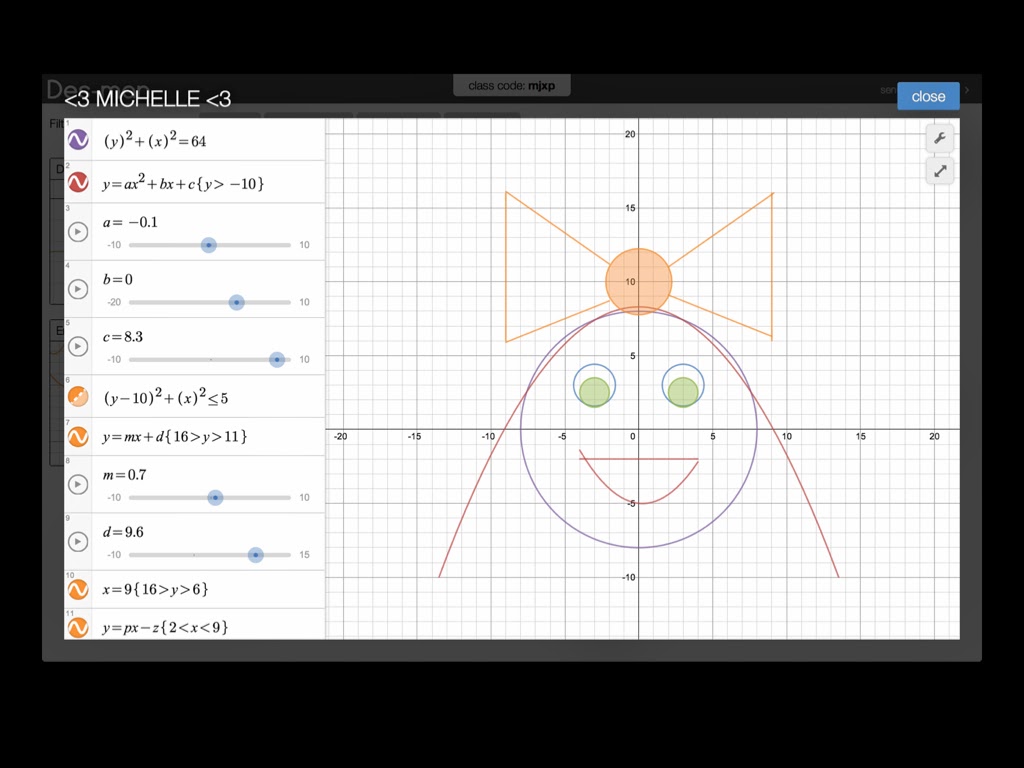
Today, students had about 90 minutes to work on creating their Des-man. Des-man was the brainchild of Fawn. Desmos then teamed up with Dan Meyer and Christopher Danielson to create a suite of classroom activities, one of them being Des-man. I've done Des-man before, but not with the Desmos classroom. Let me just say, it's awesome!

As the teacher, I could see every students' work in real-time and display it up on the projector for all to see if need be. That's a really slick feature on top of the already amazing Desmos. It's like math euphoria! It was a blast to see students work 90 minutes straight, being as creative as possible with their Des-man (or Des-woman). After three weeks, Desmos became a very familiar tool for students because they used it with tasks like Barbie Bungee, Datelines, Hit the Hoop, Vroom Vroom, Stacking Cups, and more. I'd like to showcase a few creations for you. Enjoy!


Thanks Fawn, Desmos, Dan, and Christopher for a wonderful and creative math experience. Lastly, I want to thank my students. Today, you guys helped each other out, persevered, asked for advice, freely explored, had fun, and wanted to know more about functions, domain, range, circles, sliders, and more!

Desmos is great about asking for feedback. I have some observations and am curious. Maybe I'm missing something, but I noticed some features from the regular desmos calculator missing in the classroom. Maybe these are upcoming features:
Students couldn't duplicate functions. How come?
Students couldn't create (use) tables. How come?
Students couldn't create folders or text boxes. How come?
Students can't share their Des-man (email, link, etc.). How come?
As the teacher, I can't keep the Des-man (functions included) for each student. How come?
As the teacher, I'd love to have access to each student Des-man, especially if I want to send it to that student or share at a later time.
Thanks for listening, Desmos!

Des-manian,
1035

Going Round In Circles

Whenever I start talking about circles with my students, I use this little wager.

I get students to pick one of the three choices and work the room, looking for a brave student I know will deliver my nachos. I talk up the nachos (and the circumference) as much as possible. Anywhere from 90 to 100 percentage of students will say the circumference is shorter than the height of the water bottle. Let's see if I win nachos or I let my students go to lunch early.


Okay, so double or nothing? I don't bring in this glass, but I do use a taller cup with a really small circular base. Where do you stand on the double-or-nothing wage? Did I give you enough information to take the bet? With a glass like this, you should get at least one student to keep you honest and ask which circumference of the glass you'll be measuring.


This little wager (activity) allows me a quick introduction and fun application of circumference. Somewhere I'll discuss vocabulary and formulas with students while giving them a graphic organizer they can fill out.

I'll usually do an activity where students measure the circumference and diameter of objects in order to discover the relationship of Pi. Stuff very similar to Fawn's Friday Bubbles. Note to self, use Excel (or a spreadsheet) to keep track of those measurements. I've also explored Rolling Tires in the past. This year, I brought the wheel to the class for a small activity. A physical wheel. The wheel from my son's wheelbarrow.

The small activity was for students to guess how many rotations this wheel (8-inch diameter) would make from one wall of my class to the other wall. Students were able to see how circumference can take on the meaning of a tire rotation, hence the graphic I made above. It was sweet to see students roll the wheel across my 21-foot long room and actually get 10 rotations like the math predicted. If you have a wheel like this, bring it in and do this activity.

We also did these awesome lessons. And. I. Mean. AWESOME!
Pizza Pi by Mathalicious and
Penny Circles from Team Desmos and Dan Meyer.

There's so much to do with circles and so little time. 

Round and round,
945

Estimation 180 has Lessons!

Head over to Estimation 180 and you'll see this lovely new option in the menu bar.

LESSONS!

That's right! 

LESSONS!

I've added a "Lessons" page with many lessons I've created, sorting them by their CCSS. I'd like to thank Dan Meyer and Robert Kaplinsky for their friendly suggestions (nudging) to tag my lessons in an attempt to make it easier for other teachers to find and use. Plus, I'm tired of my lessons collecting digital dust and hope that teachers can find and use them.

I was honored to give a workshop for teachers in my district today. The workshop became the motivating factor for making this Lessons page. Right now, most of the lessons are 3 Act lessons that can be found at Dan's 101qs.com A few other lessons are ones I've blogged about. However, I have added two test pages at Estimation 180 where the entire lesson is available for teachers to use. Right now. At Estimation 180.

Pay close attention to my File Cabinet and Stacking Cups lesson PAGES!.

These two full-on lessons are ready for you and your students. You'll see all three acts, teacher notes, student work, student handout (if you like/need), and downloadable videos. Let me know if you have any thoughts, advice, or questions.


I hope this "Lessons" page is useful and/or better than that silly unorganized spreadsheet I've got lingering. You'll notice a few links are under construction, but many links deliver the goods. Check in often for updates.

LESSONS!
1023

P.S. Thanks to Fawn, Nathan, Robert, and Eric for your feedback.

CMC North 2013

Here's a recap of my CMC North experience from last weekend. 

Friday:
Fawn Nguyen and I flew up to Monterey Bay, checked in, and found the Fishwife restaurant for lunch. It was within walking distance of the conference grounds. Thank goodness because it was a little chilly outside. We enjoyed lunch so much we made a trip back there for the 4-6 p.m. Happy Hour so we could fine-tune our Saturday presentation. We checked in with the CMC people, and if you ever make it up to Pacific Grove for the conference, don't forget the badge they mail you. It'll cost you $5 if you forget it, right Fawn?

Later that night, we attended the opening keynote by Dr. David Dockterman where he discussed the importance of a growth mindset.  Afterward, it was great to see and meet up with Fawn, Dan Meyer, Avery Pickford, and Breedeen Murray for some pizza. Good times. Good company.

Saturday:
Session 1:
The first session I attended was titled Using Formative Assessment to Create Equitable Practices by Karen Mayfield-Ingram. We diagnosed some student work and left with the following reminders:
1) Make a concerted effort to give students detailed feedback on any assessment.
2) Try and ask students questions that will encourage them to analyze their work better.

Session 2:
I showed up early at Larry Armstrong's session titled Flip Instruction to Transform Learning. I'm interested to know more about the flipped classroom. Not because I'm sold on the idea, but because my district is getting iPads the second semester and I have a feeling we will be encouraged to implement some type of flipped classroom model. Who knows? Again, I'm not sold on the idea, but I want more information just in case. Well, it's 5 minutes before the start of the session and the front of the room is empty: no computer plugged into the projector, no one is setting up, no Larry Armstrong. Nothing!
A CMC helper comes to the front to inform us Armstrong won't be presenting and we have time to catch another session if we want. I saw Brad Fulton come in at the back of the room and I got up to ask him if he'd present, but he said he was only coming to drop his stuff off for presenting at the following session. I turned to the CMC helper and offered to present my Number Sense session I gave at CMC South. She took me up on my offer and we had ourselves an impromptu Number Sense session. It was fun! For the forty to fifty attendees that stuck around, we had a blast doing estimation challenges and talking number sense for about 50 minutes. I will blog more about my presentation over the next few weeks. Stay tuned! I was honored when Rebecca Lewis, the Program Chair, gave me this token of appreciation for stepping in at this session. This proudly sits on my desk.

Session 3:
Shelly Lawson gave a great hands-on session titled Modeling Lessons Can Work for All Students - Yes, Even Yours.  I was excited about this one because it was geared toward 7th grade curriculum. You know you're in for a good session when you see a bag full of PVC pipes, a stopwatch, a meter stick, a steel ball, and some string. There were 5 different length PVC pipes, and four connecters; two right angles and two at about 135 degrees.

We had to construct a pipe so that the ball, when dropped, would make its way through the pipe at the fastest rate possible. Here's our contraption. It was the fastest because of my teammate's design. Great job Bob!

Shelly also introduced us to the Incredible Egg, Float That Boat, and the Penny Lab. All of these activities allow students to make measurements, mistakes, and formulate conclusions based on observations and data collected. I left with a packet full of hands-on activities that I can incorporate into my curriculum. The structure of the packet gives students pretty detailed steps and instructions. Personally, I will probably revise the activities to leave them a little more open-ended and less structured. Overall, some great activities. Email Shelly for a copy. See the link attached to her name above. By this time, I think I ran into Dittmer about 50 times. Really cool guy!

Session 4:
Fawn and I presented Hotel Snap to the CMC attendees. Fawn is awesome! Tell you something you don't know, right? Okay, chances are good you've already read her blog post on Hotel Snap. If not, go now and read it here. Fawn did an amazing job coming up with this task. You might be surprised, but I have nothing but great things to say about Fawn. Her task is challenging and can be used at numerous grade levels. CHECK IT OUT!
Photo by Dan Meyer
Thanks to Brian and Dan for helping us with the calculations. Thanks John for helping us clean up!

Session 5:
My man, Max Ray, presented Becoming Better Reasoners: Supporting Students to Develop as Problem-Solvers. I was excited since this was my first time seeing Max present.  See how calm he is in this picture?

I love how Max is so patient and allows his students (us CMC attendees) to formulate noticings, wonderings, and other thoughts as we worked through some Math Forum tasks. I enjoyed this last session of the conference because we worked in groups to problem-solve a task, we analyzed student work, and Max charged us with asking students questions that would help them further their problem-solving approach by becoming better reasoners. Well done Max!

Saturday night:
Ignite talks!!! I could write a whole other blog post on these. I was honored and privileged to present with the following mathletes!

The Math Forum organized, hosted, and took over the Ignite talks this year. Thanks Suzanne for all you did! Watch them in January or February 2014 when they post the 10 videos online. It was a lot of work preparing my 5 minute talk, but was great fun! Fawn stole the night! The energy and inspiration from these talks was a great way to cap Saturday night!

Sunday:
Dan Meyer gave the first keynote of the morning titled Fake-World Math. Dan is the man! His presentation was fantastic. I don't want to post any spoilers here, but he talked about the importance of modeling and how CCSS defines modeling. If I could summarize some important points, here's what I want to reflect on for future reference.
Although important to the math classroom at certain times, the following is NOT modeling:

  1. I do, we do, you do
  2. Using concrete manipulatives
  3. Graphs, equations, functions
Furthermore, Dan stressed that the real world is not always greater than a math problem. Vice versa, a math problem is not always greater than a real world situation. He emphasized that strong modeling starts with a simple question and allows students to identify variables, formulate the necessary model to organize and solve the task, and to validate conclusions a la something along the lines of a 3-Act task. He reminded everyone that modeling tasks are out there: Dan, Robert, and here. My summary can't do justice to his presentation, content delivery, and charisma. If you get a chance to see Dan live, DO IT!
*For the record, my initial estimate for Dan's Super Stairs task was over by fifty seconds. Bam!

Dr. Timothy Kanold gave the second keynote titled The Art of Teaching Mathematics: Inspiring Students to Learn. CMC North 2013 ended with Bill Withers' Lean on Me.

Before Fawn and I flew back to Los Angeles, we had brunch with some great math amigos (pictured below).
Left to Right: Stadel, Nguyen, Meyer, Murray, Pickford.
We also said hi to some fish at the Monterey Bay Aquarium.

Thanks Dan, Avery, and Breedeen for driving us around too!

North,
819

Weekly POPS

Have you ever tossed a puzzle at one of your students? Y'know, the puzzles kids can play around with using their hands and minds? It's crazy, right?! It's fascinating to watch a student display a wide range of behaviors: curiosity, engagement, perseverance, frustration, and an earnest desire to know the solution if they get fatigued and stumped. I have a couple bins full of puzzles in my classrooms that do this to kids. Students rarely have a chance to play with them, but when they do, they go bonkers in a good way. Occasionally, you'll hear a triumphant yell when someone solves a puzzle. Other students look in disbelief. It's hilarious. My collection of puzzles ranges from the Bedlam Cube (now known as Crazee Cube), to Cannonball Pyramids, to the Rubik's Cube, to Tangrams, to ThinkFun puzzles, to other miscellaneous puzzles I've picked up over the years. A few weeks ago, I was driving home and wanted to know if there was something I could do in math that had a similar magical effect on kids.

Have you ever tossed a puzzle at one of your students? The ones on paper that require logic and critical thinking? Those are crazy too! Kids can really get into them. Around the same time I was thinking about the power of physical puzzles, my school wanted to revamp our weekly intervention/study-hall period. I thought students could benefit from working on logic puzzles, patterns, or Get to Ten. I went to a resource called The Colossal Book of Short Puzzles and Problems by Martin Gardner in which Fawn recommended. I came across this Billiard Balls gem in which I remade for my students:

So I got to thinking and thought of some inspirational people/things from my PLN. I've always wanted to incorporate Fawn's Visual Patterns into my classroom more, especially with it's beautiful new makeover. Fawn is also known for her weekly problem-solving tasks. I've also wanted to incorporate more PoWs from the Math Forum. The Math Forum has an abundance of problem-solving tasks that range in difficulty across grade levels. Sign up, yo! Last but not least, Dan Meyer had impeccable timing and recently wrote a very invigorating post on [Fake World] Conjectures that has created quite the buzz in the comments. Personally, he struck a chord with me as he ended it saying:
Find those puzzles in the real world, the fake world, the job world, or any other world - it doesn't matter.
His post and quote made my day (with a smile).

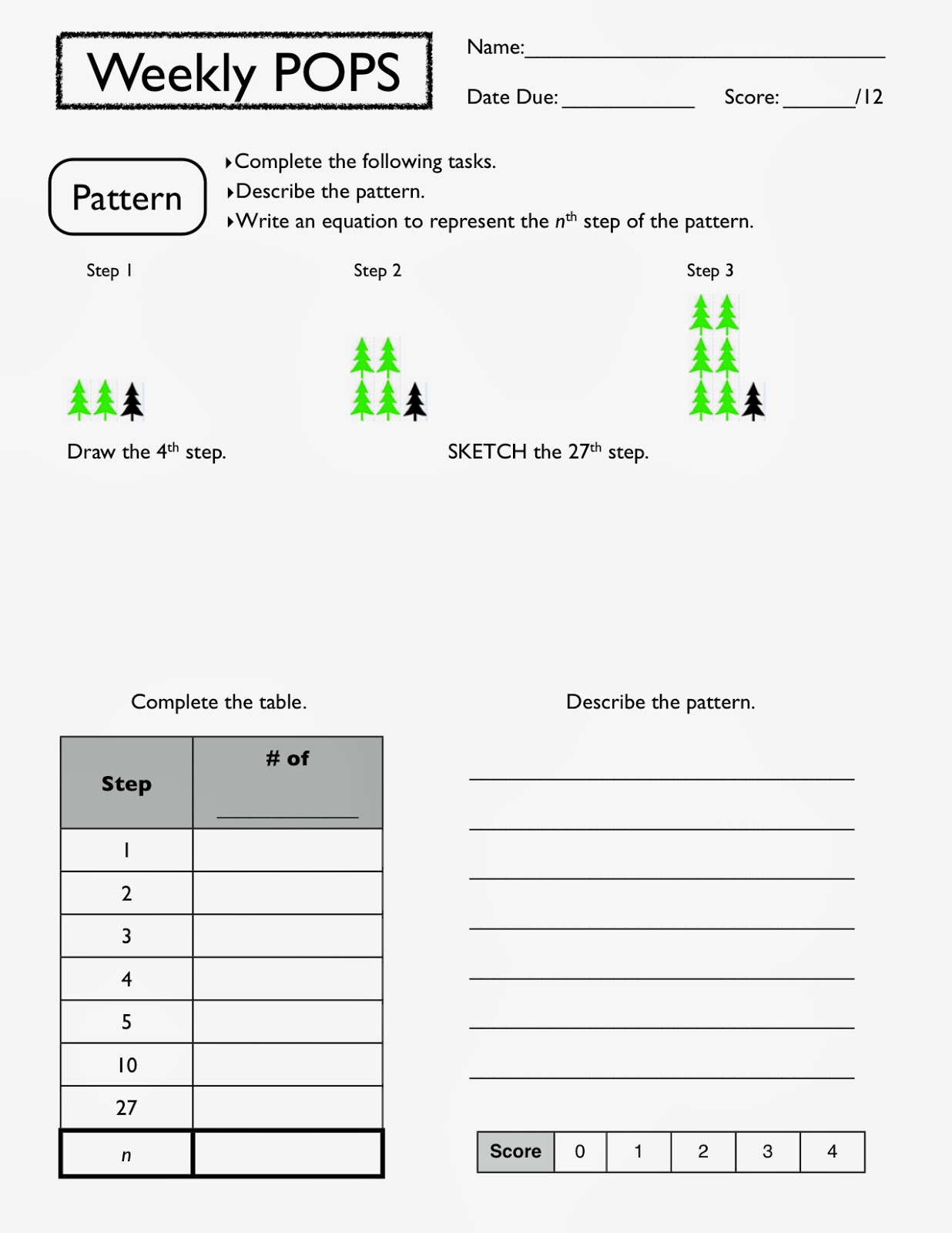
The result of all these crazy things: Weekly POPS.

POPS stands for:

  • Patterns (or puzzles like the Billiard Balls above)
  • Order of Operations (Get to 10 or Get to 24)
  • Problem-Solving

Patterns (or puzzles):
I will include a pattern either from Visual Patterns or one I create. As you can see from the handout below, it's similar to Fawn's form. I am adding a section for students to describe the pattern in their own words. If I decide not to do a pattern that week, I'll do some type of puzzle like the Billiard Ball puzzle above.
Order of Operations:
Students are to use the four given numbers and mathematical operations, symbols, and/or notations to get to the values of ten (or twenty-four). As you can see from the handout, students need to write the expression and evaluate it correctly using Order of Operations (or PEMDAS).
Problem-Solving:
Definitely one of the most important parts of the Weekly POPS, problem-solving. Right now, I'm finding old PoWs from the Math Forum's library to share with my students. As you can see from the handout, be sure to include the Math Forum's copyright information when photocopying. I'm looking for students to organize their work, demonstrate their solution strategy, and think critically.
My goal with Weekly POPS is to get students to really think critically and problem-solve. Why? because they so desperately need it. It's challenging, demanding, and necessary. There's a slight puzzle feel to POPS. Students have really been into it this week.

Students receive the POPS every Friday and have a week to complete it. They'll turn it in the following Friday and receive a new POPS. I've invested a lot of time in class this week going over my expectations, but will use Monday and Tuesday next week to show my classes student POPS that are exemplars, average, and sucky. I told them, "You earn a zero on your POPS, it's the same as POOPS."

I look forward to this adventure with my kids. Here's a folder with the POPS I've created so far. Feel free to join in the action. If this link is broken, please notify me and I'll fix it, unless your name is Fawn.

[UPDATE]: Check out Piles of Tiles that can be used in place of patterns. (12-27-2013)

POPS,
951