Showing posts with label Number Sense. Show all posts

Pumpkin Seeds

For Halloween, we gutted the larger pumpkin from Day 197 for two reasons:
1) To carve it and
2) To roast the seeds
*Little did I know this pumpkin would produce many number sense opportunities beyond Day 197's weight estimate.

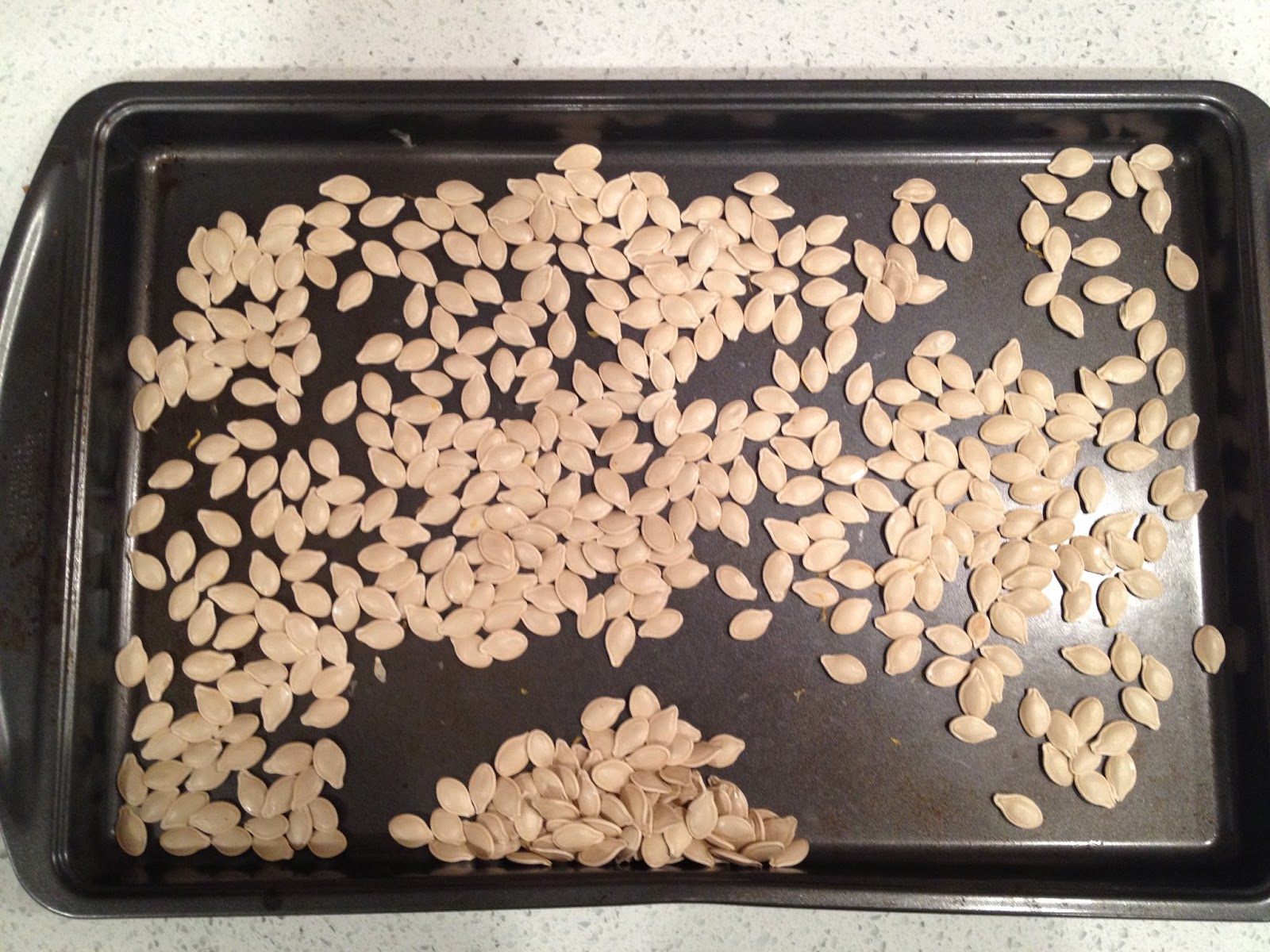
My 4.5 year-old son helped gut the pumpkin with me. We gathered as many seeds as possible and set them aside for the roasting process. The recipe I use can be found here. Before mixing the seeds in olive oil and seasonings, I lowered the pan down to my son and asked how many seeds he thought there were. [How many do you think there are?]
 
Me: How many seeds do you think there are?
Son: Well, ...[thinking for a few seconds]... there's definitely more than a hundred.
Me: How do you know it's more than a hundred?
Son: It just looks like more than a hundred.
Me: Make me a pile of seeds that would be about 100. 
He takes his hands and makes a pile toward the bottom of the pan. I can't contain my excitement to see what he has done.

His pile actually makes sense to me and definitely looks close to 100, give or take. Now that we've made a pile of his "one hundred" seeds. I ask:
Me: How many piles of 100 seeds do you think we can get?
I see he's a little confused by my question, so I ask it differently.
Me: How many piles do you think we could make where each pile has 100 seeds?
He starts to think, but by this time, my almost two year-old daughter sees the pan of seeds is now at her level, so she comes running over and wants in on the action of moving seeds. I thought our conversation was derailed as I brought the pan back up to counter height. But my son keeps it going. He didn't necessarily attempt to answer my question (which is fine by me). He took it in a different, pleasantly unexpected direction:
Son: What if we could get 10 piles?
Me: Do you mean ten piles of one hundred?
Son: Yes!
Me: Are you asking me how many seeds we would have if we had ten piles of 100?
Son: Yes.
This blew me away. Where'd this come from?
Me: Well, ten piles of one hundred seeds would mean we have a thousand seeds.
Son: A thousand??!!
Me: Yes.
Son: What if we had twenty?
Me: Twenty piles of 100 seeds?
Son: Yes.
Me: Well, what two numbers make twenty? Ten and...
Son: Ten!
Me: Right. So if ten piles make a thousand and another ten piles make a thousand, we would now have two th...
Son: ...ousand! 
Me: Right.
Son: What's 100 piles? 
Me: You mean, what's one hundred piles of one hundred? 
Son: Yea.
Me: That would be ten thousand.
My wife chimes in.
Wife: No. 
Me: One hundred piles of one hundred? Ten thousand.
Wife: Wait. You're right.
And our kids are now off in the other room playing and getting ready for going outside and looking at Halloween decorations before trick or treating. So many cool things happened:
  1. I love how we pursued my son's questions and not mine. 
  2. I love that he was fascinated by the word "thousand" even if it didn't make sense.
    1. Because he thinks a "hundred" is big.
  3. I love how we started with actual seeds (concrete) and went way more abstract.
  4. I love how my wife had the best estimate in the house [375 seeds].
  5. I love how the "pumpkin seeds" estimation challenge is just large enough so you can't accurately eyeball the amount and it's just small enough where it wouldn't take me an absurd amount of time to accurately count.
My wife and son watched the video answer this morning. My wife's response:
This is perfect for my [1st grade] students!

We paused the video when we saw ten groups of ten and paused it again when I made a larger pile of one hundred seeds. He struggled with making sense of final amount. 
Me: How would you say that number?
Son: Forty-eight eight? 
Me: How many piles of one hundred are there? 
Son: Four.
Me: So we say "four hundred" and let's count the piles of ten together. Ten, twenty,..
Together: thirty, forty, fifty, sixty, seventy, eighty,  
Me: And. Wait. There are only eight in this last group. So we say eighty-eight. Four hundred eighty eight. Say that.
Son: Four hundred eighty eight.
Me: Great. Let's go make breakfast.
Here's the recipe again and some pictures of the process.
Seasonings!
Ready for the oven.
Roasted and ready to eat!
Seeds,
225

P.S. Thanks to Christopher Danielson and all he does at #tmwyk!

Number Sense Conversations

I've put the elevator speeches to rest. Today's two minute speech went well... I think. As one event concludes, I'm excited to resume my ongoing thoughts about number sense and students.

Working with teachers and students, I can't help but be inundated with thoughts about things I miss, look forward to, and will be challenged with this year in and out of the classroom. However, there's one thing I crave more than anything else, and that's working with students, which usually entails having number sense conversations with students.

Today, I had rich number sense conversations with students in Math 7, Math 8, and high school Algebra classes. As I sit here and put the finishing touches on the slides for my upcoming conference workshop, Get Students to Argue in Class With Number Sense Activities, I can't put to words how valuable it is to allow students to talk about math in math class. That's an oversimplification, but we seriously need to provide our students with opportunities to talk to each other, even argue with each other. Mathematical Practice 3:
Construct viable arguments and critique the reasoning of others.
Steve Leinwand sums it up best:
These nine words may be the most important words in the entire Common Core effort. 
Last December at CMC North, I was honored to give an Ignite talk about something I'm passionate about: number sense and student conversations. It's titled: Number Sense: I Don't Like This Game Anymore.


Students are hungry for number sense conversations in math class. I really do believe. If you don't believe me, just put up this picture in your class and ask your students, "How long would it take to use all of that?" Then ask them to convince you of their conclusion.

As October quickly approaches, I look forward to seeing you at an upcoming conference this school year. In the meantime, I hope to post more about number sense.

Number Sense,
1005

San Diego Conversions

I was in San Diego, California the past few days doing the whole San Diego Zoo and SeaWorld thing with the family. We had a great time, but that's not the point of the post. There were definitely a handful of opportunities to capture some math moments, but I've found it more important to contain myself (mathematically) when I'm with family and make the most of our time together. Here are the two things I captured and want to share.

Number 1: 
We were waiting to board the Wild Arctic Ride (virtual helicopter ride) at SeaWorld and watched this video. There were subtitles in Spanish for our spanish-speaking (reading) friends. However, they go along with the helicopter pilot.

Here's Act 1:

When I saw the the number behind the black box, I thought, "Is that right? Is 400 miles per hour really ### kilometers per hour?"
Are they correctly converting for our Spanish speaking friends? It turns out that 400 miles per hour is about 643.7 kilometers per hour.

Here's act 3:

What do you think? Should I keep the black box there? Should I delete it?
I feel this is one of those moments where I don't insert a black box and we simply ask students:
Is 400 miles per hour really 600 kilometers per hour?
I'm curious about students arguing about this one? or would they even care?
What difference would 40 kilometers per hour make?
Where do you stand, on any of it?

Number 2: 
The great thing about San Diego is there are tons of people from many different places of the world. San Diego has an international airport and many places of interest besides SeaWorld and the zoo to contribute to this melting pot. I loved listening to all the different languages being spoken throughout the day. Therefore, it didn't surprise me when I walked into the pool area for the first time on our trip and noticed a few interesting things. I couldn't help but think how wonderful it would be to use these in any math classroom, specifically Math 6. The first thing you see as you enter the pool area is the jacuzzi. I couldn't help but notice the depth:
Okay class, check this conversion. It ends up making sense and I appreciate the use of meters for pretty much everyone outside of the United States. Seriously, I simply have such a hard time understanding why the United States uses inches, feet, yards, miles, etc. I digress.

Here's the (very shallow) pool:
Let's look a little closer at the depth signs around the pool. The deepest part of the pool is 4 feet or 1.2 meters. Okay class, check this conversion. Looks pretty legit, right?
So, if you saw a depth sign with 3.5 feet, what would you put the meters conversion at? How would you order these pictures with your students? Which would you present first? second? third? or would you give them all to your students at the same time? Would you cover up one of the measurements (like feet) and only show them one measurement so they work on finding the conversion. Here's the 3.5 ft depth sign.

Okay, if you do the conversion, 3.5 feet is 1.0668 meters. Obviously, someone was following their rounding rules. A few questions pop into mind here:
Should we round up?
Would it be wiser to round to 1 meter?
How much of a difference does roughly 4 centimeters make?
Could they not use a slightly larger tile and put 1.07 meters?
These questions aren't the only questions, nor the most profound, but I'm still curious.

There's one more crazy thing about this pool I had to capture and share. How did they get away with this? 
Look closely. Inside the pool is a depth of 4 feet (1.1 meters). Outside the pool is a depth of 3.5 feet (1.1 meters). WHAT?!!! Now reflecting, I should have had my wife take a picture of me next to the sign to get the water level and measure how deep it actually is here. I don't know about you, but 6 inches is definitely more significant than the 4 centimeters we discussed earlier.
At what point does an error like this matter significantly enough to change it? 6 inches? 2 inches? 12 inches? and in what direction: shallower or deeper?

How would you use any of these images or video in your class to help facilitate discussions or arguments regarding conversions?

SD conversions,
906

180 Ways to Use Estimation 180

New challenge: Find 180 ways to use Estimation 180. Wait a minute. That's seems a little extreme, yet I still love the idea. Here's one use I came up with this week: inequalities.  Click on any picture to enlarge.
Me: Hey guys, here's a piece of paper. Fold it into fourths for me like this.
Me: Great. Now, who remembers how tall I am?
I know, silly question, right? If these guys don't know my height by now, I'll send them back a few grades. Then I show them this picture and ask: What's the height of Mrs. Stadel compared to Mr. Stadel?
I take about 4-6 guesses and write them on the whiteboard. It’s been awhile since we’ve done this specific estimation challenge in class. Many have forgotten my wife’s height. Great! However, it’s quite obvious her height is less than mine.
Me: Let me step back. Let’s all look at these guesses. Is it safe to say that all of your guesses put her height less than mine?
Class: Yes.
Me: Okay, so before I reveal the answer let’s put this in our notes for today.
Me: Before I reveal the answer, who can remind me why we used an open circle?
Student: Because we know her height is not the same as yours.
Reveal Mrs. Stadel's height. Wait for it... Wait for it... Here it comes... Student responses: 
“Yes, I was right!” 
“Ohh, I was close.”
“Ohh, I was off by an inch.”

Next up, our beloved Mr. Meyer.

“Woah! He’s tall!”
“Someone is actually taller than you, Mr. Stadel?”

Again, toss 4-6 guesses up on the whiteboardStep back. What do we notice? Yes, all the guesses should be greater than my height.

Walk through the notes on this new section with more student confidence and participation.
Ask students:
  • What type of circle should we use this time?
  • If we’re talking about guesses that are greater than my height, how will that affect the inequality symbol?
  • What are ways to remember this inequality as greater than?
  • Which direction will we shade now?
  • Someone give me a variable we can use for Mr. Meyer's height.

Reveal answer. Same responses as my wife, but usually a different kid was right this time.

Okay, great. Now what? What about those other two inequalities, right?
Me: Before I show you this next picture, last year the 6th grade English teacher (@mrkubasek) at my old school read this novel with his students and came across these two books he found interesting. I found it interesting too and took a picture so we could talk about it in math.
Show picture.
Me: How many pages in the book on the LEFT?

No need to write anything down. Just get 6-8 guesses out loud. Don’t spend much time here. Reveal the answer. Give some math love [one clap on three: 1, 2, 3, CLAP!] to the closest student. Seriously, it’s pure gut instinct here people.  

NOW, show this picture and ask how many pages in the book on the RIGHT.

They don't know it yet, but you just broke their brains for a bit. Yup, you’ll get a lot of guesses below 307. But wait for it. I guarantee in a class of 35-40 students like mine, one student will say 307. If you do, treat it like every other guess you've gotten.
...and if no one guesses 307, step back after about 6-8 guesses and...
Me: You know all of your guesses make sense to me. I'm curious though guys. This is the same novel here, right? What if? I mean, WHAT IF? What if these books had the same amount of pages? Do you think that's possible? Do I have your permission to add it to your guesses?
Step back again. Look at all those beautiful guesses. 
Me: So if I'm looking at this right, you guys think the number of pages could be equal to 307, or could be less than 307? I wonder how we could represent this mathematically?
BAM! Focus here on the circle. Why are we shading it in this time? What's up with that line under the less than inequality?
Me: Okay, before I reveal the answer, someone remind me why we shaded in the circle. 
Reveal!
Brains broken! Now repair. 
Me: What's up with that? Anyone have any ideas/theories why they have the same amount of pages?
Alright. That fourth and final inequality. Here are the goods. Repeat all the other moves from above. 
Initial guess of one bar.
Take some guesses out loud. Reveal the answer.
Toss up new picture.

Write down some guesses on the board. Play up the "what if" again. Complete the notes. Ask a few questions before revealing the answer.
BAM!

That was fun. Boy, I wish it didn't have to end. But it did. Okay, let's find other ways to use Estimation 180 in the curriculum. The full lesson will soon be is available on the lessons page at Estimation 180.

180 ways,
957

Daily Something [WCYDWT]

#WCYDWT

What can you do with this?

Why would a teacher use this?

How would you use this in your class?

What would you add? subtract? replace? other?

How would you use the information from student performance on this?

How could this be used as a pre-assessment? an assessment? an intervention?

Take a few minutes to complete each day. What do you notice?

Hint:
*  **  ***  ****  *****  ******  *******  ********  *********

Answer as many or as few of these questions... or feel free to add your own.

This:

Thanks in advance!
843


CMC North 2013

Here's a recap of my CMC North experience from last weekend. 

Friday:
Fawn Nguyen and I flew up to Monterey Bay, checked in, and found the Fishwife restaurant for lunch. It was within walking distance of the conference grounds. Thank goodness because it was a little chilly outside. We enjoyed lunch so much we made a trip back there for the 4-6 p.m. Happy Hour so we could fine-tune our Saturday presentation. We checked in with the CMC people, and if you ever make it up to Pacific Grove for the conference, don't forget the badge they mail you. It'll cost you $5 if you forget it, right Fawn?

Later that night, we attended the opening keynote by Dr. David Dockterman where he discussed the importance of a growth mindset.  Afterward, it was great to see and meet up with Fawn, Dan Meyer, Avery Pickford, and Breedeen Murray for some pizza. Good times. Good company.

Saturday:
Session 1:
The first session I attended was titled Using Formative Assessment to Create Equitable Practices by Karen Mayfield-Ingram. We diagnosed some student work and left with the following reminders:
1) Make a concerted effort to give students detailed feedback on any assessment.
2) Try and ask students questions that will encourage them to analyze their work better.

Session 2:
I showed up early at Larry Armstrong's session titled Flip Instruction to Transform Learning. I'm interested to know more about the flipped classroom. Not because I'm sold on the idea, but because my district is getting iPads the second semester and I have a feeling we will be encouraged to implement some type of flipped classroom model. Who knows? Again, I'm not sold on the idea, but I want more information just in case. Well, it's 5 minutes before the start of the session and the front of the room is empty: no computer plugged into the projector, no one is setting up, no Larry Armstrong. Nothing!
A CMC helper comes to the front to inform us Armstrong won't be presenting and we have time to catch another session if we want. I saw Brad Fulton come in at the back of the room and I got up to ask him if he'd present, but he said he was only coming to drop his stuff off for presenting at the following session. I turned to the CMC helper and offered to present my Number Sense session I gave at CMC South. She took me up on my offer and we had ourselves an impromptu Number Sense session. It was fun! For the forty to fifty attendees that stuck around, we had a blast doing estimation challenges and talking number sense for about 50 minutes. I will blog more about my presentation over the next few weeks. Stay tuned! I was honored when Rebecca Lewis, the Program Chair, gave me this token of appreciation for stepping in at this session. This proudly sits on my desk.

Session 3:
Shelly Lawson gave a great hands-on session titled Modeling Lessons Can Work for All Students - Yes, Even Yours.  I was excited about this one because it was geared toward 7th grade curriculum. You know you're in for a good session when you see a bag full of PVC pipes, a stopwatch, a meter stick, a steel ball, and some string. There were 5 different length PVC pipes, and four connecters; two right angles and two at about 135 degrees.

We had to construct a pipe so that the ball, when dropped, would make its way through the pipe at the fastest rate possible. Here's our contraption. It was the fastest because of my teammate's design. Great job Bob!

Shelly also introduced us to the Incredible Egg, Float That Boat, and the Penny Lab. All of these activities allow students to make measurements, mistakes, and formulate conclusions based on observations and data collected. I left with a packet full of hands-on activities that I can incorporate into my curriculum. The structure of the packet gives students pretty detailed steps and instructions. Personally, I will probably revise the activities to leave them a little more open-ended and less structured. Overall, some great activities. Email Shelly for a copy. See the link attached to her name above. By this time, I think I ran into Dittmer about 50 times. Really cool guy!

Session 4:
Fawn and I presented Hotel Snap to the CMC attendees. Fawn is awesome! Tell you something you don't know, right? Okay, chances are good you've already read her blog post on Hotel Snap. If not, go now and read it here. Fawn did an amazing job coming up with this task. You might be surprised, but I have nothing but great things to say about Fawn. Her task is challenging and can be used at numerous grade levels. CHECK IT OUT!
Photo by Dan Meyer
Thanks to Brian and Dan for helping us with the calculations. Thanks John for helping us clean up!

Session 5:
My man, Max Ray, presented Becoming Better Reasoners: Supporting Students to Develop as Problem-Solvers. I was excited since this was my first time seeing Max present.  See how calm he is in this picture?

I love how Max is so patient and allows his students (us CMC attendees) to formulate noticings, wonderings, and other thoughts as we worked through some Math Forum tasks. I enjoyed this last session of the conference because we worked in groups to problem-solve a task, we analyzed student work, and Max charged us with asking students questions that would help them further their problem-solving approach by becoming better reasoners. Well done Max!

Saturday night:
Ignite talks!!! I could write a whole other blog post on these. I was honored and privileged to present with the following mathletes!

The Math Forum organized, hosted, and took over the Ignite talks this year. Thanks Suzanne for all you did! Watch them in January or February 2014 when they post the 10 videos online. It was a lot of work preparing my 5 minute talk, but was great fun! Fawn stole the night! The energy and inspiration from these talks was a great way to cap Saturday night!

Sunday:
Dan Meyer gave the first keynote of the morning titled Fake-World Math. Dan is the man! His presentation was fantastic. I don't want to post any spoilers here, but he talked about the importance of modeling and how CCSS defines modeling. If I could summarize some important points, here's what I want to reflect on for future reference.
Although important to the math classroom at certain times, the following is NOT modeling:

  1. I do, we do, you do
  2. Using concrete manipulatives
  3. Graphs, equations, functions
Furthermore, Dan stressed that the real world is not always greater than a math problem. Vice versa, a math problem is not always greater than a real world situation. He emphasized that strong modeling starts with a simple question and allows students to identify variables, formulate the necessary model to organize and solve the task, and to validate conclusions a la something along the lines of a 3-Act task. He reminded everyone that modeling tasks are out there: Dan, Robert, and here. My summary can't do justice to his presentation, content delivery, and charisma. If you get a chance to see Dan live, DO IT!
*For the record, my initial estimate for Dan's Super Stairs task was over by fifty seconds. Bam!

Dr. Timothy Kanold gave the second keynote titled The Art of Teaching Mathematics: Inspiring Students to Learn. CMC North 2013 ended with Bill Withers' Lean on Me.

Before Fawn and I flew back to Los Angeles, we had brunch with some great math amigos (pictured below).
Left to Right: Stadel, Nguyen, Meyer, Murray, Pickford.
We also said hi to some fish at the Monterey Bay Aquarium.

Thanks Dan, Avery, and Breedeen for driving us around too!

North,
819

CMC South 2013

Here's my recap on CMC South 2013... or how I developed a man-crush on Robert Kaplinsky.

Thursday night:
I drove out to Palm Springs and met up with Karim and Fawn. We found a nearby casino, math-chatted, and then landed at the roulette table where $20 lasted me for a good chunk of time. I broke even and called it a night.

Friday:
Fawn and I spent the first session reviewing our presentation in the lobby on my laptop. Poor Fawn, I think she was regretting her decision to present with me.
We reached a point where we couldn't think of anything more to review so we walked over to Robert's session at the Hilton. Lucky us, we were able to sit with John Berray, Avery Pickford, Breedeen Murray, Karim, and John Stevens.

You can read a better recap of Robert's session at Dan's blog. Robert did a fantastic job. He really did. Therefore, I guess I should explain my man-crush now, right? I think Robert has such an edge right now that the #MTBoS, math community, and those in education can all benefit from. Follow him on Twitter, use his lessons, read his blog, and get him to your school for some trainings or to observe... because he's totally willing. He has an edge because he's still in the classroom working with both students and teachers in his district. He's eager to ask questions that will make him better while at the same time will share the mistakes he's made and how's benefited from them. He delivered a stellar session that was informative, humble, resourceful, fun, engaging, honest, and necessary. Seriously, we need more Robert Kaplinskies out there working with both teachers and students. Follow him on Twitter, use his lessons, and read his blog. Lastly, if you get a chance to meet Robert and spend five minutes talking with him, you'll quickly see that he's interested in what you do and is more than willing to be in your classroom so he can observe and learn. He eagerly wants to improve his craft in education, learn from others, and find ways to be more effective at what he loves doing. Very inspiring!

Fawn and I presented after lunch. The title of our session was:

It was such a pleasure to collaborate and present with Fawn. She came up with this great math task and I look forward to presenting with her again at CMC North. She's probably dreading the thought of presenting with me again! Not to spoil anything for our CMC North session, we had attendees use snap cubes to build something that involved income and a building cost. The task required strategy, problem-solving, collaboration, and a lot of calculations. Groups were required to present their calculations, information, and reasoning on their giant whiteboards. How vague was that description? Don't worry, we'll post more after CMC North. In the meantime, here are some pictures from our session:
The man! Robert Kaplinsky!
Avery Pickford: our winner!
Some attendee quotes a la Quotes of the Week style
Thanks to all those who helped enter calculations, pass out things, clean up or kept us on track during our session.

We were able to make the last half of Jo Boaler's presentation after we cleaned up our session and headed back to the convention center. I look forward to taking her class in April 2014 and my take-aways from her session were:

  • Get rid of timed tests because "Math should never be associated with speed."
  • Give students more diagnostic feedback and tell them "I'm giving you this feedback because I believe in you."
Keep an eye on her site www.youcubed.org

Saturday:
I rolled in casually late to Michael Serra's Polygon Potpourri session. No need to describe the fun found here as Dan already recapped it.

CMC South wouldn't be right without attending a Brad Fulton session. He's interactive, funny, and engaging. Next time you get a chance to see him present or give a workshop, be there! His focus was on Math Talks. Fawn shared a little insight on his session here. However, she took it a giant step further and generously created a space for us at mathtalks.fawnnguyen.com to share student thinking and giving students a voice.

After lunch, Fawn and I went to Avery's session. Dan did a recap and Avery did two posts: part 1 and part 2. Check it out! Unfortunately, I had to leave early to go get my materials and set up my presentation. My take-away was working with the Locker Problem and Avery sending me this resource. I've never tried the locker problem, so it was a bunch of fun to play with. He also shared this gem which he demonstrated with snap cubes using the document camera (very cool!):

I presented last at CMC and wanted to thank those of you who were able to make it, even if I was your fourth choice after seeing Dan Meyer's sold-out arena. The title of my presentation was:

Overall, I think my session went well. I wish I could give this talk again, after a little more refinement. I could've used ten more minutes to better connect with the 8 Mathematical Practices. However, there was a lot to share, interact with, and discuss. I learned a great deal from my attendees; especially on rating the level of difficulty with estimation challenges. My attendees got a sneak peek at Days 176-180 of Estimation 180 and I hope you had as much fun as me. I look forward to sharing more with you about this session in a later post.

My CMC regrets: I wish I could've attended the sessions by Karim, Breedeen, and the dynamic duo of Matt Vaudrey and John Stevens. I've linked their names to their sessions. I look forward to CMC North. Maybe I'll see you there.

South,
927

Manilla folders [Number Sense]

I must share this short story with you about the number sense I've been witnessing for the past few weeks with many of my students. Be warned: not for the faint of heart.

Today, a few 7th grade boys came in after school today and wanted to help with some things around my room: tidy up desks, organize whiteboards, etc. There was a box of 100 manilla folders that I had just brought back from the office. I needed 80 of the folders and would later return the remaining folders to the office.

Here's my exchange with the student we'll refer to as Albert:
Me: I need 80 folders from that box. Albert, think of a quick way you could get those 80.
***Let's pause. How would you (the reader) quickly get 80 folders from this box?
Albert: I could count in 5's.
Me: Okay. Any quicker than that?
Albert: By 10's.
I get what Albert is trying to do. He doesn't want to count to eighty by ones. To that point, I would say his initial two responses made sense and are practical, in the mind of a 7th grader. I thought maybe I'm asking the question incorrectly, so I try it again.
Me: Right. That would be a good way to organize the folders to keep track of them as you count. Albert, I'd like you to think of a way to quickly get those folders out of the box. 
I can see the look on his face is one of confusion. Not that look like he's trying to figure it out, but that look like he has no idea what I'm asking. So after a minute, I mistakenly ask another question (in hindsight, I wish I would've stopped the conversation and let him do his thing).
Me: How many folders are in the box?
Albert: 100.
Me: How many do I need?
Albert: 80.
Me: Is there a way to get me the 80 without counting all 80?
Albert has no idea. I like this question because now it's specific. His challenge is to get me 80 folders without actually counting all 80. After a minute. He needs some prompting.
Me: If the box has 100 and I need 80, how many will be left?
Albert: 30.
Me: So 80 plus 30 is 100?
Albert: No wait, 20. 
Me: Okay, so I will send 20 back to the office. How can I get 80 folders out of the box without counting all 80?
Albert has no idea. This exact exchange continued for another round. I'd like to say that Albert eventually came to an efficient way on his own, but he didn't. I tossed 100 up on the whiteboard. We subtracted 80 and wrote 20. I thought after Albert saw the 20 on the board, he might realize to count 20 folders from the box, take out the remaining folders and switch them with the 20.

This is quite common. The number sense (or lack thereof) my students have (or don't yet) is quite fascinating. I have a lot of work ahead of me this year. One thing is for sure. I can get better at asking shorter questions. I can get better at looking for these learning opportunities. I can get better at not looking for one answer when asking questions of students. As Max Ray would say, "2 > 4."

Folders,
918

Guest Blog Posts at Estimation 180

Today, at Estimation 180, I posted some guest blog posts I collected from the beginning part of this year. I'm grateful, honored, and inspired by the stories they (or their students) shared. I hope you have time to check them out and share your story too.

Read their stories here. 


CCSS Workshop 2013

I did my first workshop this past week (5-30-2013), discussing the transition to Common Core State Standards, with a focus on the 8 Standards for Mathematical Practice. I'm working with K-5 elementary teachers, a couple of middle school math teachers, some support teachers, and a couple of administrators in the room. I'll admit, I'm not as eloquent a speaker as Steve Leinwand, but there might be a few times where I actually make sense. I'm throwing this video out there for some feedback. I don't expect you to watch the whole thing so I've provided some chapter markers you might be interested in. At the end of the notes for each chapter, I reflect by creating a wish-list of moves I would've done differently. They come across as rhetorical questions, but feel free to chime in. However, here are a few angles I'd appreciate you considering:
What did I forget to talk about?
Where could I have been more explicitly clear?
Where coud I have used a better strategy? ...and so on.


Opener: 0:00-10:10
I use an estimation task (Day 127) to kick things off, providing teachers with the handout Michael Fenton created for estimation180.com and my students. The handout has been through many revisions and I think we have a final version that's a winner.

I use the whiteboard to write the "Too Low", "Too High", and "My Estimate" of a few teachers, asking for reasoning along the way. We watch the answer and discuss.
8:15 is a precious moment where a teacher asks, "Wait a minute! What was it (the song length answer) really?" I love how a teacher is demanding more information. I wish I spent more time expressing the importance of her question. I feel rushed because of all the workshop content I have prepared. I wish I had allowed the other teachers to address her question more. I do with my students, why didn't I do this here?

Active Notebook Part 1: 10:15-12:55
Teachers glue their Estimation 180 handout to the inside cover of their workshop Blue Book and the Table of Contents to the first sheet while listening to Can't Buy Me Love.

Preview of Workshop: 12:55-20:50
I attempt at working on the following question throughout the workshop,
What's our role as we reshape the classroom with the Common Core State Standards?
I share with teachers what today will not be and what today will be. On a parallel universe I share with teachers what I perceive the CCSS to not be and what I perceive the CCSS to be. Then I share a few personal items from this past school year. Seeing that I'm doing a workshop with multiple grade level and content teachers, I'm expressing the focus of the day to be the 8 Mathematical Practices and what we do in the classroom. How do we help facilitate the learning?

Estimation Task #2: 20:50-26:45
We use Day 129 where teachers see that the song length is also the track length. Listen to their reasoning. I love this! Hearing this reasoning from teachers and students is one of the many joys I get from doing these daily estimation tasks. However, I wish I did a better job (23:50) of getting the teachers to justify their reasoning and "argue" a little more than I did. I wish I created a little more tension. Check out (25:00) the excitement of the teachers as they watch the answer.

I introduce the language of creating a task that has a low-entry point and could see that many teachers had no idea what I was referring to. Not their fault. However, I like their reaction when I translate "lower-entry point" to being easier. I wish I explained "low-entry point" better. I wish I had explained it as creating a task where most, if not all students have an equal opportunity to engage with the task, regardless of their mathematical proficiency. I wish I expressed the importance of providing students with a task where math vocabulary and thinking come as a natural result of solving the task.

Math Tools & Two Uses: 26:45-33:55
I ask teachers to glue a picture of a math tool to the front of their Blue Book and write down at least two uses for each tool. They have two minutes to complete this task. After We Will Rock You, I ask the teachers for their uses instead of telling them. This serves two purposes. Yes, I have a list of uses that I anticipate them to come up with, but I want to hear from them first, selfishly providing me with additional uses that I didn't anticipate. Secondly, I'm using this activity to illustrate how students need to provide the answers in the classroom. I wish I could have given this more time in the workshop where the teachers actually used the tools in the manners they suggested. I also should have had the teachers write down all the uses we came up with.

Introduction of 8 Mathematical Practices 33:55-1:04:00
Again, I'm feeling rushed for time! Yes, I said it, "Let me talk about these 8 Math Practices real quick." Real quick? How silly of me. These practices are not something to gloss over. Don't worry, we spend ample time doing a Jigsaw activity so teachers are out finding information about them. I provided the teachers with the handouts found at Jordan School District's site. The practices are presented in a manner representative of the grade level you might teach. Thanks Fawn for this link.  I could have explained and facilitated this a lot better, but the redeeming value is hearing teachers that were appreciative of this specific activity because they were "forced" to explore the practices instead of just receiving a handout with the information embedded. If I were you, I'd skip the section (39:30-52:00) unless you want to hear some of the teachers talking in their groups as they rotate around the room to their four different stations. I'm proud of the rotation table I provided and how teachers travel together according to their "math tool." DON'T miss the "perfect high-five" at 38:10. I love that a teacher commented that "perfect" is subjective. I say this all the time to my students.
At 52:30 I give teachers time to regroup and complete the practices by receiving information from the other teachers in their group. I recap (1:00:00) and then show teachers how to create a pocket (1:01:00) inside their Blue Book so they can store a Quick Reference "teacher" version (I referred to as "adult") of the 8 Mathematical Practices.
I wish I gave more time for reflection. I wish I reviewed each practice with the whole group by having them share out loud something they learned. During the Jigsaw activity, I was told that my time with the teachers was cut short by about ten minutes so I had to hurry things along. Arghh!

Find My Mistake: 1:04:20-1:13:00
I made an executive decision to skip the model lesson I had prepared for the worksop. I'm glad I didn't skip the Find My Mistake segment of the workshop. I'm very adamant about teachers finding the mistake quietly here. I encourage them to share with each other before we review with the whole group. I give props to Michael Pershan for mathmistakes.org. You can hear kids in the hallway, alerting me that our workshop is coming to an end very soon. We listen to each other make corrections or talk about the misconception and why us teachers are good at knowing the content we teach. We're constantly telling students what their mistakes are and telling them how to fix it. Let's switch that role. Make the students find, correct, and tell each other what the mistakes are, especially items that use algorithms. Remember, most of the teachers here are elementary teachers. I also point out that I haven't been jumping for joy every time a teacher gets an answer correct. Instead, I try my best to throw it back on the class for what they think, allowing them to critique the reasoning of others. I love how estimation and number sense is addressed with teachers on how to help encourage students to avoid these mistakes.
I hit a nerve (1:10:45) when I was asked, "What about simplifying?"
I could very well be wrong here, but my current understanding is we (as teachers) are to allow for multiple representations of the correct answer, unless explicitly instructed otherwise. In other words, ten-eighths is just as acceptable as five-fourths.
I wish I reviewed with the teachers the importance of doing an activity like this quietly and individually first, before group discussion. I wish I expressed how much I love group work and collaboration, but need to remember both teachers and students need that quiet time FIRST. The worst is being in a group where one person dominates the conversation and you don't have time to think or worse, problem-solve. I wish I had covered this with the teachers.

Summary: 1:14:15-1:19:00
I provide teachers with a fill-in-the-blank handout to glue to the inside of the back cover. Again, watch their reaction when we get to "low-entry" point. I hope I drive it home when referencing the "Cent-ed Whiffle Ball" task I recently did in Geometry. I remind myself and the teachers to listen to the students. I'm constantly working on allowing students to finish their thoughts. Don't cut students off or finish their sentences for them. I ask teachers to create a couple of goals. I provide the teachers with a list of resources found here. I like how they (at least some of them) want another in-service/workshop.
I wish I emphasized the importance of knowing the 8 Mathematical Practices better and to use the summer to better prepare for next year. I wish I had more time to pump up these points in the summary. I wish I had more time!

Unleash yourself in the comments if you will.

Thanks!
729

Amnesia

Gadzooks! You wake up tomorrow with amnesia!

Someone significant (spouse, child, significant other, neighbor, etc.) in your life informs you that you teach math. You get dropped off at your school (place of work) and are led to your classroom. Your principal can't find a substitute and your colleagues run to the photocopier to make you some busy-work handouts. You can't remember any mathematics and your students are 10 minutes away from entering your room, oblivious to all of this.

You look down and see this on your desk.


What do you do?


Not Drawn to Scale

I hope you'll allow me to vent for a bit. I have been encouraging my students to be in tune with the 8 Mathematical Practices by Standard of the CCSS for some time now. It's pretty safe to say that my students know I really favor Mathematical Practice Standard 6, Attend to Precision. However, some of the resources I occasionally use in class are beginning to play tricks with everyone's minds, including mine. Here's a resource I have, Cooperative Learning and Geometry by Becky Bride.


Don't get me wrong, I like this book. It has some great explorative exercises that have appropriately challenged my students. For example, look at this exercise to help students derive the 30-60-90 triangle relationships. Take an equilateral triangle, its altitude, and the Pythagorean Theorem to find out the special relationships between the shorter leg, longer leg, and hypotenuse. Great.


Here's where I start to beat my head against the wall. The book uses diagrams that simply shouldn't be used, especially in the context of 30-60-90 triangles. Look closely...


That's right, the 30 degree angle is opposite the longer (drawn) leg for questions 1, 3, and 4. My students get bothered by this contradiction. I do too. I have no problem admitting this to them. I'm honest with them saying, "I know guys. It goes against everything we strive to do in here. I encourage you guys to attend to precision and check for reasonableness. Yet, I give you this. I'm sorry. It says at the top 'not drawn to scale', but they should be drawn to scale. Right guys?!"

I think this about sums it up. Students will come up and ask about the dimensions they've solved for and whether or not they're reasonable. I'm proud of my students for making sense of their answers and checking for reasonableness.  I know something is a skew when my response to those students is,
"I never assume those things are drawn to scale." 
I feel rotten saying this to students. I feel like I've just provided them with a worthless and menial task. I've let them down. I feel dirty. Mr. Stadel's quality control group hasn't done their job. What message are we sending students? Do they think we're out to trick them? Do the directions read, "Find the mistakes?" They should. It's times like these that force me to (gladly) keep a closer eye on the content I provide my students with. Don't just throw some triangles at them with random angles and units. Make sure they're reasonable.

Have you ever felt this way? Have you ever been caught in this situation? What did you do? How do we avoid these situations again? How do we demand better quality content from publishers? How do we make sure we provide our students with content that matches the CCSS and Mathematical Practices? Maybe you're okay with these types of diagrams, so please explain why. I want to hear from you all on this.

nOt tO sCAlE,
939