Showing posts with label Christopher Danielson. Show all posts

Pumpkin Seeds

For Halloween, we gutted the larger pumpkin from Day 197 for two reasons:
1) To carve it and
2) To roast the seeds
*Little did I know this pumpkin would produce many number sense opportunities beyond Day 197's weight estimate.

My 4.5 year-old son helped gut the pumpkin with me. We gathered as many seeds as possible and set them aside for the roasting process. The recipe I use can be found here. Before mixing the seeds in olive oil and seasonings, I lowered the pan down to my son and asked how many seeds he thought there were. [How many do you think there are?]
 
Me: How many seeds do you think there are?
Son: Well, ...[thinking for a few seconds]... there's definitely more than a hundred.
Me: How do you know it's more than a hundred?
Son: It just looks like more than a hundred.
Me: Make me a pile of seeds that would be about 100. 
He takes his hands and makes a pile toward the bottom of the pan. I can't contain my excitement to see what he has done.
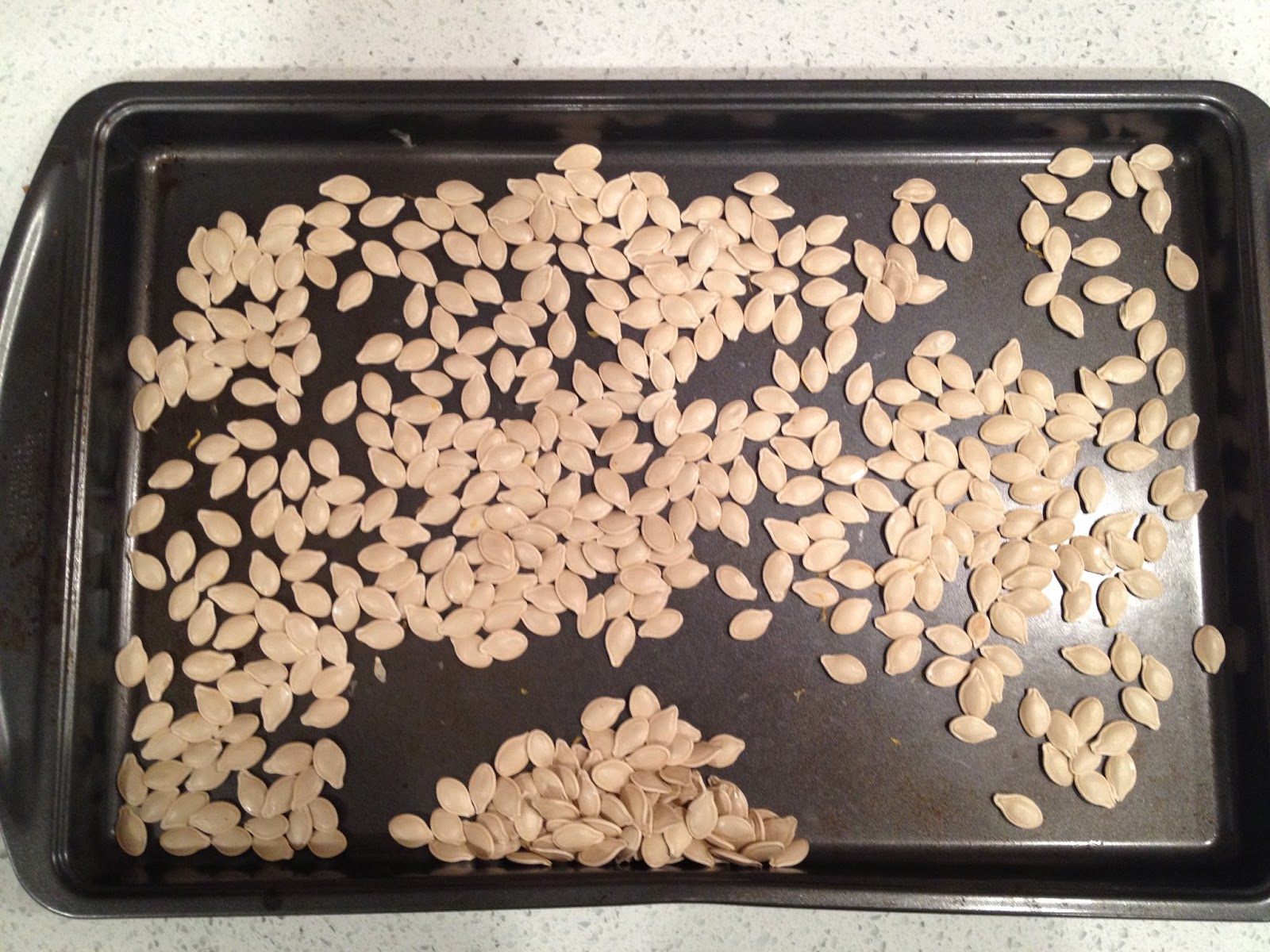
His pile actually makes sense to me and definitely looks close to 100, give or take. Now that we've made a pile of his "one hundred" seeds. I ask:
Me: How many piles of 100 seeds do you think we can get?
I see he's a little confused by my question, so I ask it differently.
Me: How many piles do you think we could make where each pile has 100 seeds?
He starts to think, but by this time, my almost two year-old daughter sees the pan of seeds is now at her level, so she comes running over and wants in on the action of moving seeds. I thought our conversation was derailed as I brought the pan back up to counter height. But my son keeps it going. He didn't necessarily attempt to answer my question (which is fine by me). He took it in a different, pleasantly unexpected direction:
Son: What if we could get 10 piles?
Me: Do you mean ten piles of one hundred?
Son: Yes!
Me: Are you asking me how many seeds we would have if we had ten piles of 100?
Son: Yes.
This blew me away. Where'd this come from?
Me: Well, ten piles of one hundred seeds would mean we have a thousand seeds.
Son: A thousand??!!
Me: Yes.
Son: What if we had twenty?
Me: Twenty piles of 100 seeds?
Son: Yes.
Me: Well, what two numbers make twenty? Ten and...
Son: Ten!
Me: Right. So if ten piles make a thousand and another ten piles make a thousand, we would now have two th...
Son: ...ousand! 
Me: Right.
Son: What's 100 piles? 
Me: You mean, what's one hundred piles of one hundred? 
Son: Yea.
Me: That would be ten thousand.
My wife chimes in.
Wife: No. 
Me: One hundred piles of one hundred? Ten thousand.
Wife: Wait. You're right.
And our kids are now off in the other room playing and getting ready for going outside and looking at Halloween decorations before trick or treating. So many cool things happened:
  1. I love how we pursued my son's questions and not mine. 
  2. I love that he was fascinated by the word "thousand" even if it didn't make sense.
    1. Because he thinks a "hundred" is big.
  3. I love how we started with actual seeds (concrete) and went way more abstract.
  4. I love how my wife had the best estimate in the house [375 seeds].
  5. I love how the "pumpkin seeds" estimation challenge is just large enough so you can't accurately eyeball the amount and it's just small enough where it wouldn't take me an absurd amount of time to accurately count.
My wife and son watched the video answer this morning. My wife's response:
This is perfect for my [1st grade] students!

We paused the video when we saw ten groups of ten and paused it again when I made a larger pile of one hundred seeds. He struggled with making sense of final amount. 
Me: How would you say that number?
Son: Forty-eight eight? 
Me: How many piles of one hundred are there? 
Son: Four.
Me: So we say "four hundred" and let's count the piles of ten together. Ten, twenty,..
Together: thirty, forty, fifty, sixty, seventy, eighty,  
Me: And. Wait. There are only eight in this last group. So we say eighty-eight. Four hundred eighty eight. Say that.
Son: Four hundred eighty eight.
Me: Great. Let's go make breakfast.
Here's the recipe again and some pictures of the process.
Seasonings!
Ready for the oven.
Roasted and ready to eat!
Seeds,
225

P.S. Thanks to Christopher Danielson and all he does at #tmwyk!

Des-man

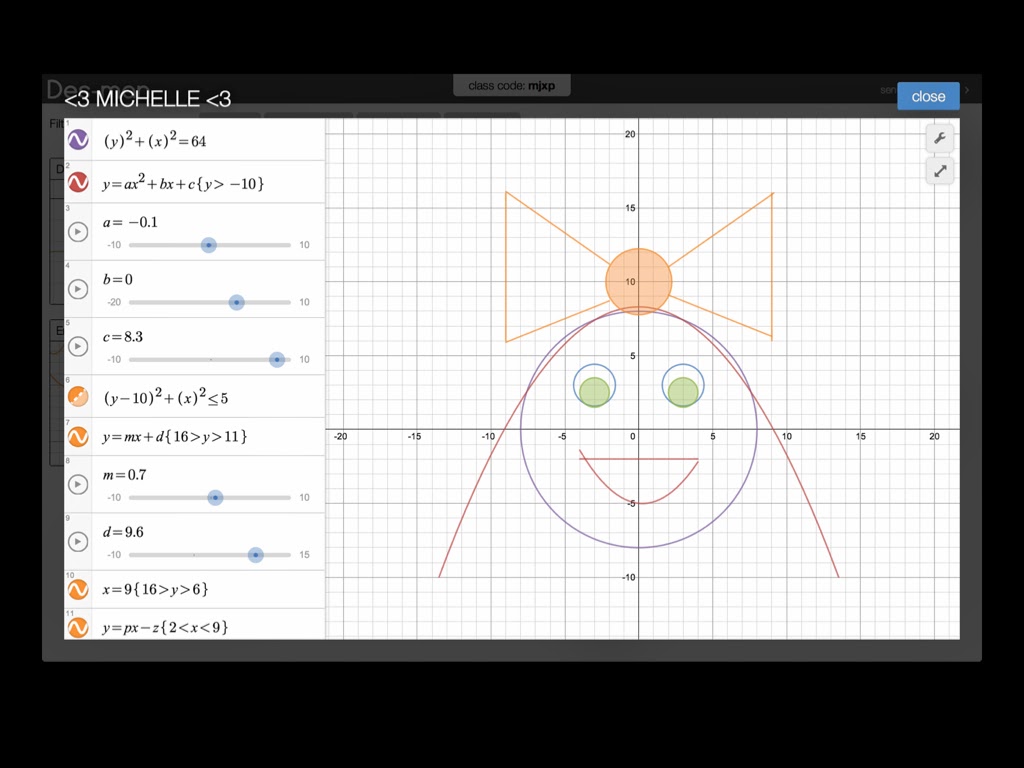
Today, students had about 90 minutes to work on creating their Des-man. Des-man was the brainchild of Fawn. Desmos then teamed up with Dan Meyer and Christopher Danielson to create a suite of classroom activities, one of them being Des-man. I've done Des-man before, but not with the Desmos classroom. Let me just say, it's awesome!

As the teacher, I could see every students' work in real-time and display it up on the projector for all to see if need be. That's a really slick feature on top of the already amazing Desmos. It's like math euphoria! It was a blast to see students work 90 minutes straight, being as creative as possible with their Des-man (or Des-woman). After three weeks, Desmos became a very familiar tool for students because they used it with tasks like Barbie Bungee, Datelines, Hit the Hoop, Vroom Vroom, Stacking Cups, and more. I'd like to showcase a few creations for you. Enjoy!


Thanks Fawn, Desmos, Dan, and Christopher for a wonderful and creative math experience. Lastly, I want to thank my students. Today, you guys helped each other out, persevered, asked for advice, freely explored, had fun, and wanted to know more about functions, domain, range, circles, sliders, and more!

Desmos is great about asking for feedback. I have some observations and am curious. Maybe I'm missing something, but I noticed some features from the regular desmos calculator missing in the classroom. Maybe these are upcoming features:
Students couldn't duplicate functions. How come?
Students couldn't create (use) tables. How come?
Students couldn't create folders or text boxes. How come?
Students can't share their Des-man (email, link, etc.). How come?
As the teacher, I can't keep the Des-man (functions included) for each student. How come?
As the teacher, I'd love to have access to each student Des-man, especially if I want to send it to that student or share at a later time.
Thanks for listening, Desmos!

Des-manian,
1035

Buses [Day 2]

Woah!!! We saw six buses today on our way to preschool. You might want to check out the Buses [Day 1] post from two days ago to understand the context of what's ahead. I was a little late to the bus-counting action on our way to preschool today so here's our first exchange.
Me: Have you seen any buses today?
Son (who turns 3 in a month): Yes. One.
Me: Was it a city or school bus?
Son: City. 
Me: Okay, we'll have to look for more buses today.

We immediately saw another city bus, bringing our total buses to two on the day. A little bit down the road was another city bus heading in the oposite direction.
Me: I see something on the other side of the road coming this way. What is it?
Son: It's another bus!! A city bus!
Me: How many total buses have we seen today? 
Son: Three.
Me: Good.
We continue along and a shorter city bus passes us. I don't point it out, but he spots it.
Son: There's another bus. 
Me: You're right. Wow! Now, how many buses have we seen?
Son: Hmph.
I pause and wait for him to process the question. Keep in mind, this is happening while I'm driving and he's in the backseat so I can't turn around to talk with him.
Son: Hmph
If I get a second "hmph" I know he doesn't have an answer and won't come up with one. Trust me, I've waited for long periods of time and will just continue to hear his cute little "hmph."
Me: Well, we already saw three buses and now we saw one more. What number comes after three?
Son: (whispering to self: one, two, three) Four.
Me: Good. So how many buses have we seen?
Son: Four.
Surprisingly, we hadn't seen a school bus yet. We were at our last red light and there it was in all its glorious mustardy-yellowy paint, a school bus. He exclaims, "A school bus!" Since we're at a red light, I turn around and ask how many buses have we seen. I get the two "hmph" count. I hold up one hand with four fingers up and the other hand with one finger up.
Me: We saw four city buses and now one school bus. How many buses have we seen today?
Son: Three
Did we just have a flashback (regression) to Tuesday?
Me: We did see three buses today, you're right. But, I think we've seen more. Count the fingers.
Son: One,... Two,... Three,... Five.
The light turns green and I have to go. I'm curious about him skipping 'four' and still landing on the correct number of buses. Seriously, what's up with that? I mumble to myself, "That's odd that he skipped four." Right as we're about to pull into the preschool parking lot, another school bus goes whizzing by in the opposite direction. He exclaims, "Another school bus!" Wow! We saw six school buses today, so I'm thinking we park the car and quickly review this last school bus.
Me: Wow! We just saw another school bus. We saw a lot of buses today. We saw five buses and now we saw one more. How many total buses did we see today?
Son: Hmph. (x2)
I hold up one hand with all five fingers up and the other hand with one finger up.
Me: So we saw five buses and we just saw another bus. Count the fingers.
Son: One,... Two,... Three,... Four,... Six.
Me: You're right. What happened to five?
He giggles! I do too because it's contagious. Seriously, what's up with this? He answered the correct number, but skipped the number directly preceding it. TWICE! He's happy he saw so many buses today. I am too. He's content with landing on the correct number. I'm perplexed.

Hmph,
1140

BTW. Thanks Christopher Danielson, for continuing to inspire me to have (and cherish) these conversations with my son.


Dancing with the Functions

I'm honored and humbled to have been a (small) part of Christopher Danielson's online course The Mathematics in School Curriculum: Functions. There were some great tasks, discussions, and contributors. I now have a better misunderstanding of functions. However you interpret that last sentence, let me assure you that this two week course broke me down in order to give me a better perspective and idea of functions. Professor Triangleman moderated the course well, provided challenging tasks and opportunities that took me out of my comfort zone, encouraged us to think differently, and didn't hesitate to whip us into shape as you can see here:

He's referring to beating me down while informing the teacher's pet (Fawn) of his tactic.
Our choices for our final project were:
  • a blog post,
  • a lesson plan,
  • an interpretive dance,
  • a work of visual art,
  • etc.
I thought writing a blog post was "too easy" in the sense that I could blog about anything ordinary at anytime. This class wasn't ordinary though, and I felt I'd rather try and give something back to the class, professor, and community in exchange for what I have received. No Fawn, not because I'm "too lazy." Therefore, I'm going to give you a lesson idea I have, based on an interpretive dance, which might be a work of visual art, all wrapped up in a blog post.

Interpretive dance really got me thinking. I thought back to the handful of dance lessons my wife (fiance at the time) and I took to practice for the First Dance at our wedding. My wife was a natural. As for me, well let's just say all the dance lessons in a lifetime wouldn't have helped. Here's a dance photo I have of us where it actually looks like I'm doing something worthy. Don't be fooled.


Don't worry, I won't torture you with video. Anyway, our dance instructor taught us many helpful tips and gave us a glimpse of dances like swing, salsa, the waltz, and the two-step box. We only did a few moves in our wedding dance, but it mainly revolved around the two-step box. We had a short song, thank goodness. I'm sure our guests would have taken their gifts back had they seen me dance any longer.

Here comes my lesson idea. I'd like to see the relationship between the number of steps taken in a dance over time. So let's make it a graphing story. Here's the first 30 seconds of a dance. Write a story for it. Even better, can you write the functions (along with any intervals, domains, ranges, etc)? Go here to Desmos to check your answers. I give you my interpretive dance.


Thanks to Sadie, Timon, and Michael Pershan for inviting me to their hangouts. I was honored to collaborate with you guys during one of the hangouts and bounce ideas off of each other. Thanks to Fawn for getting me in trouble, ratting me out to the teacher, and reminding me to submit my final project. Where would I be without you? Probably in class and not in the principal's office.

I would love some feedback on this lesson idea. Would you have your students dance? If so, what dance(s)? Would you have students come up with a function for each type of dance? What kind of relationships would you have your students look for? Would you consider "dancing" an applicable use of functions? I leave you with this clip. You must give these guys (Sean and John Scott) some crazy respect. They're insanely fantastic at tap-dancing. Just watch the first minute. Then make a graphing story.


Dance,
933

Couch Coins

Today, I had 25 minutes to get as far as possible with Couch Coins and a second grade class at my school. I'd like to debrief on a few things, but here's Act 1.


During the Summer 2012, I found a money/coins concept in a Second Grade Everyday Mathematics book similar to Couch Coins. I was inspired by PES' Coinstar commercial and ran with the concept. The intended question is: "What coins will my wife get?" On my way into work knowing that I would soon be surrounded by seven and eight year olds, I announced to Twitter that I'd be doing this 3 Act lesson with second graders today and wondered how it will go, asking for their thoughts. The response was great. Robert Kaplinsky, Christopher Danielson, and Sadie Estrella all chimed in offering that money can be challenging and to be careful of the "fewest coins" part of the task. In other words, finding the total value of the coins and half the total might just be challenging enough for second graders. Chris Lusto (in true Lusto fashion) provided some comedic relief:
Act One: Which one of these kids do you think has to pee? Act Two: Watch them squirm. Act Three: Reveal. (Act Four: Clean up.)
Why just 25 minutes? I had to bail after 25 minutes to go teach my own students (8th graders) or else I would have had about 50 minutes with these second grade kiddos. So what transpired in those precious 1500 seconds? I asked the students what they wondered and noticed about the Act 1 video. I had them write down at least one thing they wondered and one thing they noticed. I asked them to share, starting with "notice." Keep in mind my time was limited here so I only took a few...

-The coins were moving on the chair like magic.
-There were just coins.
-There were a lot of quarters.

Now, I asked what they wondered. I followed each student question with, "Who else would like to know the answer to that question?"

-Why are the coins moving out of the couch? 10
-How did the coins stack like they did? 7
-How much is half of the coins? 10
-How many coins were moving on the couch? 3

Not one student asked anything about the coins my wife should get. NO PROBLEM! You can see there was a tie between two questions and don't ask why the numbers are so low; the class had 26 kids. I told the students since most of the questions revolved around the animated coins, I would reveal the camera magic at the end while we focus on the other top (main) question: How much is half the coins?

Time for estimating the right answer and guessing a number that's too low and too high. The second graders really enjoyed this part. One student felt 10 cents was too low because they saw quarters. One student was very proud of his $99,999 being too high. Once we got our estimates, I asked the class to read and revisit the main question: "How much is half of the coins?" I typically ask my students to reengage with the task/question before moving to Act 2 so we are reminded of our task.

Here comes Act 2: I asked the students what information would help them answer the main question. Many raised their hands. One student said, "We need to know how many of each coin." This was immediately followed by agreements voiced as "yea" or "that's what I was going to say." I displayed this information and we had less than 10 minutes to work. The second grade teacher broke the kids into groups.

Students were chatting, drawing pictures, using tally marks, adding by grouping, and using other strategies. One student asked, "Can we get out our money bags?" My response, "Shyea!" (translated yes). It was fascinating to see them operate for that short amount of time. I wish I had taken pictures. Sorry everyone! I had to leave.

This morning before the lesson, the teacher and I talked about the expectation of her students and the original task. She knew her kids were capable of finding the total and half. However, she also thought that finding the fewest coins might prove to be a challenge. The second grade teacher and my pals on Twitter were right. I think Act 1 deserves an edit saying, "My wife wants half of the money." This allows the sequel to be, "What coins would my wife get if she also wants the fewest coins?" and this can be used for the early finishers.

This experience reminds me that I need to record one of these 3 Act lessons so you guys can help me get better at doing them. There's still a ways to go, but I'm loving the opportunity to work with other teachers and grade level students. I've learned so much from these other teachers. I have a great respect for elementary teachers. I also love seeing how elementary students remind me that learning can be a blast. They're not going through puberty. They're energetic. They're so much fun! Not fun enough for me to pursue a multiple subject credential and teach primary though. I love my middle schoolers. I received an email from the teacher this afternoon saying:
It was hard, awesome, fun and different, cool, fantastic, interesting, the best, made us smarter, fabulous, I liked it, and magical!  Those were a few of the comments from my class about the math lesson this morning:)  Thanks for spending some time with us this morning!  It was fun for me, too!!
Soon, I will also be posting about my recent experiences in a 4th grade (Back Box2) and 5th grade (iPad percentages) classroom. Thanks for reading!

Cha-ching,
1119

Zero Olives

My two-and-a-half year old son loves black olives just as much as I do. Tonight at dinner, my wife placed two olives on our son's napkin. Surprisingly, the olives remained untouched for a few minutes. He made some descriptive comments like, "The rice is delicious. The egg is delicious. The milk is delicious." You can tell what vocabulary we use around him, right? Quite the eclectic dinner, I know. Unbeknownst to me as I was taking a bite, he grabbed an olive with his hand so he could put it on his finger to eat and says, "There's one olive left, Dad!" Here's how the rest of this played out:
Me: "Yes, after you eat the one on your finger."
(we've had this conversation before)
He quickly shoves the finger-olive into his mouth.
Not wasting anytime, the olive-gobbler grabs the lonesome olive on the napkin and exclaims, "Now there's zero olives!"

WOAH!!!

This made my heart skip a beat. We haven't talked about zero for a couple weeks now. In previous olive consumptions, I've questioned my son how many are left after he devours his portion. He would sit there quietly and perplexed or would usually reply with a little, "hmph?" After giving him some time to think and reply, I would jump in and offer him a description simply labeled "zero." It kills me that a couple of his toys have the numbers one through nine, but no zero. For example, check out his toy phone. Where's the zero people??!! Seriously?

I'm a huge fan of using zero in math as much as humanly possible. To see it missing from toys means it could be missing from my son's vocabulary unless I work it in. He has placemats with letters, shapes, and numbers. Guess what number is missing. Zero plays a key role in number sense and math. My students know one of our class mantras is, "We love zero!" Zero is a wonderful number.

Our dinner conversation didn't end there. Let's see if this olive-gobbler has some depth. I held up two fingers and asked, "How many fingers do you see?"
Olive-gobbler: Two
(I take down one finger)
Me: How many fingers do you see?
Olive-gobbler: One
(I take down the last finger)
Me: How many fingers do you see?
Olive-gobbler just sits there......... "hmph"
He holds up his hand with all fingers extended and says, "Five!" (Wise-guy!)

I start over by holding up two fingers and repeat my questioning. Same exact response from the olive-gobbler. So it didn't work with the fingers. Later on during our dinner I put one of my olives on his napkin. He grabbed it.
Olive-gobbler: Zero olives left!
Me: You're right.
I put our workout on zero to rest for the night. We're getting there.

I cherish this post because it involves my son, olives, zero, and number sense. This is my first time blogging about my number sense experiences with my son, inspired by Christopher Danielson and the many number sense conversations he has with his children. Thanks man!

Olive-gobbler's dad,
936

When does a rock stop being a rock?

When does a pebble stop being a pebble and become a stone?
When does a stone stop being a stone and become a rock?
When does a rock stop being a rock and become a boulder?

I ask my wife these three questions too frequently. She's had enough of my philosophizing. So maybe you can help me out here? Are the answers too subjective? Is there an objective, definitive, agreed upon set of answers to these questions? Are the answers determined by weight? size? volume? mass? density? ootsies? (a la Christopher Danielson)

I'm thinking bigger picture here: How do we bring this type of thinking or wondering to our students more often? When dealing with measurement, how do we get our kids to know the correct (or most logical) way to measure quantifiable items without telling them? Would asking these types of questions help encourage our students to be better problem solvers or be better at applying the right terminology?

So many questions... here's more:
Living in the USA, our customary units system of measurements seems counterproductive with inches, feet, yards, fathoms, miles, ounces, cups, pints, quarts, gallons, barrels, etc. Terminology can be difficult enough for students and to throw all these different measurements at kids (nay, humans) can only seem daunting. When should we use feet to measure something instead of inches or yards? I envy the metric system and, well, let's leave it at that. These measurement questions become even more relevant as I dive into estimation with my students and as I update estimation180.com each week.

I haven't posted in a while and feel like I need to ease back into my blogosophy (blogging philosophy?). I'm not sure I just eased back into it. What do you think here?

Rocky,
858


Future students

Recently, I've been developing and staging 3 Act lessons for elementary students (my future students). However, who's to say the tasks can't be applied at the middle school level, or even higher.  I've been looking through the Everyday Math series our elementary school uses and have found it refreshing to see what concepts students are introduced to or expected to master at each grade level. Ironically, I came across a second grade "Exploratory" lesson that Dan Meyer recently nailed with Popcorn Picker. Second grade if you missed that.

It was fun to share the textbook scans with Dan.  Christopher Danielson jumped in with some thoughts about elementary curriculum. He works with future teachers and is a very insightful fellow! Check out his Tootsie Roll and the Ootsie.

As a middle school math teacher, this elementary stuff is all new to me, but I'm open to the challenge. Especially since I'll be helping coach a handful of teachers next year with 3 Act lessons. I'm using the summer to investigate some ideas and build up a small catalog of lessons. My working goals are to:
  1. Work on turning the abstract to concrete.
  2. Look for overlapping concepts throughout K-8 grades.
  3. Further investigate the importance & relevance of estimation.   
My first attempt is Paper Cuts - Act 1 (subconsciously inspired by Popcorn Picker and Everyday Math). Again, my intended student would be from elementary school. Would your students benefit from this task?

Lastly, it's great to know there are teachers helping students with life skills and not workbook skills. Sadie Estrella shares an experience she had this year by embracing those teaching moments we frequently have with our students. Should we eliminate 're-teach' from our vocabulary and change it to re-explore? Your thoughts on all this?

Future,
255