Showing posts with label Estimation180. Show all posts

Pumpkin Seeds

For Halloween, we gutted the larger pumpkin from Day 197 for two reasons:
1) To carve it and
2) To roast the seeds
*Little did I know this pumpkin would produce many number sense opportunities beyond Day 197's weight estimate.

My 4.5 year-old son helped gut the pumpkin with me. We gathered as many seeds as possible and set them aside for the roasting process. The recipe I use can be found here. Before mixing the seeds in olive oil and seasonings, I lowered the pan down to my son and asked how many seeds he thought there were. [How many do you think there are?]
 
Me: How many seeds do you think there are?
Son: Well, ...[thinking for a few seconds]... there's definitely more than a hundred.
Me: How do you know it's more than a hundred?
Son: It just looks like more than a hundred.
Me: Make me a pile of seeds that would be about 100. 
He takes his hands and makes a pile toward the bottom of the pan. I can't contain my excitement to see what he has done.
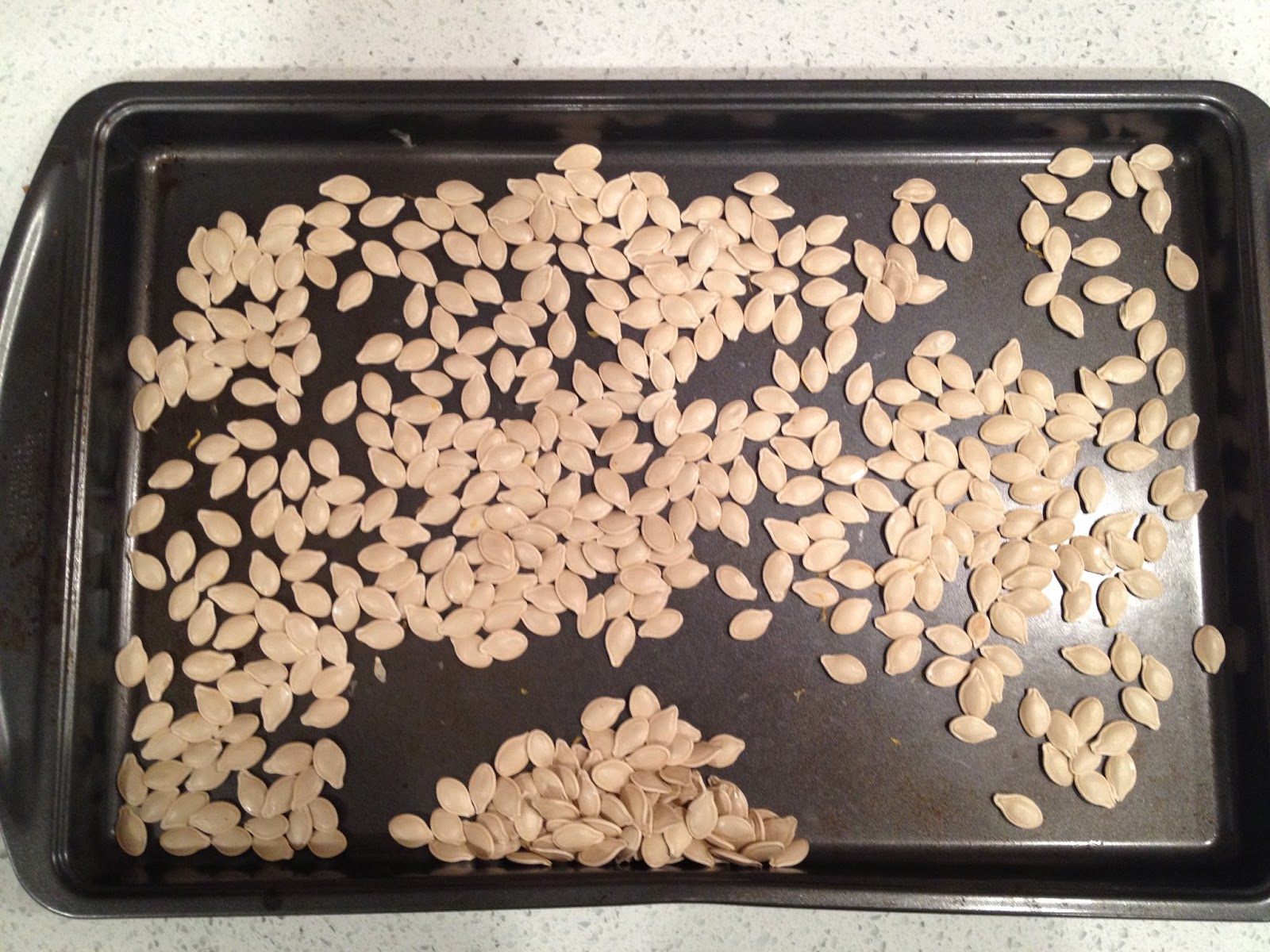
His pile actually makes sense to me and definitely looks close to 100, give or take. Now that we've made a pile of his "one hundred" seeds. I ask:
Me: How many piles of 100 seeds do you think we can get?
I see he's a little confused by my question, so I ask it differently.
Me: How many piles do you think we could make where each pile has 100 seeds?
He starts to think, but by this time, my almost two year-old daughter sees the pan of seeds is now at her level, so she comes running over and wants in on the action of moving seeds. I thought our conversation was derailed as I brought the pan back up to counter height. But my son keeps it going. He didn't necessarily attempt to answer my question (which is fine by me). He took it in a different, pleasantly unexpected direction:
Son: What if we could get 10 piles?
Me: Do you mean ten piles of one hundred?
Son: Yes!
Me: Are you asking me how many seeds we would have if we had ten piles of 100?
Son: Yes.
This blew me away. Where'd this come from?
Me: Well, ten piles of one hundred seeds would mean we have a thousand seeds.
Son: A thousand??!!
Me: Yes.
Son: What if we had twenty?
Me: Twenty piles of 100 seeds?
Son: Yes.
Me: Well, what two numbers make twenty? Ten and...
Son: Ten!
Me: Right. So if ten piles make a thousand and another ten piles make a thousand, we would now have two th...
Son: ...ousand! 
Me: Right.
Son: What's 100 piles? 
Me: You mean, what's one hundred piles of one hundred? 
Son: Yea.
Me: That would be ten thousand.
My wife chimes in.
Wife: No. 
Me: One hundred piles of one hundred? Ten thousand.
Wife: Wait. You're right.
And our kids are now off in the other room playing and getting ready for going outside and looking at Halloween decorations before trick or treating. So many cool things happened:
  1. I love how we pursued my son's questions and not mine. 
  2. I love that he was fascinated by the word "thousand" even if it didn't make sense.
    1. Because he thinks a "hundred" is big.
  3. I love how we started with actual seeds (concrete) and went way more abstract.
  4. I love how my wife had the best estimate in the house [375 seeds].
  5. I love how the "pumpkin seeds" estimation challenge is just large enough so you can't accurately eyeball the amount and it's just small enough where it wouldn't take me an absurd amount of time to accurately count.
My wife and son watched the video answer this morning. My wife's response:
This is perfect for my [1st grade] students!

We paused the video when we saw ten groups of ten and paused it again when I made a larger pile of one hundred seeds. He struggled with making sense of final amount. 
Me: How would you say that number?
Son: Forty-eight eight? 
Me: How many piles of one hundred are there? 
Son: Four.
Me: So we say "four hundred" and let's count the piles of ten together. Ten, twenty,..
Together: thirty, forty, fifty, sixty, seventy, eighty,  
Me: And. Wait. There are only eight in this last group. So we say eighty-eight. Four hundred eighty eight. Say that.
Son: Four hundred eighty eight.
Me: Great. Let's go make breakfast.
Here's the recipe again and some pictures of the process.
Seasonings!
Ready for the oven.
Roasted and ready to eat!
Seeds,
225

P.S. Thanks to Christopher Danielson and all he does at #tmwyk!

Number Sense Conversations

I've put the elevator speeches to rest. Today's two minute speech went well... I think. As one event concludes, I'm excited to resume my ongoing thoughts about number sense and students.

Working with teachers and students, I can't help but be inundated with thoughts about things I miss, look forward to, and will be challenged with this year in and out of the classroom. However, there's one thing I crave more than anything else, and that's working with students, which usually entails having number sense conversations with students.

Today, I had rich number sense conversations with students in Math 7, Math 8, and high school Algebra classes. As I sit here and put the finishing touches on the slides for my upcoming conference workshop, Get Students to Argue in Class With Number Sense Activities, I can't put to words how valuable it is to allow students to talk about math in math class. That's an oversimplification, but we seriously need to provide our students with opportunities to talk to each other, even argue with each other. Mathematical Practice 3:
Construct viable arguments and critique the reasoning of others.
Steve Leinwand sums it up best:
These nine words may be the most important words in the entire Common Core effort. 
Last December at CMC North, I was honored to give an Ignite talk about something I'm passionate about: number sense and student conversations. It's titled: Number Sense: I Don't Like This Game Anymore.


Students are hungry for number sense conversations in math class. I really do believe. If you don't believe me, just put up this picture in your class and ask your students, "How long would it take to use all of that?" Then ask them to convince you of their conclusion.

As October quickly approaches, I look forward to seeing you at an upcoming conference this school year. In the meantime, I hope to post more about number sense.

Number Sense,
1005

Estimation 180 Gear

They're here! Estimation 180 t-shirts and stickers! Yes, I'm excited.

Estimation 180 was born out of my love for number sense and visual mathematics. In addition, it was important I help my students develop better number sense and see the world of mathematics in a different way. Little did I know, the site would make its way into classrooms across the United States, Canada, and other parts of the world. Thank you all for tweeting or emailing your experiences as I find it so cool that students are exploring number sense in your classroom and having mathematical conversations, sometimes even constructive arguments.

It makes my math heart full of joy to see other teachers do amazing things with Estimation 180 and beyond. Please make some time to check out blogs like Joe Schwartz, Jonathan Claydon, Mary Bourassa, and Megan Schmidt who are just a FEW of the teachers taking the idea and running with it. Teachers like MichaelHedge, DanRobert, John, Matt, and others spread the Estimation 180 love when doing teacher trainings or presentations. I couldn't be more appreciative and grateful. Thank you! Chris Harris even shared some bacon estimations to a roomful of parents one weekend.  I love how the site has become an instrument to help teachers create a classroom of curiosity with students, building number sense along the way. In addition to daily estimation challenges, the site has many of the lessons I've developed over the past few years.

These shirts are just another extension of my passion for number sense. As I present at conferences and give teacher trainings, I'm excited to give away some t-shirts to attendees nailing estimation challenges built into my workshops. Likewise, stickers are available for you to stick some number sense in your favorite place. This is how I roll!

I'm not in this to make money. This is more of a hobby to go along with the site. I would be eternally grateful if you decide to buy shirts and stickers and spread the Estimation 180 love. Head over to the Estimation 180 store and check out the shirts, their sizes, and how easy it is to order.

Nuts and Bolts:
If you're interested, I think it'd be good to be transparent on the nuts and bolts behind the t-shirts and stickers. If you're not interested in the nuts and bolts behind the t-shirts, skip the rest of this post and check out the t-shirts and stickers.

No outside party is financially backing Estimation 180. AND I don't plan on charging for using the site, ever! Therefore, I have done everything I can think of to make these shirts as affordable as possible, because I'm not in this to make money. Any money made from shirts and stickers would go back toward web costs associated with Estimation 180 and the free t-shirts and stickers I would pass out at conferences. As you can imagine, it's been one huge math task keeping track of expenses in order to set reasonable price points for the t-shirts and stickers so that teachers can afford them.

$20 for a shirt gets you a lot! You get a high-quality shirt for one. This price also includes tax and shipping. It also looks like I can throw in a sticker with each t-shirt order. Sweet! This $20 also goes toward the cost of the blank shirt, printing, mailing envelopes, and labels (mailing and return).

$2.50 gets you a high-quality sticker. This covers the cost of getting the sticker made, the envelope, labels, and postage. Of course, if you order two or three stickers, it's a better deal.

*Important note: my buddy Johnny from Speysyde was in charge of printing the t-shirts and he did a fantastic job! Please cruise by his site. It's all about the sustainable lifestyle:
Our mission is simple. To spread awareness and advocate an eco & social sustainable lifestyle through the creative collaboration of culture, music, sport, art, adventure & travel.
I declined using some of the premium web store features my host offers, such as shipping calculators, tax calculators, and other premium web store features. This drastically keeps the cost of the shirts at $20. For each purchase and transaction, Stripe takes a small percentage from my side. There is no additional cost to you. Their service, similar to PayPal, makes each transaction secure, safe, and easy.

I think you'll truly enjoy your shirt. I am!

Gear,
1047

Barbie Zip Line

Inspiration from Matt, John, and Jedidiah helped me shape my Barbie Zip Line task today. Whenever I prepare new tasks for my students, I have been trying to keep mathematical modeling, student ownership/creativity, performance tasks, and openness in the back of my mind. That's a lot, right? Plus, there's a hundred other little things, but let's focus on the list above. As I reflect on today, I'll share how I would improve this for next time.

Supplies (in order of attachment):
  • Barbie doll, or an action figure like G.I. Joe, Superman, or Captain America
  • Velcro: One-wrap (don't get Sticky Back)
  • Carabiners
  • Swivel Spring Snap (optional)
  • Fixed Pulley
  • Rope (thin enough to fit through the pulley)
My first piece of advice after learning from today: don't skimp on the pulley system. I made two and I should have made (bought) more. I would spend the money and have enough pulley systems for the number of groups you plan on having. Second, you could connect the pulley straight to the carabiner and avoid using (buying) the swivel spring. Third, velcro (harness) is the best way to quickly attach your pulley system to the zip line rider.

Buy enough rope so that you can have lengths that are 10 feet apart. In other words, have different rope lengths: 30 ft., 40 ft., 50 ft., 60 ft., etc. This will play well into the mathematical modeling part of the task (see below). It will also help make it easier to get the pulley systems on and off of the zip line. Solving the task yourself will also help determine the rope lengths you'll need for your school site.

The task (handouts found here):
Depending where (and who) you teach, some students have been zip-lining before. Ask! It never hurts. Maybe they can share their experience. Plus, this gives you a chance, at some point (if you feel necessary), to talk about how they're sitting in front of you, ALIVE, because someone was able to do some solid math and build a sound enough structure for them to zip line on. Just sayin'.

I low-balled my students today on their budget. I should have raised it to $2500 or $3000. Figure out what will work for your site. However, this mistake allowed me to give some early finishers an extension: find a more reasonable starting budget.

Here are the opening costs of your zip line company:
Students had to receive approval from their Summer Academy principal by showing their designs. I highly encourage this move. Students see someone else taking a vested interest in their learning. The principal gets an informal glimpse of your classroom. And students have to be prepared to explain the math and their problem-solving approach. If your principal is unavailable, get someone else: teacher, custodian, campus security, etc. It could be you, but you're already doing the formative approval (assessment) in class.

All these prices can change depending on your tastes. I included a liability insurance just for fun. The materials for the harness and pulley system need to be of high quality, so don't make them cheap. $50 might have been too cheap. The most important material is the steel cable (rope). This will help create multiple solution strategies. It's beautiful. Overall, I was pleased with my price points.
I found that having students create three rides is essential to this task. At least three rides. Sometimes tasks generate such a strong focus on the ONE CORRECT WAY to construct an answer or problem-solve. This adds pressure and can rob students of discovering mistakes or playing around with numbers. By creating separate zip lines for both certain death and boredom (getting stuck), it does many beautiful things.

Students innately know what type of zip line would kill barbie: a steep zip line. They can sketch that on their whiteboard, no problem. On the flip side, students have a good understanding of a boring zip line: practically a horizontal line. They can also sketch that on their whiteboard. Both sketches can be done without using numbers, formulas, or mathematical notation. It creates an entry point for all students. So here's what they had to say:
Leyla: We have a chance to see what not to do.
Trevor: It reminds me of when we do Estimation [180] and you ask us to give a too low and too high. It helps us find a reasonable number in the middle.
Deena: It shows us what a wrong answer or zip line would be.
Students were able to draw steep zip lines, label the height 20 feet, guess the ground distance to be about 5 or 10 feet, and use the Pythagorean Theorem to calculate the length of the cable (hypotenuse).
Mathematical Modeling and Multiple Solutions:
Students were able to design their own zip line by playing around with the numbers between their certain-death zip line and boring zip line. I told them to dream big on the whiteboards as if money wasn't a factor right now. Most did. Most.

I had a couple groups first figure out the cost of all the materials ($700) and subtract it from the $1500 budget, giving their group $800 to spend on cable. With $20/foot, they could use 40 feet of cable for their zip line. They identified the height and the hypotenuse of the right triangle. Impressive.

One of these two groups felt this wasn't enough cable and it was still too steep. Michelle had been zip-lining in real life so she knew. This was my mistake, but it turned into an opportunity for me to extend this task. I asked them to create a new budget for me so the cable was longer, but within reason. If you need more of an extension, have them come up with a formula to determine the amount of cable and distance on the ground, given a specific amount of money.

Before they could go outside and test their zip line, students had to complete this list:
I had students transfer their work to their graph paper composition books before they took it to the principal. I'll insert some pictures:

Here's the permit:

It was a blast! Students loved it. Here's another extension:
Have students design a system that gets the pulleys and/or dolls back up to the top of the zip line.

[insert video here]

By the way, I did teach the Pythagorean Theorem in there somewhere. Where? You might ask. I don't remember: ALL throughout the task. Use discretion. Some students need it first. Some need it after you've let them mess around on the whiteboards.

Zip,
1152

Fun With A Name Tent

As I ask my new students to make a name tent with an 8.5" x 11" sheet of paper on the first day of Summer Academy, I think, "Let's have a little competition." This wasn't in my lesson plan. Ha!

If you haven't noticed, I have become obsessed with classroom competitions. Here are two posts in case you missed them:
Fun With A Dot and A Line
Fun With A Sticky

Therefore, I'm adding today's post of Fun With A Name Tent to the "Fun With A" series. A name tent looks like this:

I use name tents for teacher trainings or on the first week of class with students so I can quickly learn their names. Right as I tell my new students to make a name tent, I announce, "Let's see who can fold their name tent into the best thirds?"

Game on!

If you have read (or remember) my two posts from above, you know this activity will go something like this:

  • Students get time to create their best thirds.
  • Students decide in their group (of four) who has the best name tent.
  • Students vote (whole group) by eyeballing the tents and make a prioritized list. 
  • Students define how we decide the best thirds.
  • Students define what to measure.

Here are some whiteboard shots of my lazy writing as I quickly jot down what students say. It's fascinating.

I handed each group a name tent that was in the running for the best thirds. Some groups used inches and some groups used centimeters to measure.

I didn't care nor tell them what unit of measurement to use. I walked around and questioned which unit of measurement they were using and asked them to explain why they chose that specific unit of measurement. We later had a discussion (almost arguments) about which made more sense for this task. Most students eventually were convinced by their peers that centimeters would be more accurate here. My second class had two tents that were extremely close, but couldn't tell which was better:

We had to compare 0.5 centimeters to 0.25 inches to see who had the smallest error, Leyla or Srihitha? It was awesome! We had to decide if we wanted to convert the inches to centimeters or vice versa. You can see that Leyla won by 0.135 centimeters. DANG! Those are some good folds.

Next, I introduced them to Estimation 180 by estimating my height. They'll be keeping track of their estimates in their compositions books.

My favorite part was this exchange:
Brianna: Will you tell us your height?
Me: No.
Brianna: What?
Class (disappointed): Ohhhhh!
Brianna: That's not fair. Then why are we doing all this work?
Me: I understand. I said I'm not telling you my height.
And then BAM! I take out my measuring tape!
Me: Brianna, stand on your desk chair and you can measure how tall I am.
Brianna: Oh, cool! 
We proceed to estimate my wife's height and then we estimate the TOTAL height of the class. This was fun. I asked, "What would be useful to know and how would we go about getting it?" borrowed from Dan.

My favorite was Mansi. She suggested that we multiply the number of students (20) by 5 feet since most students were about 5 feet tall. Then we add or subtract the difference of each student's height in relationship to 5 feet. We started a Mansi column in our Google spreadsheet. This would make for a pretty cool lesson on integers.

Before we went outside, I had the students get in order from what they thought was shortest to tallest. If you keep track of the data in a spreadsheet, use the spreadsheet to verify their order: another great tool from a spreadsheet.

With this organized data, you could do a lesson on mean, median, mode, and range. Even mean absolute deviation if you're up to it. Another great part was Dylan noticing a student was absent today. "We don't know the height of the kid who isn't here today."

You could take this task and apply the mean or the mode. Have students predict the height of the absent kid. Furthermore, you could segue into probability if you like. What are the chances the absent kid is the mean height? the mode height?

How sweet of my first class, they wanted to include my height in the total height. We went outside and looked for an area long enough to fit our calculated total height of approximately 103 feet.

We went a little bit past 103 feet because some students were considerate enough to avoid placing their feet next to someone else's head. The dismissal time was rapidly approaching so I let it slide. One clap on three for Reese. She had the closest estimate of 102 feet.

One. Two. Three.

CLAP!

Thirds,
1050

A Few Updates

Update 1:
I finally finished Act 3 for my Deodorant lesson. I hope you check it out and can give me some feedback; I think it could be much better with your help. If nothing else, check out how long it took to use 5 sticks of deodorant. Mathematical Modeling should really be at the forefront of this task. It might appear linear, but I would bet a year's supply of deodorant that an adolescent's deodorant use will be far different than mine. I also guarantee students will think of variables ranging from climate to age to geographical location to genetics to more. I think you'll have some excellent conversations with the deodorant task. My favorite part is the sequel: How many sticks of deodorant would one use in a lifetime?

Way back when this task first started, I opened up a little estimation competition in the comments at 101qs. Don't listen to a word Nathan Kraft says. The person with the closest guess would win an Estimation 180 prize. With so many close estimates, the following gentlemen will be the first to receive the new Estimation 180 stickers, hot off the press!

Congratulations to:
1st place: Chris Robinson (May 14, 2014)
2nd place: Robert Kaplinsky (May 5, 2014)
2nd place: Michael Fenton (May 15, 2014)
3rd place: James Cleveland (May 3, 2014)

Update 2:
Estimation 180 will be getting a facelift and other updates over the summer. Here are a few things to look out for:
  • New logo
  • New fields for entering student estimates
  • Clean spreadsheets containing "other estimates"
  • Updated Lessons
  • Search by Categories
  • Sentence frames for student reasoning
I'm most excited about the last update; sentence frames. I occasionally browse over student responses and notice many students entered "I guessed." I think it would be extremely helpful for teachers to provide their students with sentence frames in order to better articulate their reasoning. I will be focusing on this tool in upcoming presentations and workshops.

The new logo was done by my niece. I love her simple design, the two 180 degree arrows, the metric reference, and her idea to transform me into a stick man. That reminds me, I still owe her a pizza!

I hope to get a few t-shirts made too. You can sport them at your next PLC, department meeting, casual Friday, or math conference. Any takers?

Update 3:
I've accepted a Teacher On Special Assignment (TOSA) position with my district for next year. It's a bittersweet feeling at this point. On one hand, I'm very excited because I'll be working at various secondary sites throughout my district, collaborating with other math teachers, helping design lessons and implementing various technology. My official title will be a Digital Learning Coach. I hope to seek advice from people like John Stevens, who have been doing this for some time now. As I pack up my room, I already miss my own classroom and students. However, I look forward to learning a great deal from the teachers I will be fortunate to work with and the students I'll be able to interact with at each site.

Updates,
243

Get Students to Argue in Math Class

I recently submitted my speaker proposals for both 2014 CMC conferences. One of my proposals is for the following session:
Title: "Get Students Arguing in Math Class with Number Sense Activities."
Description: Get students to productively argue about math situations. Participate in number sense activities requiring students to construct viable arguments, critique the reasoning of others, and use sense-making. Get ready to throw down.

I also had to answer a few questions justifying the session and connecting it to the CCSS and 8 Mathematical Practices. I provided the following connection:
The presenter will use number sense activities to get participants to construct viable arguments and share their reasoning like students. Using presenter-made tasks (Estimation 180) and other online resources appropriate for grades 3-8, attendees will be able to see the importance of student reasoning and creating productive discourse in the classroom. Teachers will also be provided with sentence frames and stems for all students, especially English language learners.

I'm really excited at the thought of this session getting accepted so I figured I would jot down a few ideas here and see what you all have to contribute. Even if I'm not accepted, I think every math class has to have students productively arguing at times. Doing estimation challenges with my students has been so beneficial for them to get better at the art of arguing. However, I know it could be better. I'm not sure if you've ever experienced it before, but it's a treat to stand off to the side or in back of a group of students arguing about a question in math. They have no idea you're nearby because they are so caught up in the argument. Don't get me wrong, it's not like they're swearing at each other and calling each other names. They are having a rich discussion, sharing conjectures, examples, counterexamples, etc. and I have the pleasure of spectating. I usually turn to an innocent bystander (nearby student) and whisper, "Awesome, look at them arguing. Isn't it great?" The student usually looks shocked that I'm happy their classmates are arguing. I love it!

I'd like this session to place a big emphasis on two mathematical practices:
MP 3: Construct viable arguments and critique the reasoning of others.
MP 1: Make sense of problems and persevere in solving them.

I plan to break these two practices down more in my session. For now, I feel I need to focus on three major parts to arguments: having excellent content, capturing the arguments, and indirect facilitation.

Content: There's a wealth of content available, but I think the more controversial the point of contention, the better. One of my favorite moments in math class was when we did Mathalicious' Datelines lesson. Students were arguing about which celebrity shouldn't date another celebrity because of the age discrepancy. Some students disagreed about the rule of (n/2) + 7, especially since I was teaching 14 year-olds at the time. It was awesome.
Here's my current list of resources that have given my students great things to argue about:
My kids went nuts arguing about a similar question to this "Would You Rather" found here.

These don't have to be full-on lessons. They can be warm-ups, math talks, used during classroom transitions or to break up your direct instruction, etc. I'm really looking forward to using @MathCurmudgeon's site MathArguments180.com
Imagine your students arguing about which student should pack your parachute based on this data.
Another up and coming resource is Open Middle by Robert Kaplinsky and Nanette Johnson.

What resources would you add to my content list?

Capture: I need to capture these arguments for a few reasons. Students need to listen to other students argue, especially from different classes. My memory is very porous, and I can't remember what students say verbatim. Students can listen to the recordings and pick a side, or provide their own agreement or dissent. I'd also love to share student arguments with other teachers, especially at this session. How do I capture this?

I just downloaded Voice Memos for iPad onto my school iPad. I will test it out next week with students. Wish me luck. Here are the features I'm optimistic about:
  • It will record in the background while another app is running.
  • It was $1.
  • I can pause the recording.
  • I can trim audio clips.
  • I can sync with Dropbox.
Have any tips for capturing student arguments?

Facilitation: Here's where I need to do a better job. For many of my students, English can get in the way of them articulating their point. I'd like for students to listen better to each other and respond accordingly. I want to hear what they have to say. I want them to be a contender in their disagreement, but I don't want them to be held back because of language deficiencies. Therefore, I need to provide them with sentence starters and stems. Fortunately, these can be used with any student. Here's a few:
  • My opinion about this is _____________.
  • I could argue that _____________.
  • I disagree with your statement that _____________ because _____________.
Have any stems or sentence frames you're already using with students to help them articulate their thoughts?

Argue,
339

NCSM 2014 Day 1

Day 1 of NCSM was yesterday and here’s something I found interesting. Robert Kaplinsky, Dave Chamberlain, and I were walking back to our hotel room from the conference and I saw this clearance sign to the entrance of our hotel. I have been known to do estimation challenges before with clearance heights, not once, but twice.


I thought to myself, "There's NO WAY that thing is 6 foot 4 inches!"

I walked up to it and thought I should hit my head. Nope.

Okay, I’ll stand on my toes. Nope.


Okay, what’s going on here?
Why is this mislabeled? What’s your theory?

I’ll admit, this made me a little suspicious of the other clearance height challenges I’ve captured. Is this worthy of Estimation 180?

Photo bomb!

Suspect,
852

180 Ways to Use Estimation 180

New challenge: Find 180 ways to use Estimation 180. Wait a minute. That's seems a little extreme, yet I still love the idea. Here's one use I came up with this week: inequalities.  Click on any picture to enlarge.
Me: Hey guys, here's a piece of paper. Fold it into fourths for me like this.
Me: Great. Now, who remembers how tall I am?
I know, silly question, right? If these guys don't know my height by now, I'll send them back a few grades. Then I show them this picture and ask: What's the height of Mrs. Stadel compared to Mr. Stadel?
I take about 4-6 guesses and write them on the whiteboard. It’s been awhile since we’ve done this specific estimation challenge in class. Many have forgotten my wife’s height. Great! However, it’s quite obvious her height is less than mine.
Me: Let me step back. Let’s all look at these guesses. Is it safe to say that all of your guesses put her height less than mine?
Class: Yes.
Me: Okay, so before I reveal the answer let’s put this in our notes for today.
Me: Before I reveal the answer, who can remind me why we used an open circle?
Student: Because we know her height is not the same as yours.
Reveal Mrs. Stadel's height. Wait for it... Wait for it... Here it comes... Student responses: 
“Yes, I was right!” 
“Ohh, I was close.”
“Ohh, I was off by an inch.”

Next up, our beloved Mr. Meyer.

“Woah! He’s tall!”
“Someone is actually taller than you, Mr. Stadel?”

Again, toss 4-6 guesses up on the whiteboardStep back. What do we notice? Yes, all the guesses should be greater than my height.

Walk through the notes on this new section with more student confidence and participation.
Ask students:
  • What type of circle should we use this time?
  • If we’re talking about guesses that are greater than my height, how will that affect the inequality symbol?
  • What are ways to remember this inequality as greater than?
  • Which direction will we shade now?
  • Someone give me a variable we can use for Mr. Meyer's height.

Reveal answer. Same responses as my wife, but usually a different kid was right this time.

Okay, great. Now what? What about those other two inequalities, right?
Me: Before I show you this next picture, last year the 6th grade English teacher (@mrkubasek) at my old school read this novel with his students and came across these two books he found interesting. I found it interesting too and took a picture so we could talk about it in math.
Show picture.
Me: How many pages in the book on the LEFT?

No need to write anything down. Just get 6-8 guesses out loud. Don’t spend much time here. Reveal the answer. Give some math love [one clap on three: 1, 2, 3, CLAP!] to the closest student. Seriously, it’s pure gut instinct here people.  

NOW, show this picture and ask how many pages in the book on the RIGHT.

They don't know it yet, but you just broke their brains for a bit. Yup, you’ll get a lot of guesses below 307. But wait for it. I guarantee in a class of 35-40 students like mine, one student will say 307. If you do, treat it like every other guess you've gotten.
...and if no one guesses 307, step back after about 6-8 guesses and...
Me: You know all of your guesses make sense to me. I'm curious though guys. This is the same novel here, right? What if? I mean, WHAT IF? What if these books had the same amount of pages? Do you think that's possible? Do I have your permission to add it to your guesses?
Step back again. Look at all those beautiful guesses. 
Me: So if I'm looking at this right, you guys think the number of pages could be equal to 307, or could be less than 307? I wonder how we could represent this mathematically?
BAM! Focus here on the circle. Why are we shading it in this time? What's up with that line under the less than inequality?
Me: Okay, before I reveal the answer, someone remind me why we shaded in the circle. 
Reveal!
Brains broken! Now repair. 
Me: What's up with that? Anyone have any ideas/theories why they have the same amount of pages?
Alright. That fourth and final inequality. Here are the goods. Repeat all the other moves from above. 
Initial guess of one bar.
Take some guesses out loud. Reveal the answer.
Toss up new picture.

Write down some guesses on the board. Play up the "what if" again. Complete the notes. Ask a few questions before revealing the answer.
BAM!

That was fun. Boy, I wish it didn't have to end. But it did. Okay, let's find other ways to use Estimation 180 in the curriculum. The full lesson will soon be is available on the lessons page at Estimation 180.

180 ways,
957