Showing posts with label Problem Solving. Show all posts

Barbie Zip Line

Inspiration from Matt, John, and Jedidiah helped me shape my Barbie Zip Line task today. Whenever I prepare new tasks for my students, I have been trying to keep mathematical modeling, student ownership/creativity, performance tasks, and openness in the back of my mind. That's a lot, right? Plus, there's a hundred other little things, but let's focus on the list above. As I reflect on today, I'll share how I would improve this for next time.

Supplies (in order of attachment):
  • Barbie doll, or an action figure like G.I. Joe, Superman, or Captain America
  • Velcro: One-wrap (don't get Sticky Back)
  • Carabiners
  • Swivel Spring Snap (optional)
  • Fixed Pulley
  • Rope (thin enough to fit through the pulley)
My first piece of advice after learning from today: don't skimp on the pulley system. I made two and I should have made (bought) more. I would spend the money and have enough pulley systems for the number of groups you plan on having. Second, you could connect the pulley straight to the carabiner and avoid using (buying) the swivel spring. Third, velcro (harness) is the best way to quickly attach your pulley system to the zip line rider.

Buy enough rope so that you can have lengths that are 10 feet apart. In other words, have different rope lengths: 30 ft., 40 ft., 50 ft., 60 ft., etc. This will play well into the mathematical modeling part of the task (see below). It will also help make it easier to get the pulley systems on and off of the zip line. Solving the task yourself will also help determine the rope lengths you'll need for your school site.

The task (handouts found here):
Depending where (and who) you teach, some students have been zip-lining before. Ask! It never hurts. Maybe they can share their experience. Plus, this gives you a chance, at some point (if you feel necessary), to talk about how they're sitting in front of you, ALIVE, because someone was able to do some solid math and build a sound enough structure for them to zip line on. Just sayin'.

I low-balled my students today on their budget. I should have raised it to $2500 or $3000. Figure out what will work for your site. However, this mistake allowed me to give some early finishers an extension: find a more reasonable starting budget.

Here are the opening costs of your zip line company:
Students had to receive approval from their Summer Academy principal by showing their designs. I highly encourage this move. Students see someone else taking a vested interest in their learning. The principal gets an informal glimpse of your classroom. And students have to be prepared to explain the math and their problem-solving approach. If your principal is unavailable, get someone else: teacher, custodian, campus security, etc. It could be you, but you're already doing the formative approval (assessment) in class.

All these prices can change depending on your tastes. I included a liability insurance just for fun. The materials for the harness and pulley system need to be of high quality, so don't make them cheap. $50 might have been too cheap. The most important material is the steel cable (rope). This will help create multiple solution strategies. It's beautiful. Overall, I was pleased with my price points.
I found that having students create three rides is essential to this task. At least three rides. Sometimes tasks generate such a strong focus on the ONE CORRECT WAY to construct an answer or problem-solve. This adds pressure and can rob students of discovering mistakes or playing around with numbers. By creating separate zip lines for both certain death and boredom (getting stuck), it does many beautiful things.

Students innately know what type of zip line would kill barbie: a steep zip line. They can sketch that on their whiteboard, no problem. On the flip side, students have a good understanding of a boring zip line: practically a horizontal line. They can also sketch that on their whiteboard. Both sketches can be done without using numbers, formulas, or mathematical notation. It creates an entry point for all students. So here's what they had to say:
Leyla: We have a chance to see what not to do.
Trevor: It reminds me of when we do Estimation [180] and you ask us to give a too low and too high. It helps us find a reasonable number in the middle.
Deena: It shows us what a wrong answer or zip line would be.
Students were able to draw steep zip lines, label the height 20 feet, guess the ground distance to be about 5 or 10 feet, and use the Pythagorean Theorem to calculate the length of the cable (hypotenuse).
Mathematical Modeling and Multiple Solutions:
Students were able to design their own zip line by playing around with the numbers between their certain-death zip line and boring zip line. I told them to dream big on the whiteboards as if money wasn't a factor right now. Most did. Most.

I had a couple groups first figure out the cost of all the materials ($700) and subtract it from the $1500 budget, giving their group $800 to spend on cable. With $20/foot, they could use 40 feet of cable for their zip line. They identified the height and the hypotenuse of the right triangle. Impressive.

One of these two groups felt this wasn't enough cable and it was still too steep. Michelle had been zip-lining in real life so she knew. This was my mistake, but it turned into an opportunity for me to extend this task. I asked them to create a new budget for me so the cable was longer, but within reason. If you need more of an extension, have them come up with a formula to determine the amount of cable and distance on the ground, given a specific amount of money.

Before they could go outside and test their zip line, students had to complete this list:
I had students transfer their work to their graph paper composition books before they took it to the principal. I'll insert some pictures:

Here's the permit:

It was a blast! Students loved it. Here's another extension:
Have students design a system that gets the pulleys and/or dolls back up to the top of the zip line.

[insert video here]

By the way, I did teach the Pythagorean Theorem in there somewhere. Where? You might ask. I don't remember: ALL throughout the task. Use discretion. Some students need it first. Some need it after you've let them mess around on the whiteboards.

Zip,
1152

Explain that, please.

Recently, I've given a few teacher workshops/conferences and have had the luxury of reflecting on teacher moves as I facilitate a lesson with the attendees. One of the many things we talk about are teacher responses to students.
Me: Did anyone hear me say, "No. That's wrong. You're wrong. I don't like your answer."
Attendees: No.
Me: Right. Instead, you'll hear me say things like, "Can you explain what you did here? Explain that, please. I noticed you did [this] here, please share how you got [that]. I'm curious how you came up with that. Walk me through what you did."  
I tell teachers that I'm taking the emphasis away from right versus wrong answers and placing an interest on the student's thought process and problem-solving. I continue with teachers:
Me: By telling a student they're wrong, a student can have the tendency to shutdown [I make the sound effect of a machine shutting down, "BOOOOvvvvvvvv"]. By asking a student to explain things, it shows that I'm more interested in how they arrived at their answer. 
As teachers, we know a student can be told they're wrong and it's easy for them to give up. On the flip side, when we validate a kid by telling them they're right, the student can also shut down and never reach the higher levels of Depth of Knowledge.

Recently, a workshop attendee asked me how I respond to students who have nailed the answer to a 3 Act task. First, I have them explain their problem-solving plan to me. Second, I question any details that were unclear, encourage them to be more precise, or have them explain their units of measurement. Third, I ask them if they feel confident in their answer after explaining it to me. Fourth, I validate them by simply saying, "That makes sense to me."

I don't tell them they're correct. I treat them just like as if they got the answer wrong. If that doesn't satisfy them, I respond with, "We'll find out soon if you're correct, but that (their explanation and work) makes sense to me." At this point, I offer them an extension to the task. I'd like to talk more about this later, but usually the extension revolves around the students creating something with the new knowledge or skills they have just recently gained.

After all that, please add your favorite lines when questioning students to this Google doc. I think it's also helpful we create a list of lines we avoid using with students as they explore math.

Here are a few people with other stellar teacher moves/lines to support students.
Max Ray: 26 Questions You Can Ask Instead
Dan Meyer: You Don't Have To Be The Answer Key
David Cox: Creating A Culture Of Questions
Steve Leinwand: Accessible Mathematics

BOOOOvvvvvvvv,
645

Piles of Tiles

I was at my parents' house for Christmas and came across this game (older than me) in a closet full of board games. Made by The Cootie Company back in the 70's, I give you Op Tile.

There's a lot going on here; game boards, tiles, dice, cards, bell-bottoms, shag carpeting. Instead of typing up the directions, amuse yourself with these:

The tiles look like plastic jello. 

The cards offer some opportunities for strategy throughout the game.

There are many things I like about this game, even though I have never played it. I like the spatial reasoning component, the challenge of placing tiles depending on what you roll with the dice (and the order in which you have to place them), and the demand for strategy that the cards present. I didn't like reading through all the directions to discover all the nuances. Some parts of the game are not intuitive. However, I really like what is intuitive: placing the tiles on your game board in the best way possible to cover the most area (square units) of the game board earning the most amount of points.

I brought the box home to create some adaptations for my students. Here's phase 1: Piles of Tiles. Having recently blogged about weekly POPS, Piles of Tiles will become an additional option for the first P (Patterns/Puzzles) in POPS. In phase 1, I'd like my students to play around with the Piles of Tiles puzzle like this:

I'll pass out this sheet (maybe two) to students and have them cut out all of the figures. They can keep their cut-outs in a plastic sandwich bag.

The student game board will look like this. 

Students can use their cut-outs to fill the 12x12 board with the specific tiles, found in the table at the bottom of the page. Once they have their solution, they can outline each figure within the game board and specify which section refers to figure A, B, C, and so on. They can use colored pencil or crayons to keep each similar figure the same color. For you detailed people, I made the grid so it prints each square unit as 1 cm by 1 cm. Therefore, you get a total of 144 square centimeters. AWESOME!

Students can stay organized and also submit the following to me:

All the Piles of Tiles goods (blank templates) can be found in my weekly POPS folder.

My goals (right now) are to get students to:

  • manipulate shapes through rotations and translations
  • build their spatial reasoning
  • recognize there are multiple solutions
  • organize their data
  • have a better understanding of area

I'm open to suggestions or feedback, so please let me know.

Since we're on the topic of puzzles, ThinkFun has some great puzzles (as I've mentioned before). Go over to their site and check out these Big Games group activities to use with students. Many of the activities are puzzles you might have seen on paper somewhere, but they rewrote them as group activities to foster collaboration, spatial reasoning, and problem-solving amongst students.

Piles of Tiles,
1032


Weekly POPS

Have you ever tossed a puzzle at one of your students? Y'know, the puzzles kids can play around with using their hands and minds? It's crazy, right?! It's fascinating to watch a student display a wide range of behaviors: curiosity, engagement, perseverance, frustration, and an earnest desire to know the solution if they get fatigued and stumped. I have a couple bins full of puzzles in my classrooms that do this to kids. Students rarely have a chance to play with them, but when they do, they go bonkers in a good way. Occasionally, you'll hear a triumphant yell when someone solves a puzzle. Other students look in disbelief. It's hilarious. My collection of puzzles ranges from the Bedlam Cube (now known as Crazee Cube), to Cannonball Pyramids, to the Rubik's Cube, to Tangrams, to ThinkFun puzzles, to other miscellaneous puzzles I've picked up over the years. A few weeks ago, I was driving home and wanted to know if there was something I could do in math that had a similar magical effect on kids.

Have you ever tossed a puzzle at one of your students? The ones on paper that require logic and critical thinking? Those are crazy too! Kids can really get into them. Around the same time I was thinking about the power of physical puzzles, my school wanted to revamp our weekly intervention/study-hall period. I thought students could benefit from working on logic puzzles, patterns, or Get to Ten. I went to a resource called The Colossal Book of Short Puzzles and Problems by Martin Gardner in which Fawn recommended. I came across this Billiard Balls gem in which I remade for my students:

So I got to thinking and thought of some inspirational people/things from my PLN. I've always wanted to incorporate Fawn's Visual Patterns into my classroom more, especially with it's beautiful new makeover. Fawn is also known for her weekly problem-solving tasks. I've also wanted to incorporate more PoWs from the Math Forum. The Math Forum has an abundance of problem-solving tasks that range in difficulty across grade levels. Sign up, yo! Last but not least, Dan Meyer had impeccable timing and recently wrote a very invigorating post on [Fake World] Conjectures that has created quite the buzz in the comments. Personally, he struck a chord with me as he ended it saying:
Find those puzzles in the real world, the fake world, the job world, or any other world - it doesn't matter.
His post and quote made my day (with a smile).

The result of all these crazy things: Weekly POPS.

POPS stands for:

  • Patterns (or puzzles like the Billiard Balls above)
  • Order of Operations (Get to 10 or Get to 24)
  • Problem-Solving

Patterns (or puzzles):
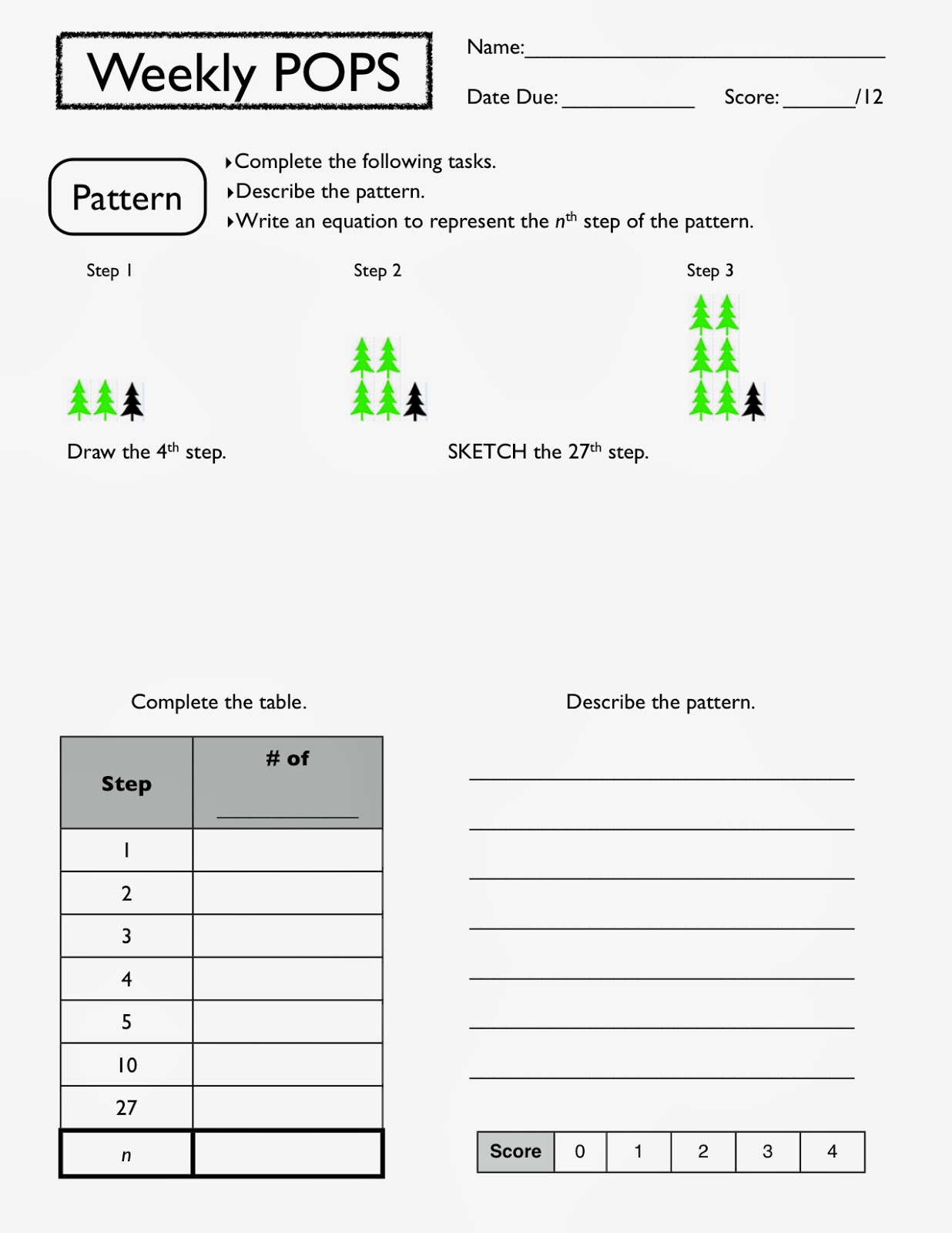
I will include a pattern either from Visual Patterns or one I create. As you can see from the handout below, it's similar to Fawn's form. I am adding a section for students to describe the pattern in their own words. If I decide not to do a pattern that week, I'll do some type of puzzle like the Billiard Ball puzzle above.
Order of Operations:
Students are to use the four given numbers and mathematical operations, symbols, and/or notations to get to the values of ten (or twenty-four). As you can see from the handout, students need to write the expression and evaluate it correctly using Order of Operations (or PEMDAS).
Problem-Solving:
Definitely one of the most important parts of the Weekly POPS, problem-solving. Right now, I'm finding old PoWs from the Math Forum's library to share with my students. As you can see from the handout, be sure to include the Math Forum's copyright information when photocopying. I'm looking for students to organize their work, demonstrate their solution strategy, and think critically.
My goal with Weekly POPS is to get students to really think critically and problem-solve. Why? because they so desperately need it. It's challenging, demanding, and necessary. There's a slight puzzle feel to POPS. Students have really been into it this week.

Students receive the POPS every Friday and have a week to complete it. They'll turn it in the following Friday and receive a new POPS. I've invested a lot of time in class this week going over my expectations, but will use Monday and Tuesday next week to show my classes student POPS that are exemplars, average, and sucky. I told them, "You earn a zero on your POPS, it's the same as POOPS."

I look forward to this adventure with my kids. Here's a folder with the POPS I've created so far. Feel free to join in the action. If this link is broken, please notify me and I'll fix it, unless your name is Fawn.

[UPDATE]: Check out Piles of Tiles that can be used in place of patterns. (12-27-2013)

POPS,
951