Showing posts with label Questions. Show all posts

#PuzzleMath ideas

Tonight, my son wanted me to work with him on his new puzzle.

I don't know your strategy for doing puzzles, but I find all the corners first and then start putting the border together before I start working on the inside. Look at that box again. Would you be able to determine the dimensions (in puzzle pieces) of this puzzle by knowing the total number of pieces?

That was my first question:
A) If you know the total number of puzzle pieces, could you think of the all the possible dimensions (in puzzle pieces) of the puzzle?

Answer:
This puzzle will either be a 1x35 or 5x7.

Then came the next question:
B) Estimate the actual dimensions (in puzzle pieces) given the picture on the box?

Answer:
I'm going to go with 5x7 because five and seven are the only factors of 35 that would reasonably make the rectangular picture on the front of the box. The puzzle should be 5 pieces high and 7 pieces across from left to right.

With a box of 35 pieces, these questions aren't too ridiculously challenging. However, I know there are crazier puzzles out there in the world; puzzle with 500, 750, 1000 pieces, etc. That's where I called on Twitter to help out. Like a champ, the #MTBoS came through and hopefully will continue to come through with #puzzlemath.

Below are some of the tweets I received followed by additional math questions I'm curious about.


Additional Questions:
C) If you think you know the dimensions, could you determine:
  • The number of corner pieces
  • The number of border (non-corner) pieces
  • The number of inside pieces
If so, could you write a rule for any of these?

D) Knowing these quantities, say you randomly choose a puzzle piece, what are the chances it's:
  • A corner piece
  • A border (non-corner piece)
  • An inside piece
  • The exact center (if possible) piece
Please add to the collection of puzzles and questions by tweeting with the hashtag #puzzlemath.

Puzzlemath,
1050

Pumpkin Seeds

For Halloween, we gutted the larger pumpkin from Day 197 for two reasons:
1) To carve it and
2) To roast the seeds
*Little did I know this pumpkin would produce many number sense opportunities beyond Day 197's weight estimate.

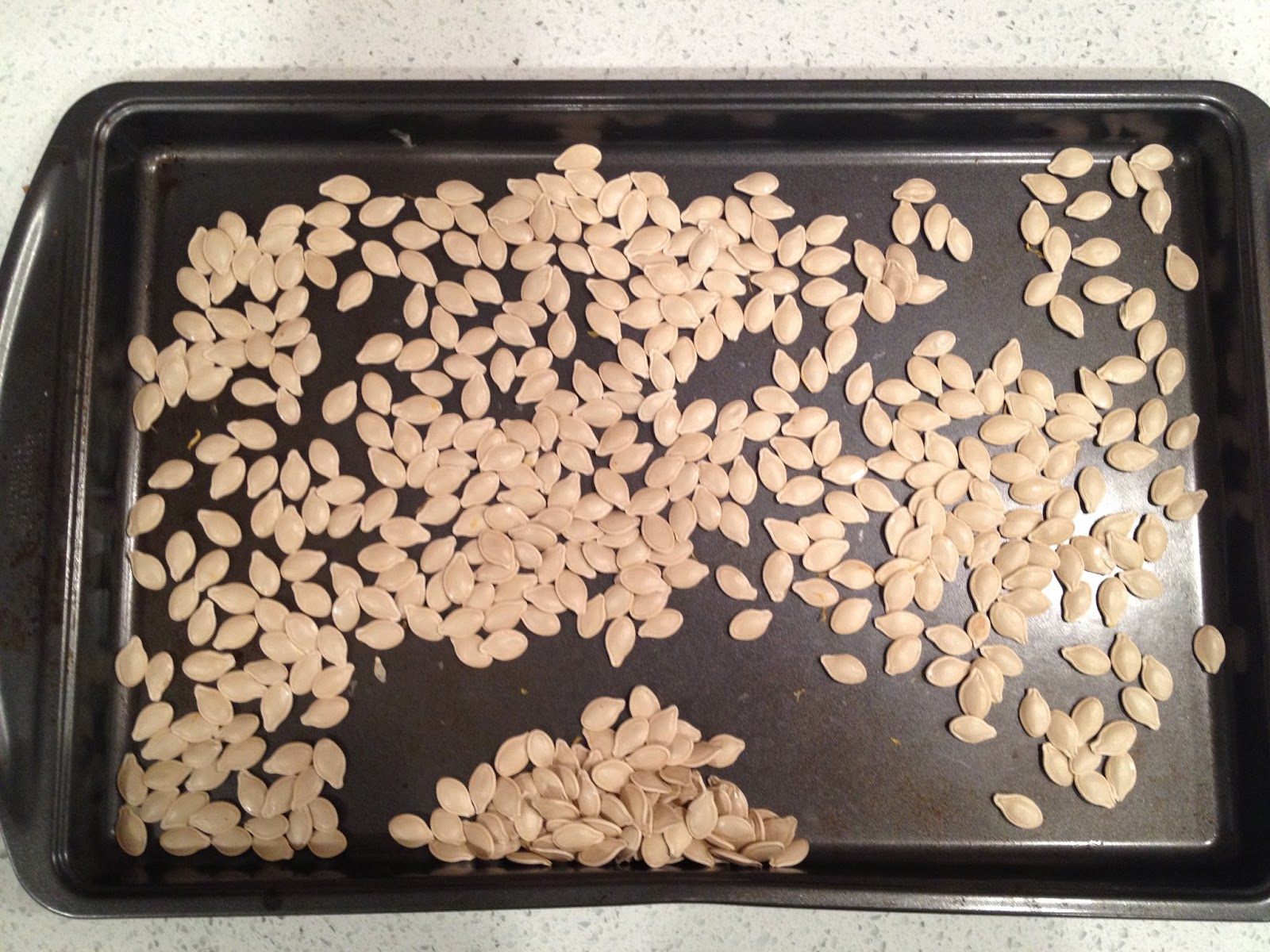
My 4.5 year-old son helped gut the pumpkin with me. We gathered as many seeds as possible and set them aside for the roasting process. The recipe I use can be found here. Before mixing the seeds in olive oil and seasonings, I lowered the pan down to my son and asked how many seeds he thought there were. [How many do you think there are?]
 
Me: How many seeds do you think there are?
Son: Well, ...[thinking for a few seconds]... there's definitely more than a hundred.
Me: How do you know it's more than a hundred?
Son: It just looks like more than a hundred.
Me: Make me a pile of seeds that would be about 100. 
He takes his hands and makes a pile toward the bottom of the pan. I can't contain my excitement to see what he has done.

His pile actually makes sense to me and definitely looks close to 100, give or take. Now that we've made a pile of his "one hundred" seeds. I ask:
Me: How many piles of 100 seeds do you think we can get?
I see he's a little confused by my question, so I ask it differently.
Me: How many piles do you think we could make where each pile has 100 seeds?
He starts to think, but by this time, my almost two year-old daughter sees the pan of seeds is now at her level, so she comes running over and wants in on the action of moving seeds. I thought our conversation was derailed as I brought the pan back up to counter height. But my son keeps it going. He didn't necessarily attempt to answer my question (which is fine by me). He took it in a different, pleasantly unexpected direction:
Son: What if we could get 10 piles?
Me: Do you mean ten piles of one hundred?
Son: Yes!
Me: Are you asking me how many seeds we would have if we had ten piles of 100?
Son: Yes.
This blew me away. Where'd this come from?
Me: Well, ten piles of one hundred seeds would mean we have a thousand seeds.
Son: A thousand??!!
Me: Yes.
Son: What if we had twenty?
Me: Twenty piles of 100 seeds?
Son: Yes.
Me: Well, what two numbers make twenty? Ten and...
Son: Ten!
Me: Right. So if ten piles make a thousand and another ten piles make a thousand, we would now have two th...
Son: ...ousand! 
Me: Right.
Son: What's 100 piles? 
Me: You mean, what's one hundred piles of one hundred? 
Son: Yea.
Me: That would be ten thousand.
My wife chimes in.
Wife: No. 
Me: One hundred piles of one hundred? Ten thousand.
Wife: Wait. You're right.
And our kids are now off in the other room playing and getting ready for going outside and looking at Halloween decorations before trick or treating. So many cool things happened:
  1. I love how we pursued my son's questions and not mine. 
  2. I love that he was fascinated by the word "thousand" even if it didn't make sense.
    1. Because he thinks a "hundred" is big.
  3. I love how we started with actual seeds (concrete) and went way more abstract.
  4. I love how my wife had the best estimate in the house [375 seeds].
  5. I love how the "pumpkin seeds" estimation challenge is just large enough so you can't accurately eyeball the amount and it's just small enough where it wouldn't take me an absurd amount of time to accurately count.
My wife and son watched the video answer this morning. My wife's response:
This is perfect for my [1st grade] students!

We paused the video when we saw ten groups of ten and paused it again when I made a larger pile of one hundred seeds. He struggled with making sense of final amount. 
Me: How would you say that number?
Son: Forty-eight eight? 
Me: How many piles of one hundred are there? 
Son: Four.
Me: So we say "four hundred" and let's count the piles of ten together. Ten, twenty,..
Together: thirty, forty, fifty, sixty, seventy, eighty,  
Me: And. Wait. There are only eight in this last group. So we say eighty-eight. Four hundred eighty eight. Say that.
Son: Four hundred eighty eight.
Me: Great. Let's go make breakfast.
Here's the recipe again and some pictures of the process.
Seasonings!
Ready for the oven.
Roasted and ready to eat!
Seeds,
225

P.S. Thanks to Christopher Danielson and all he does at #tmwyk!

Explain that, please.

Recently, I've given a few teacher workshops/conferences and have had the luxury of reflecting on teacher moves as I facilitate a lesson with the attendees. One of the many things we talk about are teacher responses to students.
Me: Did anyone hear me say, "No. That's wrong. You're wrong. I don't like your answer."
Attendees: No.
Me: Right. Instead, you'll hear me say things like, "Can you explain what you did here? Explain that, please. I noticed you did [this] here, please share how you got [that]. I'm curious how you came up with that. Walk me through what you did."  
I tell teachers that I'm taking the emphasis away from right versus wrong answers and placing an interest on the student's thought process and problem-solving. I continue with teachers:
Me: By telling a student they're wrong, a student can have the tendency to shutdown [I make the sound effect of a machine shutting down, "BOOOOvvvvvvvv"]. By asking a student to explain things, it shows that I'm more interested in how they arrived at their answer. 
As teachers, we know a student can be told they're wrong and it's easy for them to give up. On the flip side, when we validate a kid by telling them they're right, the student can also shut down and never reach the higher levels of Depth of Knowledge.

Recently, a workshop attendee asked me how I respond to students who have nailed the answer to a 3 Act task. First, I have them explain their problem-solving plan to me. Second, I question any details that were unclear, encourage them to be more precise, or have them explain their units of measurement. Third, I ask them if they feel confident in their answer after explaining it to me. Fourth, I validate them by simply saying, "That makes sense to me."

I don't tell them they're correct. I treat them just like as if they got the answer wrong. If that doesn't satisfy them, I respond with, "We'll find out soon if you're correct, but that (their explanation and work) makes sense to me." At this point, I offer them an extension to the task. I'd like to talk more about this later, but usually the extension revolves around the students creating something with the new knowledge or skills they have just recently gained.

After all that, please add your favorite lines when questioning students to this Google doc. I think it's also helpful we create a list of lines we avoid using with students as they explore math.

Here are a few people with other stellar teacher moves/lines to support students.
Max Ray: 26 Questions You Can Ask Instead
Dan Meyer: You Don't Have To Be The Answer Key
David Cox: Creating A Culture Of Questions
Steve Leinwand: Accessible Mathematics

BOOOOvvvvvvvv,
645