Showing posts with label TMWYK. Show all posts

Roofs Are Expensive!

Today is Veteran's Day. If you personally know a veteran, say "thank you" to them somehow: call, email, text, or in person. If you don't know a veteran, then ask a friend if they know a veteran and if they do, ask them to say "thank you" on your behalf.

Because today is Veteran's day, my district isn't in service today. Therefore, I was able to sleep in a few minutes longer today. I woke up to the sound of this pitter-pattering on the roof of our house. Not five minutes later, my 4.5 year-old son walks into the room and says he hears something that woke him up. I wonder what? Ha.

He climbs in bed with me and I ask him if he knows what the sound is. I proceed to tell him the sounds he hears are birds walking around on the roof hitting the roof with their beaks. When we moved into our house, there was a fake owl tied to our roof. Supposedly it keeps birds away. Not too sure it's all that effective, but we keep it up to have an occasional laugh.

My son thinks that the birds might start to ruin the roof and that we'll have to replace it.
Son: That will probably cost more than $100 to fix.
Me: How much more?
Son: Probably like one-hundred, one thousand dollars.
If you read my Pumpkin Seeds post, you know that his vocabulary includes a thousand now which is the biggest number he currently "knows". I use "knows" very loosely.
Me: Oh, I see. Well, which number is bigger? One hundred or one thousand?
Son: One thousand!
Me: Right. So we say the bigger number first, like this, "One thousand, one hundred."
Son (whispering to himself): One thousand. One hundred.
Me: That's a lot of money.
Son: Maybe one hundred twenty?
Me: Oh, so that's smaller than one thousand, one hundred.
Son: I KNOW! TEN THOUSAND!
Me: How do you know?
Son: Well, we have a big roof. We would need a lot of wood. We'd have to go to Home Depot and get all the things. 
Me: So we can buy all the things from Home Depot?
Son: Yes.
Me: And then would we put the roof on by ourselves or have some worker-men do it for us.
Son: You and I can do it Dad.
It dawns on me. Geez, I hope it's not $10,000. That's a lot of money. At the same time, I'm glad my son doesn't know the concept/magnitude of "A million" yet. Regardless, I have no idea what a new roof might cost, let alone how to put a new roof on. But maybe I'll save a lot of money on the labor because I have a 4.5 year-old son extremely willing to climb on top of our house and help install a new roof.

Roofing,
1023

P.S. I'm enjoying these conversations and posting about them.
Today felt like Mathematical Practice 4 with my son.


An Amusing Context for Zero

From the mouths of babes:

Tonight, my 4.5 year old son was getting ready for bed. Getting ready for bed means he needs to shower. And as any parent can relate, there's the usual banter of "get your jammies out" to "let's brush your teeth." Tonight went in this direction:
Me: C'mon. Let's get ready for your shower. I have three clothes on still.
He comes around the corner.
Son: Dad, I have zero clothes on still. 
Yes. Yes, he did. He was, indeed, ready for shower. Bahahahaha.

Like I said, from the mouths of babes: an amusing context for zero.

Jammies,
918

Pumpkin Seeds

For Halloween, we gutted the larger pumpkin from Day 197 for two reasons:
1) To carve it and
2) To roast the seeds
*Little did I know this pumpkin would produce many number sense opportunities beyond Day 197's weight estimate.

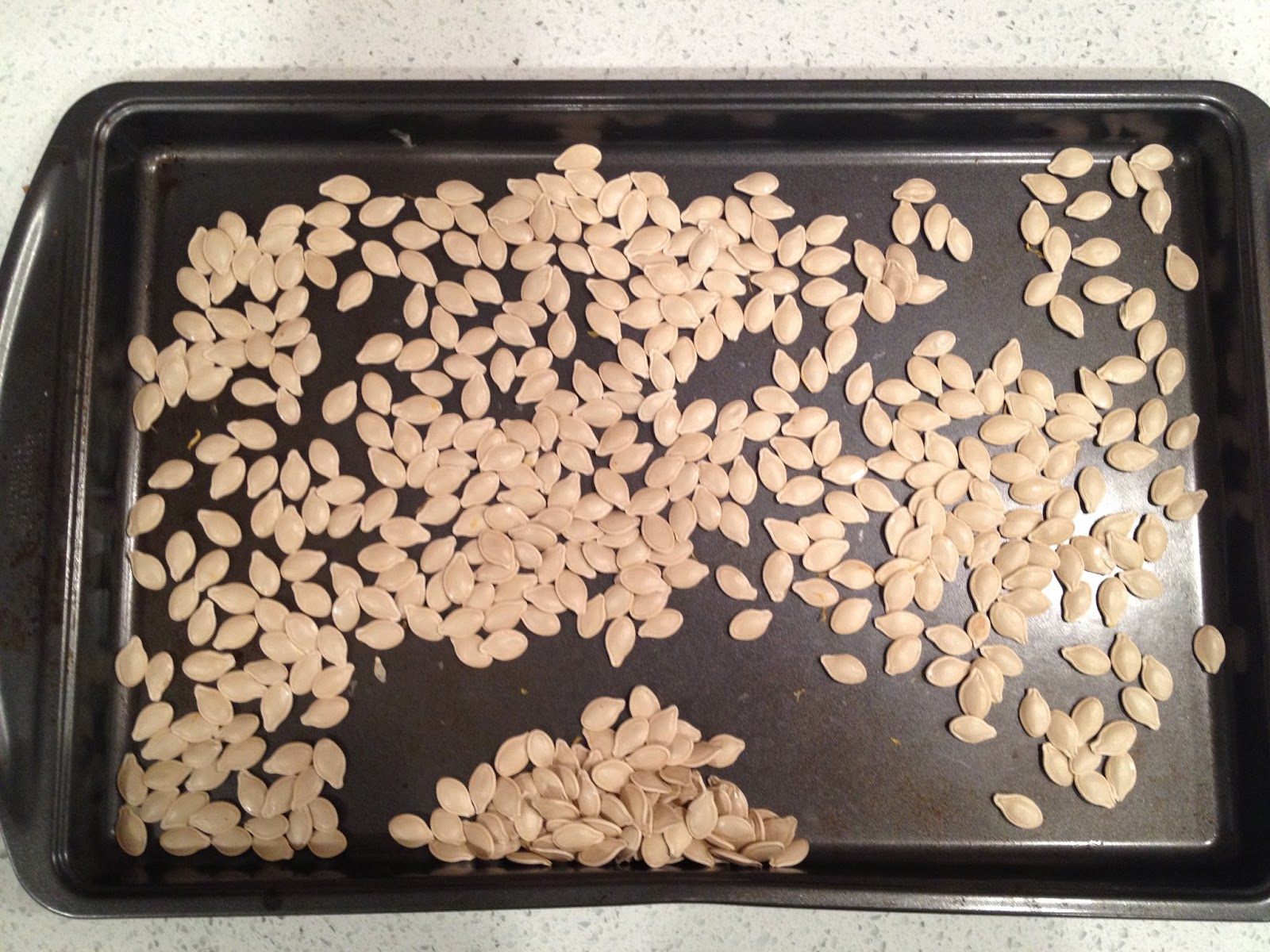
My 4.5 year-old son helped gut the pumpkin with me. We gathered as many seeds as possible and set them aside for the roasting process. The recipe I use can be found here. Before mixing the seeds in olive oil and seasonings, I lowered the pan down to my son and asked how many seeds he thought there were. [How many do you think there are?]
 
Me: How many seeds do you think there are?
Son: Well, ...[thinking for a few seconds]... there's definitely more than a hundred.
Me: How do you know it's more than a hundred?
Son: It just looks like more than a hundred.
Me: Make me a pile of seeds that would be about 100. 
He takes his hands and makes a pile toward the bottom of the pan. I can't contain my excitement to see what he has done.

His pile actually makes sense to me and definitely looks close to 100, give or take. Now that we've made a pile of his "one hundred" seeds. I ask:
Me: How many piles of 100 seeds do you think we can get?
I see he's a little confused by my question, so I ask it differently.
Me: How many piles do you think we could make where each pile has 100 seeds?
He starts to think, but by this time, my almost two year-old daughter sees the pan of seeds is now at her level, so she comes running over and wants in on the action of moving seeds. I thought our conversation was derailed as I brought the pan back up to counter height. But my son keeps it going. He didn't necessarily attempt to answer my question (which is fine by me). He took it in a different, pleasantly unexpected direction:
Son: What if we could get 10 piles?
Me: Do you mean ten piles of one hundred?
Son: Yes!
Me: Are you asking me how many seeds we would have if we had ten piles of 100?
Son: Yes.
This blew me away. Where'd this come from?
Me: Well, ten piles of one hundred seeds would mean we have a thousand seeds.
Son: A thousand??!!
Me: Yes.
Son: What if we had twenty?
Me: Twenty piles of 100 seeds?
Son: Yes.
Me: Well, what two numbers make twenty? Ten and...
Son: Ten!
Me: Right. So if ten piles make a thousand and another ten piles make a thousand, we would now have two th...
Son: ...ousand! 
Me: Right.
Son: What's 100 piles? 
Me: You mean, what's one hundred piles of one hundred? 
Son: Yea.
Me: That would be ten thousand.
My wife chimes in.
Wife: No. 
Me: One hundred piles of one hundred? Ten thousand.
Wife: Wait. You're right.
And our kids are now off in the other room playing and getting ready for going outside and looking at Halloween decorations before trick or treating. So many cool things happened:
  1. I love how we pursued my son's questions and not mine. 
  2. I love that he was fascinated by the word "thousand" even if it didn't make sense.
    1. Because he thinks a "hundred" is big.
  3. I love how we started with actual seeds (concrete) and went way more abstract.
  4. I love how my wife had the best estimate in the house [375 seeds].
  5. I love how the "pumpkin seeds" estimation challenge is just large enough so you can't accurately eyeball the amount and it's just small enough where it wouldn't take me an absurd amount of time to accurately count.
My wife and son watched the video answer this morning. My wife's response:
This is perfect for my [1st grade] students!

We paused the video when we saw ten groups of ten and paused it again when I made a larger pile of one hundred seeds. He struggled with making sense of final amount. 
Me: How would you say that number?
Son: Forty-eight eight? 
Me: How many piles of one hundred are there? 
Son: Four.
Me: So we say "four hundred" and let's count the piles of ten together. Ten, twenty,..
Together: thirty, forty, fifty, sixty, seventy, eighty,  
Me: And. Wait. There are only eight in this last group. So we say eighty-eight. Four hundred eighty eight. Say that.
Son: Four hundred eighty eight.
Me: Great. Let's go make breakfast.
Here's the recipe again and some pictures of the process.
Seasonings!
Ready for the oven.
Roasted and ready to eat!
Seeds,
225

P.S. Thanks to Christopher Danielson and all he does at #tmwyk!

San Diego Conversions

I was in San Diego, California the past few days doing the whole San Diego Zoo and SeaWorld thing with the family. We had a great time, but that's not the point of the post. There were definitely a handful of opportunities to capture some math moments, but I've found it more important to contain myself (mathematically) when I'm with family and make the most of our time together. Here are the two things I captured and want to share.

Number 1: 
We were waiting to board the Wild Arctic Ride (virtual helicopter ride) at SeaWorld and watched this video. There were subtitles in Spanish for our spanish-speaking (reading) friends. However, they go along with the helicopter pilot.

Here's Act 1:

When I saw the the number behind the black box, I thought, "Is that right? Is 400 miles per hour really ### kilometers per hour?"
Are they correctly converting for our Spanish speaking friends? It turns out that 400 miles per hour is about 643.7 kilometers per hour.

Here's act 3:

What do you think? Should I keep the black box there? Should I delete it?
I feel this is one of those moments where I don't insert a black box and we simply ask students:
Is 400 miles per hour really 600 kilometers per hour?
I'm curious about students arguing about this one? or would they even care?
What difference would 40 kilometers per hour make?
Where do you stand, on any of it?

Number 2: 
The great thing about San Diego is there are tons of people from many different places of the world. San Diego has an international airport and many places of interest besides SeaWorld and the zoo to contribute to this melting pot. I loved listening to all the different languages being spoken throughout the day. Therefore, it didn't surprise me when I walked into the pool area for the first time on our trip and noticed a few interesting things. I couldn't help but think how wonderful it would be to use these in any math classroom, specifically Math 6. The first thing you see as you enter the pool area is the jacuzzi. I couldn't help but notice the depth:
Okay class, check this conversion. It ends up making sense and I appreciate the use of meters for pretty much everyone outside of the United States. Seriously, I simply have such a hard time understanding why the United States uses inches, feet, yards, miles, etc. I digress.

Here's the (very shallow) pool:
Let's look a little closer at the depth signs around the pool. The deepest part of the pool is 4 feet or 1.2 meters. Okay class, check this conversion. Looks pretty legit, right?
So, if you saw a depth sign with 3.5 feet, what would you put the meters conversion at? How would you order these pictures with your students? Which would you present first? second? third? or would you give them all to your students at the same time? Would you cover up one of the measurements (like feet) and only show them one measurement so they work on finding the conversion. Here's the 3.5 ft depth sign.

Okay, if you do the conversion, 3.5 feet is 1.0668 meters. Obviously, someone was following their rounding rules. A few questions pop into mind here:
Should we round up?
Would it be wiser to round to 1 meter?
How much of a difference does roughly 4 centimeters make?
Could they not use a slightly larger tile and put 1.07 meters?
These questions aren't the only questions, nor the most profound, but I'm still curious.

There's one more crazy thing about this pool I had to capture and share. How did they get away with this? 
Look closely. Inside the pool is a depth of 4 feet (1.1 meters). Outside the pool is a depth of 3.5 feet (1.1 meters). WHAT?!!! Now reflecting, I should have had my wife take a picture of me next to the sign to get the water level and measure how deep it actually is here. I don't know about you, but 6 inches is definitely more significant than the 4 centimeters we discussed earlier.
At what point does an error like this matter significantly enough to change it? 6 inches? 2 inches? 12 inches? and in what direction: shallower or deeper?

How would you use any of these images or video in your class to help facilitate discussions or arguments regarding conversions?

SD conversions,
906

Manilla folders [Number Sense]

I must share this short story with you about the number sense I've been witnessing for the past few weeks with many of my students. Be warned: not for the faint of heart.

Today, a few 7th grade boys came in after school today and wanted to help with some things around my room: tidy up desks, organize whiteboards, etc. There was a box of 100 manilla folders that I had just brought back from the office. I needed 80 of the folders and would later return the remaining folders to the office.

Here's my exchange with the student we'll refer to as Albert:
Me: I need 80 folders from that box. Albert, think of a quick way you could get those 80.
***Let's pause. How would you (the reader) quickly get 80 folders from this box?
Albert: I could count in 5's.
Me: Okay. Any quicker than that?
Albert: By 10's.
I get what Albert is trying to do. He doesn't want to count to eighty by ones. To that point, I would say his initial two responses made sense and are practical, in the mind of a 7th grader. I thought maybe I'm asking the question incorrectly, so I try it again.
Me: Right. That would be a good way to organize the folders to keep track of them as you count. Albert, I'd like you to think of a way to quickly get those folders out of the box. 
I can see the look on his face is one of confusion. Not that look like he's trying to figure it out, but that look like he has no idea what I'm asking. So after a minute, I mistakenly ask another question (in hindsight, I wish I would've stopped the conversation and let him do his thing).
Me: How many folders are in the box?
Albert: 100.
Me: How many do I need?
Albert: 80.
Me: Is there a way to get me the 80 without counting all 80?
Albert has no idea. I like this question because now it's specific. His challenge is to get me 80 folders without actually counting all 80. After a minute. He needs some prompting.
Me: If the box has 100 and I need 80, how many will be left?
Albert: 30.
Me: So 80 plus 30 is 100?
Albert: No wait, 20. 
Me: Okay, so I will send 20 back to the office. How can I get 80 folders out of the box without counting all 80?
Albert has no idea. This exact exchange continued for another round. I'd like to say that Albert eventually came to an efficient way on his own, but he didn't. I tossed 100 up on the whiteboard. We subtracted 80 and wrote 20. I thought after Albert saw the 20 on the board, he might realize to count 20 folders from the box, take out the remaining folders and switch them with the 20.

This is quite common. The number sense (or lack thereof) my students have (or don't yet) is quite fascinating. I have a lot of work ahead of me this year. One thing is for sure. I can get better at asking shorter questions. I can get better at looking for these learning opportunities. I can get better at not looking for one answer when asking questions of students. As Max Ray would say, "2 > 4."

Folders,
918

Quesadilla - Part 1

My son and I look forward to Saturday mornings because Dad typically makes breakfast. Let me rephrase that, I really look forward to Saturday mornings because I get to make breakfast for the olive-gobbler and myself. It's the highlight of my whole weekend sometimes. I usually go with one of my two staples, pancakes or an egg and cheese quesadilla. Today, we went with the egg and cheese quesadilla. It's easy to make and we enjoy it together. Sometimes we throw in some bacon (the most delicious thing on earth). We also love to dip our quesadilla in Chik-Fil-A sauce.

Since he's only two-and-a-half, he can't man up to an entire quesadilla yet. Likewise, I should probably watch my cholesterol and avoid routinely eating 3 eggs and cheese every Saturday. It's a delicious compromise. That said, as he gets older he eats more and in turn my cholesterol intake is slightly less, I think.

I came up with a 3 Act idea for our quesadilla breakfasts. You'll notice I don't use halves, fourths, and other math related vocabulary on purpose. It gives you a chance to use that vocabulary with your students. Text included below.

Narrative:
"On the weekends, my son and I look forward to making an egg and cheese quesadilla for breakfast. We scramble the eggs, add the cheese, grill up the tortillas, and when the quesadilla is ready, I cut it into sections so we can share. When he was two years old, he’d only eat one of the sections. Now that he’s a little bit older, he’ll eat more than one, but won’t entirely eat two.  So I need to rethink this."

Quesadilla - Part 2
I'm working on another idea related to this whole circle, fraction idea. Stay tuned.

*Fawn, you're temporarily sworn to secrecy while I line things up.

Quesadilla,
405

P.S. How many times did I use the word "whole"?

Small, medium, or large

My wife, son and I went on a walk this morning. Destination: Bruegger's Bagels. There's a park between our house and the bagels. We frequently use this park since it has a play structure, monkey bars, slides, and swings (one of our favorites). Our two-and-a-half year old son (the olive-gobbler) loves to request that Dad (me) use the swing adjacent the swing he's on. Still a kid at heart, I frequently will jump off the swing in midair and my son has come to expect it. Of course, he requests, "Dad'll do a big big jump!" There were other kids around and I didn't want to be a horrible example and/or jump off and hurt one of them. As I explained this to him, he responds, "Dad'll do a medium jump."

I jump off the swing without hurting anyone, myself included. I turn to my wife and say, "I'm going to test something out when we get bagels." We walk over to the bagel establishment, place our order, and I grab a couple of straws. Enter this picture:
I took the straw wrapper and ripped it into three different sizes and ask him to identify the large one. He puts his finger on the piece on the right. I then ask him, "Which one is the medium one?" He places his finger on the piece in the middle. Lastly, I ask, "Which one is the small one?" and he places his finger on the left. Let's be clear here. I am not claiming my son is a genius or that my next magic trick is that he knows his multiplication facts. I was simply assessing if he really understood the difference between small, medium, and large. He does. I don't have another two-and-a-half year old kid to compare him to so I'm not sure if this is fair. What I do know is that he's making a one-to-one association and comparing sizes. I find this fascinating. As a family, we've been using the Your Baby Can Read series and have found it wonderful. I highly recommend it. The following is in one of his books.
Find the biggest comb.
This series has many wonderful ways of communicating language with children. My wife, an elementary teacher, would probably do a better job writing this post as she would be able to explain it all better than me. Knowing that he has a pretty good understanding comparing, let's see if he can order them if I mix them up a little.
Me: Okay, let's order them from least to greatest.
He looks at me blankly as he chews on his bagel. I didn't expect him to understand what I had just said. That's okay. I'm still going to use this language. I follow it up with this.
Me: Let's put them in order starting with the smallest.
Son: Hmph.
Me: Where is the small piece?
He points to the small piece.
Me: Okay, let's put that first (as I place it on is left). Where is the medium?
He points to the medium size piece.
Me: Let's put that next to the small piece.
Son: Hmph.
Me: Here, let's move it next to the small piece. What piece is left?
Son: The large! (saying it like he's just won the lottery).
Again, I'm not claiming my son is the next Einstein. I need to keep him honest and humble at the same time so here's how I proceed.  I take the largest straw wrapper and rip off a tiny piece so that it's smaller than what we previously agreed was the "small one". I temporarily hide the piece previously known as the "large one".
Me: Now which piece is the small?
He points to the new tiny piece.
Me: and the medium?
Son: This one (pointing to the piece formally known as 'small')
Me: and the large?
Son: This one (pointing to the piece formally known as 'medium')
I hope you're following me. If not, here's a picture to compare to the first one.
Previous small, medium, & large
New small, medium, & large
Let's see what this kid is made of. I reveal the piece I ripped the tiny piece from, formally known as "large one."
Me: What size is this?
Son: Hmph.
Me: This is the small, medium, and large (as I point at the new small, medium, and large) so what size is this piece (pointing at the piece formally known as "large")?
Son: Hmph.
I give him a few seconds to contemplate, mull it over, and possibly share his own name. Nope, nothing. He's perplexed. He's staring at it. He wants to call it something. He wants to have a name for it and compare it to the other three, but is looking for some direction here. I can see he's just about to take another bite of his bagel and be done with his dad's straw wrapper experiment. I jump in and say, "It's EXTRA large!" If this conversation was happening six months from now, I'd ask if the newly named piece would be "extra large" or stay known as "large." Likewise, would the tiny piece now known as "small" be correct or be known as the "extra small" piece? You decide.
Do you have these conversations with your students? If I was having it with my students, I'd hold out longer and force them to come up with a way to classify all four pieces using their own language. The teacher in me does not take a vacation nor do I take time off during the weekends. I love these conversations and I am now seeing them naturally occurring with my son. I cherish these opportunities and love seeing how his brain is working.

Lastly, a wonderful 3 Act opportunity made an appearance at the end of our bagel extravaganza today. I'll be posting it on Dan Meyer's 101qs.com so let me know the first question that comes to mind right here. It might be winter, but math is not in hibernation. It's still out there in the wild. Be ready to capture it any chance you get.


Small, medium, or large,
849


Zero Olives

My two-and-a-half year old son loves black olives just as much as I do. Tonight at dinner, my wife placed two olives on our son's napkin. Surprisingly, the olives remained untouched for a few minutes. He made some descriptive comments like, "The rice is delicious. The egg is delicious. The milk is delicious." You can tell what vocabulary we use around him, right? Quite the eclectic dinner, I know. Unbeknownst to me as I was taking a bite, he grabbed an olive with his hand so he could put it on his finger to eat and says, "There's one olive left, Dad!" Here's how the rest of this played out:
Me: "Yes, after you eat the one on your finger."
(we've had this conversation before)
He quickly shoves the finger-olive into his mouth.
Not wasting anytime, the olive-gobbler grabs the lonesome olive on the napkin and exclaims, "Now there's zero olives!"

WOAH!!!

This made my heart skip a beat. We haven't talked about zero for a couple weeks now. In previous olive consumptions, I've questioned my son how many are left after he devours his portion. He would sit there quietly and perplexed or would usually reply with a little, "hmph?" After giving him some time to think and reply, I would jump in and offer him a description simply labeled "zero." It kills me that a couple of his toys have the numbers one through nine, but no zero. For example, check out his toy phone. Where's the zero people??!! Seriously?

I'm a huge fan of using zero in math as much as humanly possible. To see it missing from toys means it could be missing from my son's vocabulary unless I work it in. He has placemats with letters, shapes, and numbers. Guess what number is missing. Zero plays a key role in number sense and math. My students know one of our class mantras is, "We love zero!" Zero is a wonderful number.

Our dinner conversation didn't end there. Let's see if this olive-gobbler has some depth. I held up two fingers and asked, "How many fingers do you see?"
Olive-gobbler: Two
(I take down one finger)
Me: How many fingers do you see?
Olive-gobbler: One
(I take down the last finger)
Me: How many fingers do you see?
Olive-gobbler just sits there......... "hmph"
He holds up his hand with all fingers extended and says, "Five!" (Wise-guy!)

I start over by holding up two fingers and repeat my questioning. Same exact response from the olive-gobbler. So it didn't work with the fingers. Later on during our dinner I put one of my olives on his napkin. He grabbed it.
Olive-gobbler: Zero olives left!
Me: You're right.
I put our workout on zero to rest for the night. We're getting there.

I cherish this post because it involves my son, olives, zero, and number sense. This is my first time blogging about my number sense experiences with my son, inspired by Christopher Danielson and the many number sense conversations he has with his children. Thanks man!

Olive-gobbler's dad,
936