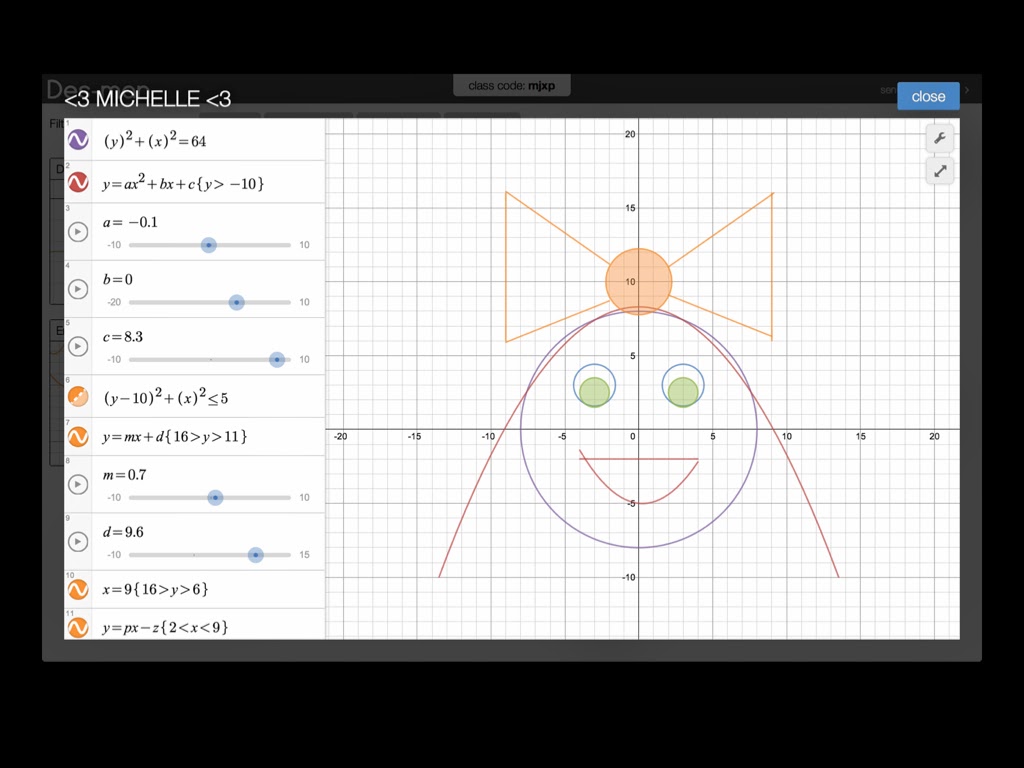
Today, students had about 90 minutes to work on creating their Des-man. Des-man was the brainchild of Fawn. Desmos then teamed up with Dan Meyer and Christopher Danielson to create a suite of classroom activities, one of them being Des-man. I've done Des-man before, but not with the Desmos classroom. Let me just say, it's awesome!
As the teacher, I could see every students' work in real-time and display it up on the projector for all to see if need be. That's a really slick feature on top of the already amazing Desmos. It's like math euphoria! It was a blast to see students work 90 minutes straight, being as creative as possible with their Des-man (or Des-woman). After three weeks, Desmos became a very familiar tool for students because they used it with tasks like Barbie Bungee, Datelines, Hit the Hoop, Vroom Vroom, Stacking Cups, and more. I'd like to showcase a few creations for you. Enjoy!
Thanks Fawn, Desmos, Dan, and Christopher for a wonderful and creative math experience. Lastly, I want to thank my students. Today, you guys helped each other out, persevered, asked for advice, freely explored, had fun, and wanted to know more about functions, domain, range, circles, sliders, and more!
Desmos is great about asking for feedback. I have some observations and am curious. Maybe I'm missing something, but I noticed some features from the regular desmos calculator missing in the classroom. Maybe these are upcoming features: Students couldn't duplicate functions. How come? Students couldn't create (use) tables. How come? Students couldn't create folders or text boxes. How come? Students can't share their Des-man (email, link, etc.). How come? As the teacher, I can't keep the Des-man (functions included) for each student. How come? As the teacher, I'd love to have access to each student Des-man, especially if I want to send it to that student or share at a later time. Thanks for listening, Desmos!
Not sure I made the best teaching move today, but I had to try it. We explored Dan Meyer's "Will it hit the hoop?" task(s).
Act 1: Roll "Take 1"
Agree on the question, "Will he make the basketball shot?"
Ask students to make a series of guesses for a total of six takes.
Act 2: Ask for information I typically ask students to think of information they would find useful in answering the question. Today, I went somewhere else with Mathematical Practice 5. I asked students to make two lists:
List 1: Math tools that would be UNhelpful.
List 2: Math tools that would be helpful.
This is the fourth and final week of the summer academy. My students have been exploring many math tools. I'll list the activity/task with the prevailing tool(s):
Class height: Measurement, mean, median, mode, range
Vroom Vroom: Measuring, Data collecting, Desmos, function of best bit, quadratic equations
As you can see, many of our tasks were dominated by slope-intercept and Desmos. I didn't find their lists surprising.
I love how some students thought Desmos would be helpful, while others thought it'd be unhelpful. Those that found it unhelpful, wished you could insert images into Desmos so they could use sliders to find the path of Dan's shots. Boy, were they happy when they discovered you could import images. My first class was split down the middle: half thought slope-intercept might be useful and half didn't. It took a few convincing students to explain why Vroom Vroom was an example where a linear function was unhelpful.
Overall, I'm pleased with this approach, but I wouldn't do it with every task. It might confuse students that there's only one way to solve a task and detract from the importance of MP 5. I thought this was a fitting opportunity for students to mainly see the difference between a linear function and quadratic function. Specifically, I wanted them to see the advantages of using sliders in Desmos with a quadratic function instead of a linear function. I think students need to shuffle through their tool belt often and pick the right tools for the right task. I think today it was necessary. Dan has written about this or breaking students' tools. Moving forward, it's a matter of using this strategy at relevant times and not overusing it. However, I might be wrong altogether. That's where it's your turn to chime in...
Whenever I start talking about circles with my students, I use this little wager.
I get students to pick one of the three choices and work the room, looking for a brave student I know will deliver my nachos. I talk up the nachos (and the circumference) as much as possible. Anywhere from 90 to 100 percentage of students will say the circumference is shorter than the height of the water bottle. Let's see if I win nachos or I let my students go to lunch early.
Okay, so double or nothing? I don't bring in this glass, but I do use a taller cup with a really small circular base. Where do you stand on the double-or-nothing wage? Did I give you enough information to take the bet? With a glass like this, you should get at least one student to keep you honest and ask which circumference of the glass you'll be measuring.
This little wager (activity) allows me a quick introduction and fun application of circumference. Somewhere I'll discuss vocabulary and formulas with students while giving them a graphic organizer they can fill out.
I'll usually do an activity where students measure the circumference and diameter of objects in order to discover the relationship of Pi. Stuff very similar to Fawn's Friday Bubbles. Note to self, use Excel (or a spreadsheet) to keep track of those measurements. I've also explored Rolling Tires in the past. This year, I brought the wheel to the class for a small activity. A physical wheel. The wheel from my son's wheelbarrow.
The small activity was for students to guess how many rotations this wheel (8-inch diameter) would make from one wall of my class to the other wall. Students were able to see how circumference can take on the meaning of a tire rotation, hence the graphic I made above. It was sweet to see students roll the wheel across my 21-foot long room and actually get 10 rotations like the math predicted. If you have a wheel like this, bring it in and do this activity.
We also did these awesome lessons. And. I. Mean. AWESOME! Pizza Pi by Mathalicious and Penny Circles from Team Desmos and Dan Meyer.
There's so much to do with circles and so little time.
What I like: I like the placement of the x-axis along the ground to represent zero height.
I like how this task reminded me of the low arching bridges along George Washington Memorial Parkway in Alexandria, Virginia.
What I dislike: I dislike that the x-axis and the y-axis were already placed for us. The students have no say in this. I dislike how the arch is already "modeled" by the given function. There isn't any chance for students to explore this on their own, especially if they had no say in the placement of the y-axis. I dislike the answer to this question. It's hilarious. Get this: The truck has to be dead center so that it will allow 0.23 feet of clearance on each side of the truck. Regarding number sense, what is twenty-three hundredths of a foot? No one talks like that, do they? After converting this answer, I could see myself telling the driver, “You have less than 3 inches to spare on each side. And that’s ONLY if you center the truck with the middle of the bridge." Let's look for an alternate route or someone might have to get out of the truck [not it] to guide the driver.
Things I'm intrigued by: What was the reasoning behind the placement of the y-axis? Why isn't it dead center or along the right wall? Why isn't there any sign on this bridge that says the maximum height and/or width of trucks allowed? Is this a "one way" road?
Here's what I did: *Disclaimer: I'm not pretending to nail this Makeover: I think it can be better. That's your job: so let's get it on and help me in the comments. I'll admit, the Makeover was more work than I anticipated and I'm tapped, but I'm happy to do it now during the summer. Thanks Dan for the Makeover challenge!
I found an accident report for a coach bus that crashed into this exact bridge (below) in 2004. There are many of these low arched bridges located along George Washington Memorial Parkway in Alexandria, Virginia. I've seen a few of them when we've taken our 8th graders to visit Mt. Vernon. I remember our bus driver telling us about this specific collision.
1) Show your students this picture, but don't tell them about the collision:
Allow students to make observations and ask questions (maybe Notice and Wonder). Tell them where this bridge is located if they ask. Don't tell them what the signs say. Have a discussion.
2) Now show your students this picture and ask:
Which of these (six) vehicles would safely pass under the arched bridge?
3) Have students make guesses and write it down. You're taking a chance, but at least one student should notice that some vehicles might pass safely using the left lane, but not when the same vehicle is traveling in the right lane.
4) Ask your students what information or tools they might need to help determine which vehicles can safely pass through this arched bridge.
Bridge height(s)
Vehicle height(s)
Width of road
Width of lanes
5) Find the vehicle heights we'll be working with. Depending on the time you have, students can use the internet for finding the average height of each vehicle. I did the grunt work for you with this slide:
6) Show students three heights of the bridge and street dimensions. They probably want to know what those yellow signs on the bridge say. Too bad! The picture is low quality and very pixelated. I'll admit, this might feel like we're now stringing the kids along, but let's offer them measurable dimensions, not some arbitrary equation that "models" the arch. Share the following: Height of the bridge on the left side Height of the bridge in the center Height of the bridge on the right side
Width of the entire road (including space for lane lines and shoulder) and width of two lanes.
7) Offer your students Desmos or Geogebra. Plot the three heights. Use sliders to find an equation that models this low arching bridge. Here are three four scenarios I came up with in Desmos. I'm still not sure which I like best. You decide. I've linked the Desmos files for you to mess around with. Where do you fancy the y-axis?
Okay, I like both the center and the justified right. Placing the y-axis in the center of the bridge made it a lot easier to find an equation that modeled the bridge. Placing the y-axis on the right side of the bridge might produce negative x-values, but since distance is never negative, the absolute value of the domain will tell me how many feet away from the right side of the road the vehicle must be.
8) Give students time to explore the functions, quadratics, sliders, domain, range, and so on. There's more. This task requires students to apply the heights of the vehicles in a specific manner. Sure, students can click and drag on the graphs in Desmos to find the heights of vehicles and determine if it safely passes, but what part of the car "safely passes"? The top left? Top center? Top right? Therefore, students have to now take into account the width of the vehicle. Let's go back to the original question:
Which of these (six) vehicles would safely pass under the arched bridge? And in what lane?
Which vehicle(s) will pass safely in both lanes?
Which vehicle(s) will only pass safely in the left lane?
Which vehicles(s) would have to go into the oncoming traffic lanes?
Which vehicle(s) need to stop and turn around?
Ask how far the vehicles will be from the right side curb when "passing safely"?
9) Tell students to look for a little more clearance than 0.23 feet (2.76 inches). You can read the accident report for all the details about the street and bridge. You'll find the clearance heights posted on the bridge and about 1,500 feet before the bridge.
Unfortunately, the accident report will also show the bus that collided with the bridge while the driver was talking on his cell phone. The bus ran into the bridge without even applying the brakes.
What you did or suggested: Amy Zimmer emailed: "Is it the new Daniel Craig James Bond that has the train scene where he has to duck just before he is about to run into the bridge when the good guy and the bad guy are fighting on a speeding train?" followed by "I would give lots of trucks and see which ones fit."
If you've made it this far. I appreciate your determination and perseverance. Thanks for tuning in. I know this task can be better, so let's get it on in the comments.
Up next, Global Math Department presentation on August 13, 2013: Back to School Night: Ignite. Join the fun.