Showing posts with label The Math Forum. Show all posts

CueThink

CueThink is an application (iPad) I would love to see get some serious math love in schools and the online math community. I had the good fortune of being introduced to CueThink by the wonderful people at The Math Forum (thank you Suzanne). I simply want to give you a glimpse in hopes you'll take a tour of the app and teacher dashboard.

*Look over CueThink and keep potential in the back of your mind. The app already has fantastic features, but think how it could potentially support students in being better problem solvers.

Download the app. Take the tour:

What do you Notice? What do you Wonder?
  • Highlight text and see where it goes.
  • Make an ESTIMATE (so cool).
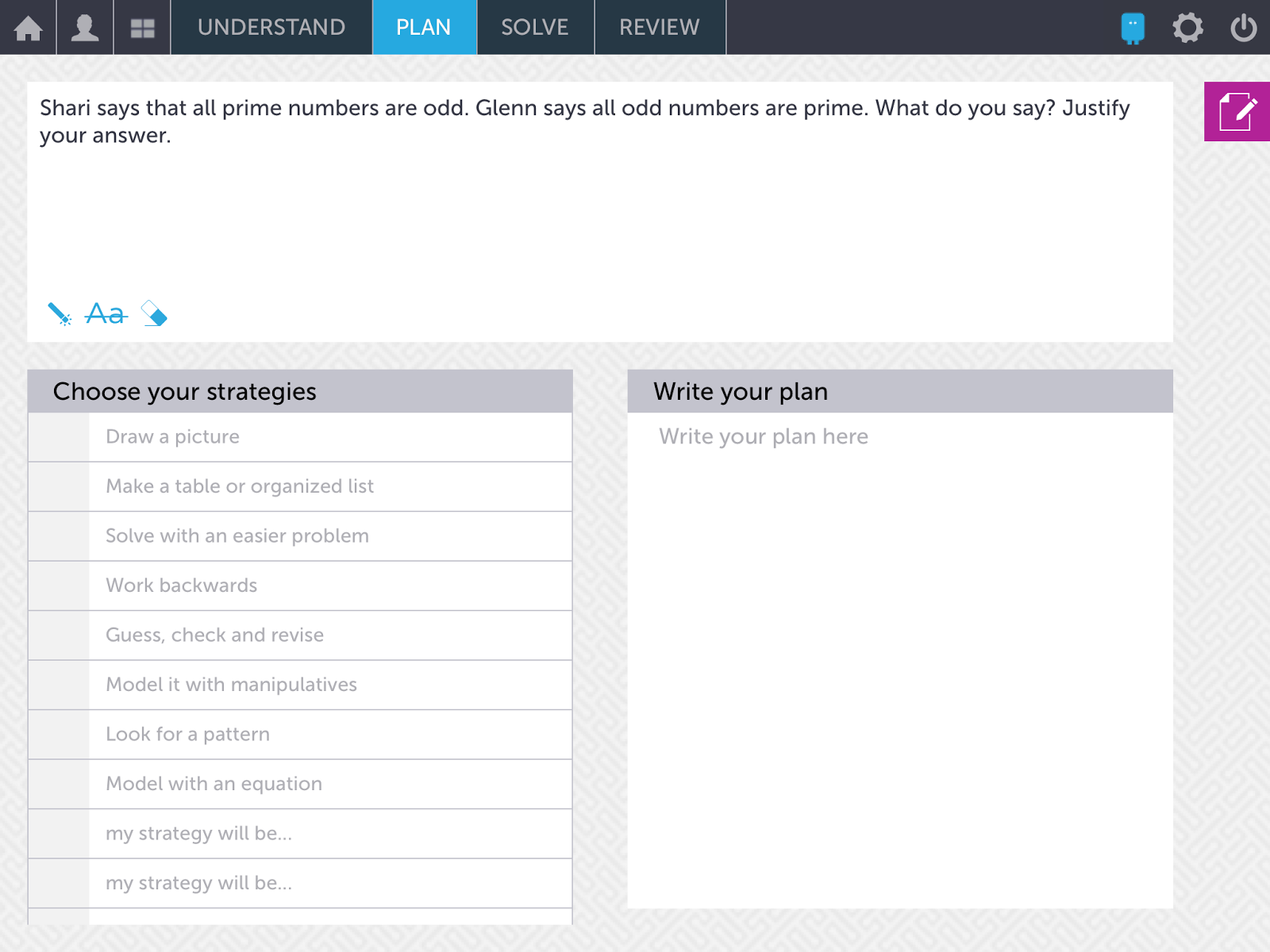
Choose your strategies:

Show and record your solution:
  • Cool tools on the right
  • Record the audio explanation of your solution
Review everything before you submit:

I was giddy exploring this app for the first time; seeing how well it could support students through the problem-solving process, seeing the functionality for feedback, and having a teacher dashboard. I know there's more to come to make this app even better, but think of the potential.

Teacher side: give students feedback at specific points of their recorded solution:

Hungry for more? Check out the CueThink teacher dashboard!

CueThink,
843

LARGE Whiteboards: GET 'EM!

This post is simply a way for me to quickly document/share a few ideas on large whiteboards.

I went to Home Depot and did the following:
  • Found the large whiteboard sheets: 
  • Had someone make two cuts:
  • I get one large whiteboard and two smaller boards:
  • Took home and sanded the corners to get rounded edges:

My classroom desks are in groups of three or four, depending on my furniture, space and mood. Besides using these boards for 3-Act Tasks, here are my favorite everyday activities:
  • Placemat:
Students are given a question to work on. Each student carves out a section on their whiteboard to solve on their own first. As you can see, there's an open space in the middle.
Once students are done with their individual work, they discuss what their group answer should be and write it in the middle section. This really allows students to compare their work with their peers and give each other support, especially for those who might be stuck or need a nudge. Great everyday use and for review activities like Race Car Math. 
I. LOVE. PLACEMAT!
  • Brain Dump
Brain dump: Project something and have the students write down everything they know about it in their section. Then they compare and contrast as a group before sharing whole group. You could also do a Notice/Wonder (a la The Math Forum).

Put the timer on and ask students to write as many ways as possible to get to -100 or whatever you fancy. GO!

The Home Depot boards can be a little weighty. If you have the budget, I’d recommend you first look into the large whiteboards from whiteboardsusa.com. They weigh less, have a slightly better writing surface, have rounded corners, and have a carrying handle for kids to easily carry around the classroom. You can get a set of 10 for a little over $100. Top-notch whiteboards. 

I use cut-up dark t-shirts and socks as erasers. There are plenty more things you can do with whiteboards and I've documented some of them in a few blog posts. Probably the best investment I've made as a teacher. At teacher trainings, workshops, and conferences, I'm practically begging teachers to get these whiteboards in their classrooms.  

Now, I have a blog post in which teachers can refer to. But, here are more awesome additional uses of whiteboards. Nathan Kraft outfitted his entire room with whiteboards, inspired by Alex Overwijk. Don't miss Frank Noschese pioneering all this whiteboard magic. You can see Fawn Nguyen using these on a regular basis too.
Huge style points for them all!

Whiteboards,
1011

Exhaustion

Today was the first day of working as an EnCOMPASS fellow in Philadelphia. The Math Forum and Drexel University are our most gracious hosts. Make it a point to meet anyone from The Math Forum at your next math conference. They are such wonderful, interested, caring and giving people.

The Math Forum had us hard at work today as we used Google Hangouts to connect Philly fellows with offsite fellows, looking over PoWs (Problems of the Week) and the EnCompass software. You know when you work with the Math Forum, you're going to get a good helping of them asking us fellows, "What do you notice?" and "What do you wonder?" Since we're working on giving feedback, Annie Fetter gave us another gem: What would you love the software to do?

Another great part about the hangouts and looking over The Math Forum's site, is that I was able to listen to many other teachers share how they used The Math Forum's site and resources. In doing so, it gave me a chance to explore their site and peel back more layers of resources, support, and strategies I didn't know existed. For example, check out these beautiful links:
Our work hours were from about 8am to 4pm with a few breaks and lunch. Every working minute was productively spent engaging in some type of activity: discussions, gallery walks, reflections, exploring, commenting, etc. By the end of the work day, I was mentally exhausted. I've felt this way before. Sometimes at all-day conferences where you talk math all throughout the day and evening with people I've felt this way. I always need some type of break, some type of release or chance to decompress. I can't talk math all day nor want to. I might think or look for math all day, but talking it can be exhausting. Maybe I'm a wimp. So be it. However, I want to talk about more than math with people at conferences or some gathering like today's institute. I find it interesting to listen to people tell stories about non-math topics. So, thank you to everyone for sharing and not making it all about math.

This made me think about the daily mental exhaustion of a student. Let's randomly pick a percentage. How about 60%? I don't know. Let's say students are actively engaged 60% of the time at school? Okay, please disagree with me and pick your own percentage. This is super informal. Whatever you pick, take it and raise it to a percentage you'd like them to be at and don't make it 100%. Be realistic.

I raise my expectation to 85%. I'd like my students to be actively engaged in school 85% of the time, with 95% being my ultimate goal. I felt The Math Forum was able to gather some great things from people today because they broke it up and kept us actively engaged at least 90% of the time. I was exhausted, but it was a good exhausted. It wasn't like sitting in a chair all day at a conference listening to presenter after presenter deliver a one-way PowerPoint. Think of students and either subjecting them to a high level of engagement or subjecting them to teacher after teacher of un-engaging classroom time.

This post is longer than I anticipated. I want to think about this more, so here are questions I will continue to ponder:

  • What is constructive engagement and how should I (or we) define it?
  • What does constructive engagement look like in my class?
  • How do I get my students to be positively exhausted at the end of the day? 
  • On average, what percent of the time are students engaged in my class? at school?
  • How can I increase this percentage by un-engaging (breaking up the class time) them at times?
  • Would homework exist or should my students need a chance to decompress from my class? Did they get their fill for the day?
  • Would homework simply be blogging (as reflection), like I'm doing right now?

Exhausted,
1032