Showing posts with label Conversations. Show all posts

Roofs Are Expensive!

Today is Veteran's Day. If you personally know a veteran, say "thank you" to them somehow: call, email, text, or in person. If you don't know a veteran, then ask a friend if they know a veteran and if they do, ask them to say "thank you" on your behalf.

Because today is Veteran's day, my district isn't in service today. Therefore, I was able to sleep in a few minutes longer today. I woke up to the sound of this pitter-pattering on the roof of our house. Not five minutes later, my 4.5 year-old son walks into the room and says he hears something that woke him up. I wonder what? Ha.

He climbs in bed with me and I ask him if he knows what the sound is. I proceed to tell him the sounds he hears are birds walking around on the roof hitting the roof with their beaks. When we moved into our house, there was a fake owl tied to our roof. Supposedly it keeps birds away. Not too sure it's all that effective, but we keep it up to have an occasional laugh.

My son thinks that the birds might start to ruin the roof and that we'll have to replace it.
Son: That will probably cost more than $100 to fix.
Me: How much more?
Son: Probably like one-hundred, one thousand dollars.
If you read my Pumpkin Seeds post, you know that his vocabulary includes a thousand now which is the biggest number he currently "knows". I use "knows" very loosely.
Me: Oh, I see. Well, which number is bigger? One hundred or one thousand?
Son: One thousand!
Me: Right. So we say the bigger number first, like this, "One thousand, one hundred."
Son (whispering to himself): One thousand. One hundred.
Me: That's a lot of money.
Son: Maybe one hundred twenty?
Me: Oh, so that's smaller than one thousand, one hundred.
Son: I KNOW! TEN THOUSAND!
Me: How do you know?
Son: Well, we have a big roof. We would need a lot of wood. We'd have to go to Home Depot and get all the things. 
Me: So we can buy all the things from Home Depot?
Son: Yes.
Me: And then would we put the roof on by ourselves or have some worker-men do it for us.
Son: You and I can do it Dad.
It dawns on me. Geez, I hope it's not $10,000. That's a lot of money. At the same time, I'm glad my son doesn't know the concept/magnitude of "A million" yet. Regardless, I have no idea what a new roof might cost, let alone how to put a new roof on. But maybe I'll save a lot of money on the labor because I have a 4.5 year-old son extremely willing to climb on top of our house and help install a new roof.

Roofing,
1023

P.S. I'm enjoying these conversations and posting about them.
Today felt like Mathematical Practice 4 with my son.


An Amusing Context for Zero

From the mouths of babes:

Tonight, my 4.5 year old son was getting ready for bed. Getting ready for bed means he needs to shower. And as any parent can relate, there's the usual banter of "get your jammies out" to "let's brush your teeth." Tonight went in this direction:
Me: C'mon. Let's get ready for your shower. I have three clothes on still.
He comes around the corner.
Son: Dad, I have zero clothes on still. 
Yes. Yes, he did. He was, indeed, ready for shower. Bahahahaha.

Like I said, from the mouths of babes: an amusing context for zero.

Jammies,
918

Pumpkin Seeds

For Halloween, we gutted the larger pumpkin from Day 197 for two reasons:
1) To carve it and
2) To roast the seeds
*Little did I know this pumpkin would produce many number sense opportunities beyond Day 197's weight estimate.

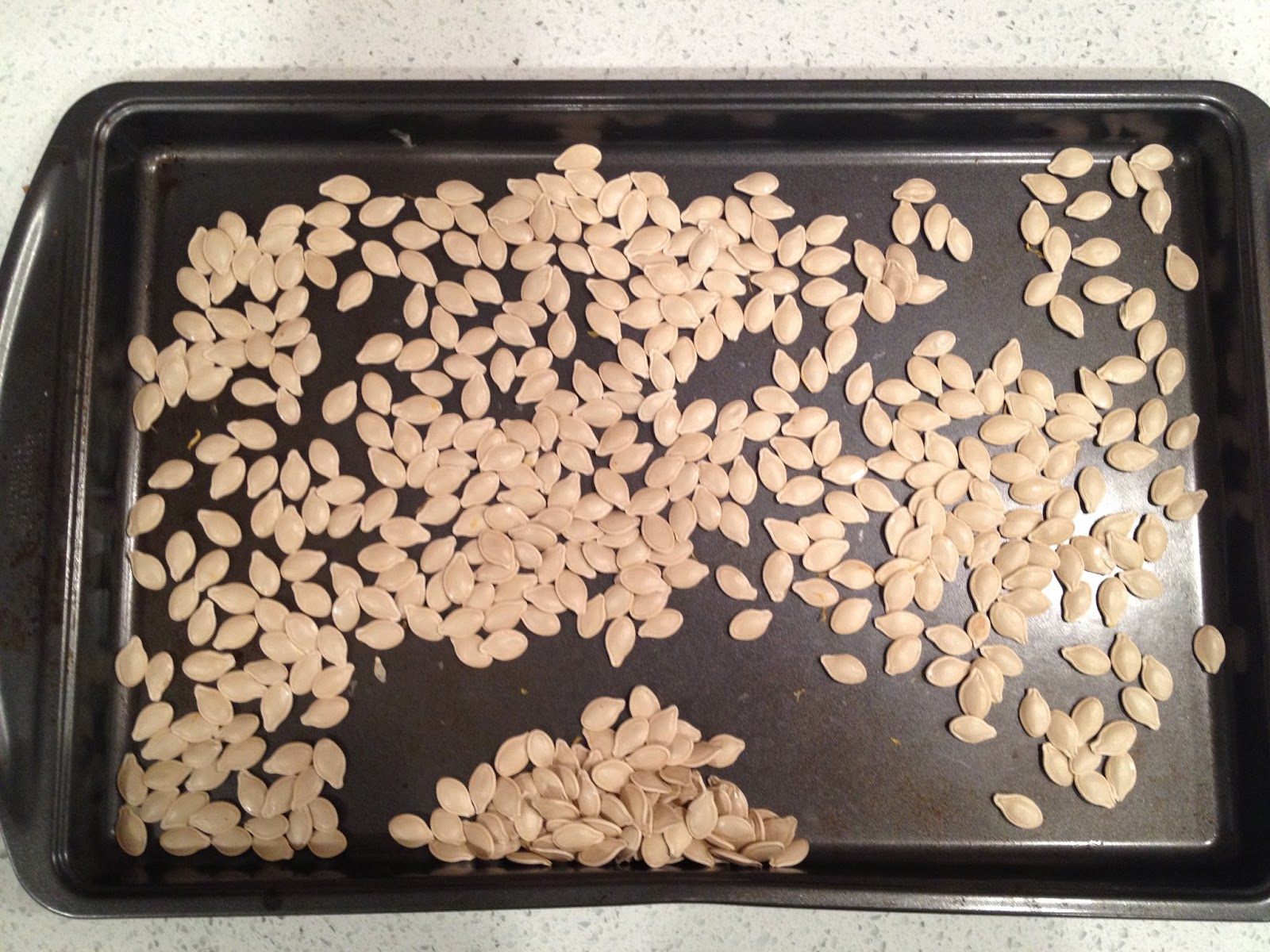
My 4.5 year-old son helped gut the pumpkin with me. We gathered as many seeds as possible and set them aside for the roasting process. The recipe I use can be found here. Before mixing the seeds in olive oil and seasonings, I lowered the pan down to my son and asked how many seeds he thought there were. [How many do you think there are?]
 
Me: How many seeds do you think there are?
Son: Well, ...[thinking for a few seconds]... there's definitely more than a hundred.
Me: How do you know it's more than a hundred?
Son: It just looks like more than a hundred.
Me: Make me a pile of seeds that would be about 100. 
He takes his hands and makes a pile toward the bottom of the pan. I can't contain my excitement to see what he has done.

His pile actually makes sense to me and definitely looks close to 100, give or take. Now that we've made a pile of his "one hundred" seeds. I ask:
Me: How many piles of 100 seeds do you think we can get?
I see he's a little confused by my question, so I ask it differently.
Me: How many piles do you think we could make where each pile has 100 seeds?
He starts to think, but by this time, my almost two year-old daughter sees the pan of seeds is now at her level, so she comes running over and wants in on the action of moving seeds. I thought our conversation was derailed as I brought the pan back up to counter height. But my son keeps it going. He didn't necessarily attempt to answer my question (which is fine by me). He took it in a different, pleasantly unexpected direction:
Son: What if we could get 10 piles?
Me: Do you mean ten piles of one hundred?
Son: Yes!
Me: Are you asking me how many seeds we would have if we had ten piles of 100?
Son: Yes.
This blew me away. Where'd this come from?
Me: Well, ten piles of one hundred seeds would mean we have a thousand seeds.
Son: A thousand??!!
Me: Yes.
Son: What if we had twenty?
Me: Twenty piles of 100 seeds?
Son: Yes.
Me: Well, what two numbers make twenty? Ten and...
Son: Ten!
Me: Right. So if ten piles make a thousand and another ten piles make a thousand, we would now have two th...
Son: ...ousand! 
Me: Right.
Son: What's 100 piles? 
Me: You mean, what's one hundred piles of one hundred? 
Son: Yea.
Me: That would be ten thousand.
My wife chimes in.
Wife: No. 
Me: One hundred piles of one hundred? Ten thousand.
Wife: Wait. You're right.
And our kids are now off in the other room playing and getting ready for going outside and looking at Halloween decorations before trick or treating. So many cool things happened:
  1. I love how we pursued my son's questions and not mine. 
  2. I love that he was fascinated by the word "thousand" even if it didn't make sense.
    1. Because he thinks a "hundred" is big.
  3. I love how we started with actual seeds (concrete) and went way more abstract.
  4. I love how my wife had the best estimate in the house [375 seeds].
  5. I love how the "pumpkin seeds" estimation challenge is just large enough so you can't accurately eyeball the amount and it's just small enough where it wouldn't take me an absurd amount of time to accurately count.
My wife and son watched the video answer this morning. My wife's response:
This is perfect for my [1st grade] students!

We paused the video when we saw ten groups of ten and paused it again when I made a larger pile of one hundred seeds. He struggled with making sense of final amount. 
Me: How would you say that number?
Son: Forty-eight eight? 
Me: How many piles of one hundred are there? 
Son: Four.
Me: So we say "four hundred" and let's count the piles of ten together. Ten, twenty,..
Together: thirty, forty, fifty, sixty, seventy, eighty,  
Me: And. Wait. There are only eight in this last group. So we say eighty-eight. Four hundred eighty eight. Say that.
Son: Four hundred eighty eight.
Me: Great. Let's go make breakfast.
Here's the recipe again and some pictures of the process.
Seasonings!
Ready for the oven.
Roasted and ready to eat!
Seeds,
225

P.S. Thanks to Christopher Danielson and all he does at #tmwyk!

Number Sense Conversations

I've put the elevator speeches to rest. Today's two minute speech went well... I think. As one event concludes, I'm excited to resume my ongoing thoughts about number sense and students.

Working with teachers and students, I can't help but be inundated with thoughts about things I miss, look forward to, and will be challenged with this year in and out of the classroom. However, there's one thing I crave more than anything else, and that's working with students, which usually entails having number sense conversations with students.

Today, I had rich number sense conversations with students in Math 7, Math 8, and high school Algebra classes. As I sit here and put the finishing touches on the slides for my upcoming conference workshop, Get Students to Argue in Class With Number Sense Activities, I can't put to words how valuable it is to allow students to talk about math in math class. That's an oversimplification, but we seriously need to provide our students with opportunities to talk to each other, even argue with each other. Mathematical Practice 3:
Construct viable arguments and critique the reasoning of others.
Steve Leinwand sums it up best:
These nine words may be the most important words in the entire Common Core effort. 
Last December at CMC North, I was honored to give an Ignite talk about something I'm passionate about: number sense and student conversations. It's titled: Number Sense: I Don't Like This Game Anymore.


Students are hungry for number sense conversations in math class. I really do believe. If you don't believe me, just put up this picture in your class and ask your students, "How long would it take to use all of that?" Then ask them to convince you of their conclusion.

As October quickly approaches, I look forward to seeing you at an upcoming conference this school year. In the meantime, I hope to post more about number sense.

Number Sense,
1005

Common Core Elevator Speech - Day 1

For the next week, I will challenge myself (and you) to work on an elevator speech each day about Common Core Math. I will try to be as fluid as possible in my thinking as if I were describing Common Core to a complete stranger as we rode an elevator together. And with that, here's today's elevator speech:
For me, Common Core is a tool to help students see how the world around us can be explained using critical thinking and mathematical properties. My favorite part of Common Core are the 8 Standards for Mathematical Practice. No matter what grade level, the practices emphasize that both teachers and students are problem solvers and how important it is to understand why mathematical properties and procedures exist, and not just the answer. I get to see my students thinking and focusing on finding solutions through hard work and collaboration instead of me just standing up at the front of the room, telling them a procedure they will most likely forget in a day or two. I get to see students be creative in their mathematical thinking and I help guide them when they need teacher support.
Come along for the ride and share your elevator speech in the comments. Take a minute or two to compose an elevator speech. It's a work in progress...

Going up,
504

[Update] More days:
Day 2
Day 3
Day 4
Day 5
Day 6
Day 7

San Diego Conversions

I was in San Diego, California the past few days doing the whole San Diego Zoo and SeaWorld thing with the family. We had a great time, but that's not the point of the post. There were definitely a handful of opportunities to capture some math moments, but I've found it more important to contain myself (mathematically) when I'm with family and make the most of our time together. Here are the two things I captured and want to share.

Number 1: 
We were waiting to board the Wild Arctic Ride (virtual helicopter ride) at SeaWorld and watched this video. There were subtitles in Spanish for our spanish-speaking (reading) friends. However, they go along with the helicopter pilot.

Here's Act 1:

When I saw the the number behind the black box, I thought, "Is that right? Is 400 miles per hour really ### kilometers per hour?"
Are they correctly converting for our Spanish speaking friends? It turns out that 400 miles per hour is about 643.7 kilometers per hour.

Here's act 3:

What do you think? Should I keep the black box there? Should I delete it?
I feel this is one of those moments where I don't insert a black box and we simply ask students:
Is 400 miles per hour really 600 kilometers per hour?
I'm curious about students arguing about this one? or would they even care?
What difference would 40 kilometers per hour make?
Where do you stand, on any of it?

Number 2: 
The great thing about San Diego is there are tons of people from many different places of the world. San Diego has an international airport and many places of interest besides SeaWorld and the zoo to contribute to this melting pot. I loved listening to all the different languages being spoken throughout the day. Therefore, it didn't surprise me when I walked into the pool area for the first time on our trip and noticed a few interesting things. I couldn't help but think how wonderful it would be to use these in any math classroom, specifically Math 6. The first thing you see as you enter the pool area is the jacuzzi. I couldn't help but notice the depth:
Okay class, check this conversion. It ends up making sense and I appreciate the use of meters for pretty much everyone outside of the United States. Seriously, I simply have such a hard time understanding why the United States uses inches, feet, yards, miles, etc. I digress.

Here's the (very shallow) pool:
Let's look a little closer at the depth signs around the pool. The deepest part of the pool is 4 feet or 1.2 meters. Okay class, check this conversion. Looks pretty legit, right?
So, if you saw a depth sign with 3.5 feet, what would you put the meters conversion at? How would you order these pictures with your students? Which would you present first? second? third? or would you give them all to your students at the same time? Would you cover up one of the measurements (like feet) and only show them one measurement so they work on finding the conversion. Here's the 3.5 ft depth sign.

Okay, if you do the conversion, 3.5 feet is 1.0668 meters. Obviously, someone was following their rounding rules. A few questions pop into mind here:
Should we round up?
Would it be wiser to round to 1 meter?
How much of a difference does roughly 4 centimeters make?
Could they not use a slightly larger tile and put 1.07 meters?
These questions aren't the only questions, nor the most profound, but I'm still curious.

There's one more crazy thing about this pool I had to capture and share. How did they get away with this? 
Look closely. Inside the pool is a depth of 4 feet (1.1 meters). Outside the pool is a depth of 3.5 feet (1.1 meters). WHAT?!!! Now reflecting, I should have had my wife take a picture of me next to the sign to get the water level and measure how deep it actually is here. I don't know about you, but 6 inches is definitely more significant than the 4 centimeters we discussed earlier.
At what point does an error like this matter significantly enough to change it? 6 inches? 2 inches? 12 inches? and in what direction: shallower or deeper?

How would you use any of these images or video in your class to help facilitate discussions or arguments regarding conversions?

SD conversions,
906

The Broadcaster and The Artist

We have a 30-minute intervention period four days a week at my school as part of our RtI program. Monday and Tuesday are slotted for math intervention. Thursday and Friday are slotted for Language Arts intervention. The students that report to me on Friday are supposed to participate in some type of activity that helps them improve with collaboration and/or communication. Here's a quick little activity we did last week you can try with your students. It's really cool to see how the students communicate with each other.

I made these two slides in Keynote.

I took my students to the outside lunch tables to sit across from their partner. One partner (artist) had a blank sheet of paper and their partner (broadcaster) had one of the sheets pictured above.


Job Descriptions:
Broadcaster: without showing the artist the sheet of paper, use descriptive language to help them draw the picture in front of you. You can't touch the artist's paper or point where anything should be drawn.

Artist: follow the directions of the broadcaster and ask any clarifying questions.

Add or subtract any rules you'd like. When groups are finished, have them compare their drawing with the original. After they see how accurate or inaccurate they were and have a good laugh, switch roles. If they had the yellow sheet during round 1, their group now gets the blue sheet during round 2.

The fun part is having each group pick their favorite drawing and we do a little competition back in class. I display their drawings using the document camera and we share some compliments and some good laughs. Hope you give it a shot.

Some Student work:


Broadcast,
1107

Manilla folders [Number Sense]

I must share this short story with you about the number sense I've been witnessing for the past few weeks with many of my students. Be warned: not for the faint of heart.

Today, a few 7th grade boys came in after school today and wanted to help with some things around my room: tidy up desks, organize whiteboards, etc. There was a box of 100 manilla folders that I had just brought back from the office. I needed 80 of the folders and would later return the remaining folders to the office.

Here's my exchange with the student we'll refer to as Albert:
Me: I need 80 folders from that box. Albert, think of a quick way you could get those 80.
***Let's pause. How would you (the reader) quickly get 80 folders from this box?
Albert: I could count in 5's.
Me: Okay. Any quicker than that?
Albert: By 10's.
I get what Albert is trying to do. He doesn't want to count to eighty by ones. To that point, I would say his initial two responses made sense and are practical, in the mind of a 7th grader. I thought maybe I'm asking the question incorrectly, so I try it again.
Me: Right. That would be a good way to organize the folders to keep track of them as you count. Albert, I'd like you to think of a way to quickly get those folders out of the box. 
I can see the look on his face is one of confusion. Not that look like he's trying to figure it out, but that look like he has no idea what I'm asking. So after a minute, I mistakenly ask another question (in hindsight, I wish I would've stopped the conversation and let him do his thing).
Me: How many folders are in the box?
Albert: 100.
Me: How many do I need?
Albert: 80.
Me: Is there a way to get me the 80 without counting all 80?
Albert has no idea. I like this question because now it's specific. His challenge is to get me 80 folders without actually counting all 80. After a minute. He needs some prompting.
Me: If the box has 100 and I need 80, how many will be left?
Albert: 30.
Me: So 80 plus 30 is 100?
Albert: No wait, 20. 
Me: Okay, so I will send 20 back to the office. How can I get 80 folders out of the box without counting all 80?
Albert has no idea. This exact exchange continued for another round. I'd like to say that Albert eventually came to an efficient way on his own, but he didn't. I tossed 100 up on the whiteboard. We subtracted 80 and wrote 20. I thought after Albert saw the 20 on the board, he might realize to count 20 folders from the box, take out the remaining folders and switch them with the 20.

This is quite common. The number sense (or lack thereof) my students have (or don't yet) is quite fascinating. I have a lot of work ahead of me this year. One thing is for sure. I can get better at asking shorter questions. I can get better at looking for these learning opportunities. I can get better at not looking for one answer when asking questions of students. As Max Ray would say, "2 > 4."

Folders,
918

Snail's Pace

Last post, I shared a lesson (Woody's Raise) that included both Act 1 and Act 3. I asked you all to collaborate and design Act 2. Many of you came through like champs in the comments.
THANK YOU!

For this post, I only have an Act 1, leaving Act 2 even more open-ended. I'll admit, I only have Act 1 because I haven't invested the time necessary for Act 2 and Act 3. Here's my current Act 1.

I thought of this lesson many months ago while out walking in the morning, but wanted to capture it on video... no joke. So until that time actually comes along, I'll give you what I envisioned for Act 1, the video version. We start with Bill Conti's Gonna Fly Now (Theme from Rocky) as we take a couple close-up shots of the snail. The camera pans out to a bird's eye view of the snail starting at one side of the sidewalk, letting time elapse for about 15-20 seconds.

Back to the picture of the snail who has an increasingly long road ahead of him. I notice that he isn't taking the shortest path to the other side. I notice that there aren't any other snails to avoid. I notice the sidewalk is wet. I wonder what his path will be. Will his path be linear? curved? circular? other? I wonder what his rate will be. I wonder what the dimensions of the sidewalk are. I wonder if the Pythagorean Theorem could be used here. What do you wonder?

Head over to Dan Meyer's 101qs.com and enter a question (or skip it) so you can see my Teacher Notes for Act 2. You might need to log in. Thanks to Ignacio Mancera for linking a site with Speed of Animals. This will help assist our Act 2 adventure.

Here's what I have so far if you can't get into 101qs.

What initial conversation(s) would you have with students?
How would you have students work with Act 2 information (dimensions, rate of snail)?
Is this a waste of time?
Should we (I) shelf this idea for now? (or even toss it in the trash can?)

Slowly,
333


Woody's Raise

We decided to get Netflix recently and I was excited to see that Cheers episodes are available. I occasionally put an episode on in the background while I get work done. I came across this episode that literally snuck in some math (money, raises, time, rate) right before the end of the episode. Sam Malone, the owner of the bar in the tie (played by Ted Danson), is talking with Woody Boyd, a bartender (played by Woody Harrelson), about a raise. Roll Act 1:


After consulting with my man, Nathan Kraft, I bleeped out a part of Woody's last line. The two of us discussed the tendency a bleep can have in implying some profanity was removed. So if this lesson goes horribly wrong, blame Nathan! All those toothpicks finally caught up with him. Here's how the exchange goes between Sam and Woody:
Sam: We were talking about your 50 dollar a month raise.
Woody: Sam, it was a hundred a month.
Sam is caught for trying to pull a fast one on Woody. Woody appears to let it slide, but something occurred to Woody. He turns to Sam and the exchange continues:
Woody: I think a hundred a month is too steep. I'll settle for [BLEEP] a week. 
Sam (without blinking): You got it!
I anticipate students noticing that the amount was bleeped out and wondering what was bleeped. I anticipate students not sure if Woody said, "[BLEEP] a week" or something inaudible? I anticipate students noticing that the studio crowd laughs while wondering if Sam was just made a fool by Woody. I would love to first have a leisurely conversation with students about who they think just got the better deal in this exchange, Sam or Woody? Or was there even a better deal to be had? If you've ever watched an episode of Cheers, you know that neither character has a strong IQ. If anything, Woody is portrayed as a real naive, gullible, and takes-you-at-face-value type of character. Sam is about a handful of points above Woody. So what about Act 2 after you take some guesses from the class on who just got the better deal from this exchange?

This might be the first 3 Act lesson in which I don't have any additional information for Act 2. In all fairness, this might not fit my previous rant on measurable acts, but I think the 8 Standards for Mathematical Practice are rubbing off on me (in a good way), especially Practice 4: Model with Mathematics.

I posted the Woody's Raise lesson on 101qs.com with very little in Act 2 because I'd love to know where the teacher would take this with his/her class. This type of teacher discretion can't be packaged in an online portal or catalog of video instruction. Here's what I threw out there for Act 2 (the first edition):

At what "raise" amount per week would Woody "settle" for the:
  1. Better deal
  2. Equivalent deal
  3. Worse deal
I have many questions when thinking about Act 2. Here's a few:
Over time, when does Sam or Woody begin to benefit or suffer from this deal, compared to the $100 raise per month?
Do all months have exactly four weeks? Does that matter or should we use 52 weeks in a year?
How would you anticipate students representing Woody's better deal versus the worse deal?
What would this look like graphically?
What would this look like organized in a table?
What equations could you anticipate students writing? If any?
How does this deal apply to Woody's hourly rate?
In what classroom could you talk about the tips Woody might make? Remember this takes place in a bar. Middle school students? High school students? College? A workshop with teachers? I think there's a lot of fun to be had with this video clip. Let's Roll Act 3 and see what Woody would "settle" for instead of the $100 a month raise:


I'm posting this lesson because I'm thinking out loud. More importantly, I'm curious what you would do in between Act 1 and Act 3 with your students. How would it be different in an elementary classroom? Middle school classroom? High school classroom? Teacher workshop? What would your Act 2 be? Where would you take this lesson with your students? I believe this is a multi-dimensional lesson that can take on some great mathematics. Bleeping out that weekly rate in Act 1 really opens up Act 2 for some rich mathematical discussions and modeling. Toss your Act 2 in the comments. Thanks!

Cheers,
1026

Buses [Day 2]

Woah!!! We saw six buses today on our way to preschool. You might want to check out the Buses [Day 1] post from two days ago to understand the context of what's ahead. I was a little late to the bus-counting action on our way to preschool today so here's our first exchange.
Me: Have you seen any buses today?
Son (who turns 3 in a month): Yes. One.
Me: Was it a city or school bus?
Son: City. 
Me: Okay, we'll have to look for more buses today.

We immediately saw another city bus, bringing our total buses to two on the day. A little bit down the road was another city bus heading in the oposite direction.
Me: I see something on the other side of the road coming this way. What is it?
Son: It's another bus!! A city bus!
Me: How many total buses have we seen today? 
Son: Three.
Me: Good.
We continue along and a shorter city bus passes us. I don't point it out, but he spots it.
Son: There's another bus. 
Me: You're right. Wow! Now, how many buses have we seen?
Son: Hmph.
I pause and wait for him to process the question. Keep in mind, this is happening while I'm driving and he's in the backseat so I can't turn around to talk with him.
Son: Hmph
If I get a second "hmph" I know he doesn't have an answer and won't come up with one. Trust me, I've waited for long periods of time and will just continue to hear his cute little "hmph."
Me: Well, we already saw three buses and now we saw one more. What number comes after three?
Son: (whispering to self: one, two, three) Four.
Me: Good. So how many buses have we seen?
Son: Four.
Surprisingly, we hadn't seen a school bus yet. We were at our last red light and there it was in all its glorious mustardy-yellowy paint, a school bus. He exclaims, "A school bus!" Since we're at a red light, I turn around and ask how many buses have we seen. I get the two "hmph" count. I hold up one hand with four fingers up and the other hand with one finger up.
Me: We saw four city buses and now one school bus. How many buses have we seen today?
Son: Three
Did we just have a flashback (regression) to Tuesday?
Me: We did see three buses today, you're right. But, I think we've seen more. Count the fingers.
Son: One,... Two,... Three,... Five.
The light turns green and I have to go. I'm curious about him skipping 'four' and still landing on the correct number of buses. Seriously, what's up with that? I mumble to myself, "That's odd that he skipped four." Right as we're about to pull into the preschool parking lot, another school bus goes whizzing by in the opposite direction. He exclaims, "Another school bus!" Wow! We saw six school buses today, so I'm thinking we park the car and quickly review this last school bus.
Me: Wow! We just saw another school bus. We saw a lot of buses today. We saw five buses and now we saw one more. How many total buses did we see today?
Son: Hmph. (x2)
I hold up one hand with all five fingers up and the other hand with one finger up.
Me: So we saw five buses and we just saw another bus. Count the fingers.
Son: One,... Two,... Three,... Four,... Six.
Me: You're right. What happened to five?
He giggles! I do too because it's contagious. Seriously, what's up with this? He answered the correct number, but skipped the number directly preceding it. TWICE! He's happy he saw so many buses today. I am too. He's content with landing on the correct number. I'm perplexed.

Hmph,
1140

BTW. Thanks Christopher Danielson, for continuing to inspire me to have (and cherish) these conversations with my son.


Buses

I just returned from taking my son (turns 3 in a month) to preschool. One of the many perks to Spring Break so far! On the way to preschool, my son spotted a city bus.
Son: Ohhhh! A bus!
Me: Right. What type of bus? 
Son: A city bus. 
A little background knowledge here: He loves trucks! Let me rephrase that. He loves anything larger than a car, has an engine, is big, makes a lot of noise, is big, does construction, is big, intakes diesel, etc. I've seen many kids share these interests, especially when the garbage man does his rounds in our neighborhood. You'd think the garbage man was passing out ice cream or something (and he doesn't need that silly Ice Cream truck music either). We have multiple truck books that get frequent use before nap and bedtime. We have a surplus of toy trucks and Legos, recently added to by the most generous, wonderful, and great Fawn. You're the best!


Back to our drive. We had just stopped at a red light and on the other side of the street he spots a school bus.
Son: Ohhh! A school bus!
Me: You're right!
Son: We've seen two buses!
Me: I know. Look what's coming up behind the school bus.
Son: Another bus.
Me: And what type of bus is that?
Son: A city bus.
Me: So how many buses have we seen?
Son: Three!
Me: That's right. We've seen 2 city buses and 1 school bus, so we've seen a total of...
I pause for him to fill in the blank.
Son: Three!
We're still stopped at the red light and have a little time before the green light. I turn around and illustrate this again with my fingers, because lately he's been doing really well identifying the numbers one through five on a single hand. Since we saw two different types of buses, I use two hands. I hold up on hand with two fingers up and say, "We've seen two city buses" and on the other hand I hold up one finger saying, "and we've seen one school bus. So we've seen a total of how many buses?"
I expect him to say "three" because it's fresh in his mind, but he pleasantly surprises me and I can see his eyes moving across my fingers and mentally counting the fingers to verify the word 'three' matches up with Dad's fingers. "Three." he says.

The light turns green and we're on our way. We have less than five minutes until we get to preschool. Of course, I'm keeping my eyes peeled for more buses. No buses. Shucks. However, we pull into the parking lot of the preschool and park. Before I exit the car to get him out, I turn around and want to try something. Simply for fun.
Me: So we saw two city buses [I'm holding up two fingers on one hand]. What if we saw two school buses [I hold up two fingers on my second hand]. How many buses would we have seen?
Son: Three.
Me: Are you sure? Count my fingers.
Son: One... two... three... four, five, six, seven, eight, nine, te...
Me: Okay, silly. [holding up two fingers on each hand again] If we saw two city buses and two school buses, how many total buses would we see?
Son: Three.
I left it at that. He's content with the concrete. It's not about future counting for him. It's about what he just experienced, what's relevant, what's applicable and what's associated with his interests. I made a small attempt at the abstract, just for fun. There's no need to push this any further. He's convinced we saw three buses and he's right. He doesn't care about a fourth bus that we didn't see. Plus, it's time for preschool. Man, I love vacation. I get to have conversations like this with my son. It doesn't get any better than that.

Buses,
1047

[UPDATE]
*Read what happened two days later in Buses [Day 2].

Quotes of the Week [QOTW]

Have your students said something that completely moved you?
Was it insightful?
Was it relative?
Was it an epiphany?
Was it a proclamation?
Ok, let's not get carried away.

I hope you know what I'm talking about. Those comments become even more powerful when students see you acknowledge them and they didn't even think you were paying attention. I'm talking about those insightful things students say while they're collaborating with their peers, discussing solutions, or completing tasks. They blurt out something that catches you off guard (in a good way). The first semester has come to a close and I'm reflecting on student quotes. Quotes of the week: QOTW.

My students have said some great stuff and I was lucky enough to start telling myself to capture it on our front whiteboard. Why are there so many opportunities to hear what they say? Because we do a lot of group work and collaboration so they're bound to say something sensational. It's not about me. It's about them. They don't think I'm listening, but I am.

There's a section now carved out on my whiteboard for student quotes. It happened out of happenstance. This wasn't planned. I didn't find this idea somewhere on the wild internet (although it'd be cool if someone started a site for student quotes). A couple of students said something toward the beginning of the year and I wrote it on the board to share with all my classes throughout the day. They went nuts. Students were quoting the quote. I snapped a picture of it to make room for the next big quote and away we went. I'd like to share some of my favorites with you as I shared them with my students today.

"There has to be an easier way!" This is the one that started it all! In response to solving a weekly PS (Lucky 7’s) given to me by Fawn Nguyen, a group of students was filling their pages with numbers as they worked through exponential rules. Shawn continued the pattern for a long time on his paper, badly wanting to figure out the nth term in the pattern, lifted his head and let out this gem. The rest is history.

"Do it really neat so no one writes any bad stuff." After getting our new whiteboards and whiteboarding for a few days, students walked the room dishing out some harsh criticism to each other and their work. After addressing this criticism with them, students realized the importance of keeping their work clean, organized, and neat. Before beginning their task, Will verbalized his desire to be neat as to motivate his group. Good idea!

"We're actually learning." Yes, girls we’re actually learning. That’s because you’re actually thinking on your own while exploring math and not being told some procedure to regurgitate back to me. This was the result of my geometry class exploring parallel and perpendicular lines in a coordinate plane. These two girls were struggling for a day or two without any intervention from me and on the third day they had their shining moment. 

"That's upsetting me!" A quote is only as good as the context that goes with it. If you look at this quote, it could be your typical math student after doing the typical math question, resulting in typical frustration. However, Elle was working with her group on my Transversals, Tape, and Stickies task where they were given limited clues and had to identify twelve angles created by three intersecting lines. The bell rang and as she was heading back to her desk, let this one rip. She wanted resolution and was upset she didn't complete her task before leaving for the day. She came in the following day and conquered it with her group! Tenacious!

"Is that the opposite of PEMDAS?" In solving equations using inverse operations, James asks if the procedure is basically the opposite of PEMDAS (order of operations). Why, yes James it is. This was an "a-ha" moment for him. I couldn’t let this one escape.

"I plugged mine in. It worked! It's ALIVE!" You know those stories where someone says, "You had to be there." This is one of those stories. Elijah was checking his answer to an algebraic equation. Sure he could've just got a number for his answer and stopped, but he didn't. This is Elijah plugging in and verifying that his answer is the only solution. His excitement that the solution worked is hard to capture with an EXPO marker, but he took on the persona of a mad scientist, a la Frankenstein. I didn't write it on the board, but his "It's ALIVE!" was followed by "MWOOHAHAHA!" I love it!

"That doesn't make any sense." Another quote that could be any math student at any time. We've all been there. We've all heard this before, but what's the story here? Sierra said this after doing her calculations for our Stacking Cups task. She received some weird number of cups to stack as tall as Mr. Stadel. She immediately points out to her group that it doesn't make any sense. I love how students might be getting numbers, but they're checking those numbers for reasonableness before applying them. Back to the drawing board she went.

"We're demanding more information." The classic case of eating your own words. This past week we were exploring both Fawn Nguyen's and Dan Meyer's infamous Graphing Stories. All my classes began asking for more information as we progressed through Dan's videos. I continually praised them for demanding more information. We were working on the MARS lesson "Interpreting Distance-Time Graphs" I stole from Fawn and the students wanted more information as they wrote a story for Tom. I repeatedly refused any help by saying, "no" or "be creative" or "use the information on the page." Sean quickly replied, "But, Mr. Stadel we're demanding more information." You got me Sean! He practically jumped out of his seat when he saw me writing his quote on the board. FUN, right?

Expect a blooper's reel when doing this. you'll have the clowns that want to force something or think they're saying something sensational. That's my George. "I like colors." I don't think so George. You can stop now.

I can't make this up. I'm not paying my students to say this stuff. It's not contrived. It's natural. It's authentic. This board reminds my students that I'm listening. The more I can capture these and write these up, I believe the safer it is for my students to take risks, share their thoughts, and explore math. It's all them, but remember every quote has a story. So keep listening!

QOTW,
909


Quesadilla - Part 1

My son and I look forward to Saturday mornings because Dad typically makes breakfast. Let me rephrase that, I really look forward to Saturday mornings because I get to make breakfast for the olive-gobbler and myself. It's the highlight of my whole weekend sometimes. I usually go with one of my two staples, pancakes or an egg and cheese quesadilla. Today, we went with the egg and cheese quesadilla. It's easy to make and we enjoy it together. Sometimes we throw in some bacon (the most delicious thing on earth). We also love to dip our quesadilla in Chik-Fil-A sauce.

Since he's only two-and-a-half, he can't man up to an entire quesadilla yet. Likewise, I should probably watch my cholesterol and avoid routinely eating 3 eggs and cheese every Saturday. It's a delicious compromise. That said, as he gets older he eats more and in turn my cholesterol intake is slightly less, I think.

I came up with a 3 Act idea for our quesadilla breakfasts. You'll notice I don't use halves, fourths, and other math related vocabulary on purpose. It gives you a chance to use that vocabulary with your students. Text included below.

Narrative:
"On the weekends, my son and I look forward to making an egg and cheese quesadilla for breakfast. We scramble the eggs, add the cheese, grill up the tortillas, and when the quesadilla is ready, I cut it into sections so we can share. When he was two years old, he’d only eat one of the sections. Now that he’s a little bit older, he’ll eat more than one, but won’t entirely eat two.  So I need to rethink this."

Quesadilla - Part 2
I'm working on another idea related to this whole circle, fraction idea. Stay tuned.

*Fawn, you're temporarily sworn to secrecy while I line things up.

Quesadilla,
405

P.S. How many times did I use the word "whole"?

Small, medium, or large

My wife, son and I went on a walk this morning. Destination: Bruegger's Bagels. There's a park between our house and the bagels. We frequently use this park since it has a play structure, monkey bars, slides, and swings (one of our favorites). Our two-and-a-half year old son (the olive-gobbler) loves to request that Dad (me) use the swing adjacent the swing he's on. Still a kid at heart, I frequently will jump off the swing in midair and my son has come to expect it. Of course, he requests, "Dad'll do a big big jump!" There were other kids around and I didn't want to be a horrible example and/or jump off and hurt one of them. As I explained this to him, he responds, "Dad'll do a medium jump."

I jump off the swing without hurting anyone, myself included. I turn to my wife and say, "I'm going to test something out when we get bagels." We walk over to the bagel establishment, place our order, and I grab a couple of straws. Enter this picture:
I took the straw wrapper and ripped it into three different sizes and ask him to identify the large one. He puts his finger on the piece on the right. I then ask him, "Which one is the medium one?" He places his finger on the piece in the middle. Lastly, I ask, "Which one is the small one?" and he places his finger on the left. Let's be clear here. I am not claiming my son is a genius or that my next magic trick is that he knows his multiplication facts. I was simply assessing if he really understood the difference between small, medium, and large. He does. I don't have another two-and-a-half year old kid to compare him to so I'm not sure if this is fair. What I do know is that he's making a one-to-one association and comparing sizes. I find this fascinating. As a family, we've been using the Your Baby Can Read series and have found it wonderful. I highly recommend it. The following is in one of his books.
Find the biggest comb.
This series has many wonderful ways of communicating language with children. My wife, an elementary teacher, would probably do a better job writing this post as she would be able to explain it all better than me. Knowing that he has a pretty good understanding comparing, let's see if he can order them if I mix them up a little.
Me: Okay, let's order them from least to greatest.
He looks at me blankly as he chews on his bagel. I didn't expect him to understand what I had just said. That's okay. I'm still going to use this language. I follow it up with this.
Me: Let's put them in order starting with the smallest.
Son: Hmph.
Me: Where is the small piece?
He points to the small piece.
Me: Okay, let's put that first (as I place it on is left). Where is the medium?
He points to the medium size piece.
Me: Let's put that next to the small piece.
Son: Hmph.
Me: Here, let's move it next to the small piece. What piece is left?
Son: The large! (saying it like he's just won the lottery).
Again, I'm not claiming my son is the next Einstein. I need to keep him honest and humble at the same time so here's how I proceed.  I take the largest straw wrapper and rip off a tiny piece so that it's smaller than what we previously agreed was the "small one". I temporarily hide the piece previously known as the "large one".
Me: Now which piece is the small?
He points to the new tiny piece.
Me: and the medium?
Son: This one (pointing to the piece formally known as 'small')
Me: and the large?
Son: This one (pointing to the piece formally known as 'medium')
I hope you're following me. If not, here's a picture to compare to the first one.
Previous small, medium, & large
New small, medium, & large
Let's see what this kid is made of. I reveal the piece I ripped the tiny piece from, formally known as "large one."
Me: What size is this?
Son: Hmph.
Me: This is the small, medium, and large (as I point at the new small, medium, and large) so what size is this piece (pointing at the piece formally known as "large")?
Son: Hmph.
I give him a few seconds to contemplate, mull it over, and possibly share his own name. Nope, nothing. He's perplexed. He's staring at it. He wants to call it something. He wants to have a name for it and compare it to the other three, but is looking for some direction here. I can see he's just about to take another bite of his bagel and be done with his dad's straw wrapper experiment. I jump in and say, "It's EXTRA large!" If this conversation was happening six months from now, I'd ask if the newly named piece would be "extra large" or stay known as "large." Likewise, would the tiny piece now known as "small" be correct or be known as the "extra small" piece? You decide.
Do you have these conversations with your students? If I was having it with my students, I'd hold out longer and force them to come up with a way to classify all four pieces using their own language. The teacher in me does not take a vacation nor do I take time off during the weekends. I love these conversations and I am now seeing them naturally occurring with my son. I cherish these opportunities and love seeing how his brain is working.

Lastly, a wonderful 3 Act opportunity made an appearance at the end of our bagel extravaganza today. I'll be posting it on Dan Meyer's 101qs.com so let me know the first question that comes to mind right here. It might be winter, but math is not in hibernation. It's still out there in the wild. Be ready to capture it any chance you get.


Small, medium, or large,
849


Zero Olives

My two-and-a-half year old son loves black olives just as much as I do. Tonight at dinner, my wife placed two olives on our son's napkin. Surprisingly, the olives remained untouched for a few minutes. He made some descriptive comments like, "The rice is delicious. The egg is delicious. The milk is delicious." You can tell what vocabulary we use around him, right? Quite the eclectic dinner, I know. Unbeknownst to me as I was taking a bite, he grabbed an olive with his hand so he could put it on his finger to eat and says, "There's one olive left, Dad!" Here's how the rest of this played out:
Me: "Yes, after you eat the one on your finger."
(we've had this conversation before)
He quickly shoves the finger-olive into his mouth.
Not wasting anytime, the olive-gobbler grabs the lonesome olive on the napkin and exclaims, "Now there's zero olives!"

WOAH!!!

This made my heart skip a beat. We haven't talked about zero for a couple weeks now. In previous olive consumptions, I've questioned my son how many are left after he devours his portion. He would sit there quietly and perplexed or would usually reply with a little, "hmph?" After giving him some time to think and reply, I would jump in and offer him a description simply labeled "zero." It kills me that a couple of his toys have the numbers one through nine, but no zero. For example, check out his toy phone. Where's the zero people??!! Seriously?

I'm a huge fan of using zero in math as much as humanly possible. To see it missing from toys means it could be missing from my son's vocabulary unless I work it in. He has placemats with letters, shapes, and numbers. Guess what number is missing. Zero plays a key role in number sense and math. My students know one of our class mantras is, "We love zero!" Zero is a wonderful number.

Our dinner conversation didn't end there. Let's see if this olive-gobbler has some depth. I held up two fingers and asked, "How many fingers do you see?"
Olive-gobbler: Two
(I take down one finger)
Me: How many fingers do you see?
Olive-gobbler: One
(I take down the last finger)
Me: How many fingers do you see?
Olive-gobbler just sits there......... "hmph"
He holds up his hand with all fingers extended and says, "Five!" (Wise-guy!)

I start over by holding up two fingers and repeat my questioning. Same exact response from the olive-gobbler. So it didn't work with the fingers. Later on during our dinner I put one of my olives on his napkin. He grabbed it.
Olive-gobbler: Zero olives left!
Me: You're right.
I put our workout on zero to rest for the night. We're getting there.

I cherish this post because it involves my son, olives, zero, and number sense. This is my first time blogging about my number sense experiences with my son, inspired by Christopher Danielson and the many number sense conversations he has with his children. Thanks man!

Olive-gobbler's dad,
936

When does a rock stop being a rock?

When does a pebble stop being a pebble and become a stone?
When does a stone stop being a stone and become a rock?
When does a rock stop being a rock and become a boulder?

I ask my wife these three questions too frequently. She's had enough of my philosophizing. So maybe you can help me out here? Are the answers too subjective? Is there an objective, definitive, agreed upon set of answers to these questions? Are the answers determined by weight? size? volume? mass? density? ootsies? (a la Christopher Danielson)

I'm thinking bigger picture here: How do we bring this type of thinking or wondering to our students more often? When dealing with measurement, how do we get our kids to know the correct (or most logical) way to measure quantifiable items without telling them? Would asking these types of questions help encourage our students to be better problem solvers or be better at applying the right terminology?

So many questions... here's more:
Living in the USA, our customary units system of measurements seems counterproductive with inches, feet, yards, fathoms, miles, ounces, cups, pints, quarts, gallons, barrels, etc. Terminology can be difficult enough for students and to throw all these different measurements at kids (nay, humans) can only seem daunting. When should we use feet to measure something instead of inches or yards? I envy the metric system and, well, let's leave it at that. These measurement questions become even more relevant as I dive into estimation with my students and as I update estimation180.com each week.

I haven't posted in a while and feel like I need to ease back into my blogosophy (blogging philosophy?). I'm not sure I just eased back into it. What do you think here?

Rocky,
858